
Attending the ceremony were former President Truong Tan Sang; Deputy Prime Minister Mai Van Chinh; Deputy Minister of Education and Training Nguyen Van Phuc; Chairman of Tay Ninh Provincial People's Committee Le Van Han, along with representatives of central and local ministries and branches, and teachers and students in border areas.
According to the plan, Tay Ninh province will simultaneously deploy 19 inter-level boarding primary and secondary schools in 19 border communes. Among them, 15 schools will be newly built, and 4 schools will be upgraded from existing facilities. The total scale will serve 25,620 students, including 13,020 primary school students and 12,600 secondary school students. After completion, schools are expected to organize boarding for 6,319 students and semi-boarding for 19,301 students.
The program is synchronously invested in facilities with 595 classrooms, 295 subject classrooms and a system of functional rooms such as library, equipment room, school counseling, youth union room, tradition room and spaces serving teaching and living. Accompanying infrastructure includes playgrounds, training grounds, multi-purpose buildings, sports areas, swimming pools, green trees and modern teaching equipment.
The goal is that each border commune has a model inter-level boarding school, meeting level 2 facilities standards, organizing boarding and semi-boarding classes 2 sessions/day. After completion, 19 schools will contribute to arranging and replacing 30 schools and remote school sites, gradually completing the education network in the locality.
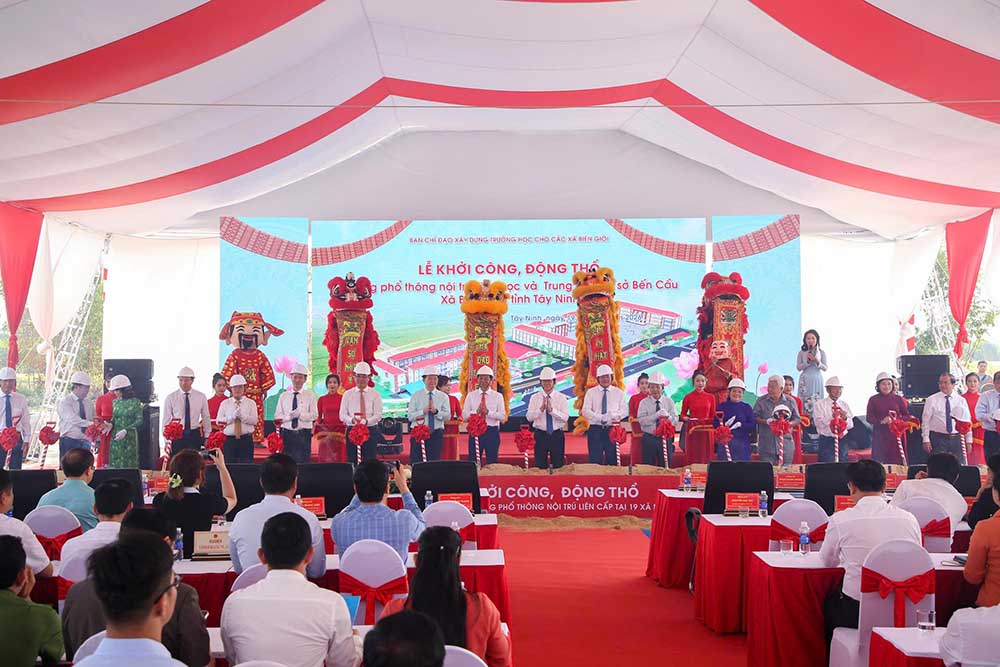
The total investment of the program is over 3.968 billion VND, of which the central budget supports over 3,500 billion VND, the rest is guaranteed by the local budget, mainly serving site clearance and leveling work.
At the ceremony, Ms. Dang Thi Minh Thuy - a teacher at Ben Cau Elementary School said that building boarding schools is of practical significance in the context that many families in border areas are still in difficulty, and parents have few conditions to take care of their children. The boarding model will help students study and live stably, limiting dropouts.
Meanwhile, Vo Tuyet Nhi, a student at Ben Cau Secondary School, expressed her joy at being about to study in a new environment with full and modern facilities, creating more favorable conditions for learning.
According to Tay Ninh Provincial People's Committee, the program to build inter-level boarding schools in border areas aims to concretize the policy of developing education in disadvantaged areas, contributing to narrowing the gap in learning conditions, improving the quality of human resources, improving people's lives, and at the same time strengthening national defense - security and promoting sustainable socio-economic development.


