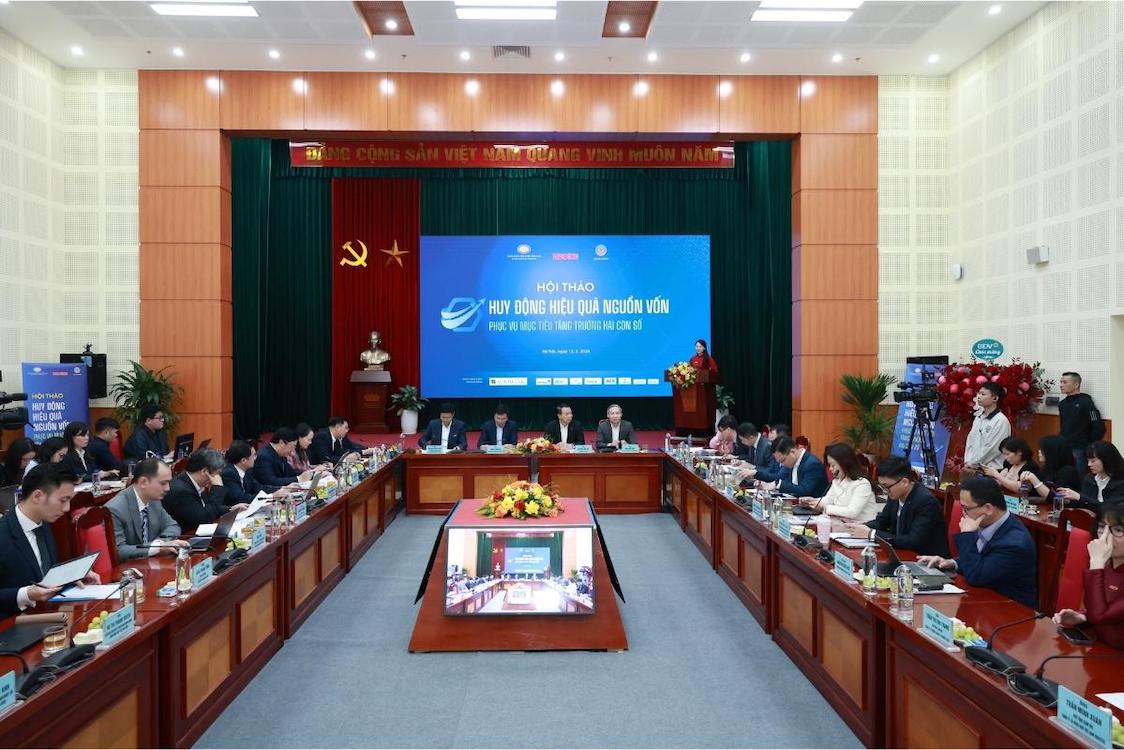
At the Workshop "Effectively mobilizing capital sources, serving the goal of double-digit growth" organized by the Ministry of Finance and the State Bank of Vietnam in coordination with Lao Dong Newspaper on March 12, 2026, Mr. Hoang Van Thu - Vice Chairman of the State Securities Commission - said that the Ministry of Finance has sent the Government Official Dispatch No. 127/TTr-BTC dated March 4 to consider issuing a Decree replacing Decree 153/2020/ND-CP on private placement of corporate bonds, in order to tighten management, limit risks for investors and transparentize the market, especially focusing on stricter regulations on the purpose of using capital and investor targets.
The draft Decree aims to unlock resources for economic development, creating favorable conditions for businesses. At the same time, strengthen inspection and supervision tools.

According to Mr. Hoang Van Thu, there are 7 important new points proposed in this draft:
First, tighten the purpose of issuance and capital management
The draft requires businesses to clearly state the purpose of issuance and strictly manage and use capital.
The collected money must be monitored separately, ensuring the correct use of the announced project, avoiding the situation of using capital for the wrong purpose.
Second, classifying investors and bond types
The draft separates dossiers and procedures for 2 groups: Group of public companies, securities companies, fund management and Group of remaining companies.
Notably, based on the 2025 Enterprise Law, the draft supplements the condition that enterprises must have payables (including the value of bonds expected to be issued) not exceeding 05 times equity.
Professional individual investors are only allowed to buy bonds when they have credit ratings and have collateral (or payment guarantees).
Third, clearly define the responsibilities of organizations and individuals
The draft supplements specific regulations on the responsibilities of organizations and individuals participating in the bond issuance process, including dossier consulting organizations, issuance agents, audit organizations, credit rating organizations and valuation enterprises.
Which organization performs which stage will be directly responsible for that, creating transparency in the distribution chain.
Fourth, adjust regulations on organizations providing services
Accepting the opinions of the State Bank, the draft removes the regulation that commercial banks and foreign bank branches are bond issuing agents.
At the same time, the draft also clearly stipulates the representative of bondholders and the management of collateral for bonds with collateral.
Fifth, strengthen information disclosure about corporate bonds
The draft Decree supplements regulations that issuing enterprises must periodically and abnormally disclose information to bondholders until bonds are no longer outstanding.
For cases where enterprises use capital through a second party to implement investment projects, reports on the situation of capital use must be audited until the second party disburses all the money collected from the offering into the project.
Sixth, strengthen responsibility for supervision and handling of violations
The draft Decree also clearly defines the responsibilities of management agencies. In which, the SSC will supervise public companies and securities business organizations, and the provincial-level People's Committee will preside over inspection, examination and handling of violations against enterprises (not public companies) headquartered in localities.
Seventh, supplement dispute resolution mechanism
The draft supplements 1 Article on handling violations and 1 Article on resolving disputes and compensation for damages.
This creates a solid legal corridor to protect the legitimate rights of investors when disputes arise, while deterring fraudulent acts in the market.