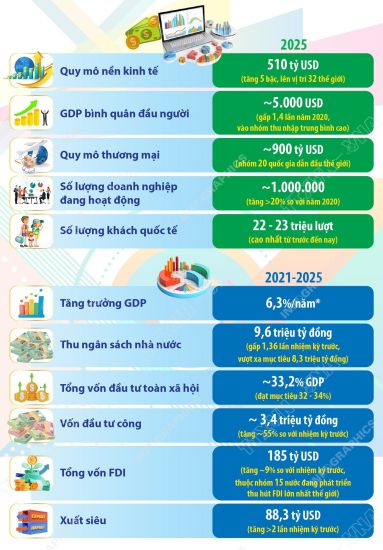
Vietnam needs to establish a new growth level
Recognizing that the Vietnamese economy in the first 11 months of 2025 shows strong recovery potential, average inflation is controlled at 3.29%; exchange rates and interest rates are relatively stable, creating momentum for production, exports and investment development, Dr. Nguyen Bich Lam - former Director General of the General Statistics Office said that this is a "solid shield" for the economy to stand firm against external fluctuations. Macroeconomic stability is the fulcrum, protecting the economy, helping Vietnam stand firm against major waves of natural disasters and global fluctuations.
Notably, despite having to fight against historical natural disasters in the Central region, weakening purchasing power and the impact of the first shocks of the year, Vietnam's economy still has notable bright spots.
A new growth level is gradually forming with improved quality in a volatile environment. Many positive signs of the economy in the past 11 months, from export recovery, improved industrial production, focused public investment, expanded credit, to revealing the drivers of the new growth triangle: Green economy - digital economy - knowledge economy, show that the economy is trying to keep pace in the context of "many obstacles".
Dr. Nguyen Bich Lam also believes that these bright spots should therefore be seen not only as achievements, but also as tests of resilience, for the accuracy of policies and macroeconomic management capacity in the new context.
But not only looking at the "bright spots", when looking back at the economic picture in 11 months of 2025, Dr. Nguyen Bich Lam further emphasized that the Vietnamese economy is forced to establish a new growth level, because the context has changed, risk seeds are increasing, and policy space is no longer as wide as before.
Historical disasters swept through the Central region and many regions across the country, purchasing power weakened, private investment stagnated, while large openness made the economy more sensitive to geopolitical fluctuations and world economic policies, these are realities exposing the fragility of the economy, something we have not properly realized" - Dr. Nguyen Bich Lam analyzed.
The former Director General of the General Statistics Office said that the rise of exports, the recovery of investment capital flows, and the processing industry continue to be pillars, along with efforts to maintain macroeconomic stability, have created an important driving force for growth. However, weak purchasing power, rapid credit growth but not commensurate with the absorption capacity of the economy and heavy losses due to natural disasters set limits that need to be frankly identified.
Precisely in that interweaving, the requirement to establish a new growth level becomes an urgent requirement. The new growth level is not only a higher GDP growth rate, but a growth structure based on productivity, quality, technology, green economy, digital economy, knowledge economy and the resilience of the entire system. This is a process of fundamental reconstruction" - Dr. Nguyen Bich Lam gave his opinion and said that the results achieved in the first 11 months of 2025 show that the internal strength of the economy is still sustainable, adaptability is still strong and the room for reform is still very large. If we know how to transform difficulties into motivation, turn challenges into opportunities to improve institutions, increase competitiveness and invest with a goal, Vietnam can completely enter a new and more solid growth cycle.
Expanding the growth shirt
Looking at the entire period 2021-2025 with macroeconomic achievements maintaining stability and achieving many positive results, but economic experts believe that this is also showing that the "old growth jacket" is increasingly cramped. Especially when the advantage of cheap labor gradually disappears as Vietnam steps deeper into the global value chain; the rate of productivity growth is still modest, while capital and resource resources are not a sustainable foundation for the future.
According to Master Nguyen Quoc Anh - Deputy Director of the Institute of Economic and Financial Strategy and Policy (Ministry of Finance), the above context sets out the requirement that Vietnam needs a new growth model based on innovation, technology and green economy to achieve the double-digit GDP target for the period 2026-2030, towards a high-income country in 2045.
Reality shows that, to escape the middle-income trap, the challenge that has caused many countries to stagnate when the economy reaches a certain level, Vietnam needs to make a strong enough transition to reach the aspiration in 2045: To become a developed country with high income. Therefore, the double-digit GDP growth target in the period 2026-2030 is not just an ambition, but a vital requirement.
Accordingly, Vietnam needs to shift from growth in breadth to in depth, in which total factor productivity (TFP) becomes the main measure. Improving labor productivity through the application of technology, training high-quality human resources and promoting modern governance will be decisive factors.
The second requirement is to strongly restructure the economy towards modernity, immediately and synchronously remove long-term bottlenecks such as institutions, infrastructure and human resource quality. The digital economy, green economy and circular economy will be the "key" to open the door to deep integration and global competition, and therefore the construction of innovation centers, the development of semiconductor chip industries, renewable energy or low-carbon economies will be a mandatory trend.
Another requirement is to build a system of transparent and substantive measurement indicators, measuring policy effectiveness with specific figures such as the proportion of the digital economy in GDP, social labor productivity, TFP contribution to growth or the rate of technology innovation enterprises.