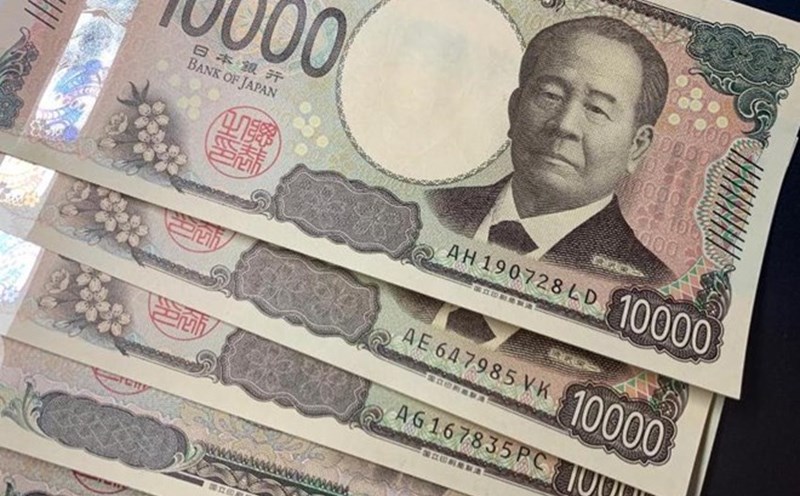
The Japanese Yen regained some of its decline in the first trading session of the week, after plunging sharply at the end of last week. This development takes place in the context of the market considering when the Bank of Japan (BOJ) continues to raise interest rates, while monitoring the possibility of government intervention as market liquidity weakens at the end of the year.
According to the minutes of the policy meeting announced on Monday, BOJ policymakers discussed the need to continue raising interest rates.
Meanwhile, the euro was supported after US President Donald Trump sent an optimistic signal about progress in negotiations to end the conflict in Ukraine.
Japanese Finance Minister Satsuki Katayama last week affirmed that Tokyo has full authority to act to deal with excessive fluctuations of the Yen. Warnings about the possibility of intervention have somewhat curbed the selling momentum of the Yen, but pessimistic sentiment towards this currency is still clearly shown in other pairs of currencies.
Mr. Bart Wakabayashi - Tokyo Branch Director of State Street - commented: "Occupying a position to buy the Yen is currently quite risky. We are seeing a strong selling trend of the Yen, especially compared to the Australian dollar.
In the first session of the week, the Yen increased by 0.3%, to 156.14 Yen/USD, after falling 0.5% at the end of last week. Compared to the Australian dollar, the Yen traded around 105.02, only slightly lower than the 17-month low of 105.08 recorded on Friday.
On the currency market, the USD Index remained almost unchanged at 98,003. The Euro remained stable around 1,1770 USD, while the British pound slightly decreased to 1,3491 USD.
Previously, the BOJ raised the policy interest rate to 0.75% at the December meeting, the highest level in 30 years. However, the meeting minutes showed that many members still believe that the actual interest rate is still too low and needs to continue to be adjusted upwards. This move is still not enough to stop the weakening of the Yen, which once slipped to 157.78 Yen/USD on December 19.
Japan had to intervene in the market in July 2024, when the yen fell to its lowest level in 38 years, touching 161.96 Yen/USD.
In the context of a year-end trading week with little economic data, geopolitical factors are becoming the focus of attention. US President Donald Trump said that he and Ukrainian President Volodymyr Zelenskiy are "very close" to an agreement to end the conflict, although acknowledging that there are still many key issues that have not been resolved.
French President Emmanuel Macron also said that the parties have made certain progress in ensuring security, and revealed that a "Coalition ready to act" will meet in Paris in early January to finalize specific commitments.