
Domestic gas prices
According to records in the afternoon of April 14, domestic retail gas prices continued to maintain a high level after the adjustment increase from the beginning of April, although some slight fluctuations appeared in each region.
In the Northern region, the price of a 12kg gas cylinder in Hanoi is at 629,208 VND, while a 48kg cylinder holds at 2,516,832 VND. In Hai Phong, the price is still higher, with a 12kg cylinder about 638,928 VND and a 48kg cylinder reaching 2,540,160 VND.
In the Central region, gas prices in Da Nang are commonly around 596,000 VND/12kg cylinder. Prices in localities may vary depending on transportation costs and distribution systems.
According to LPG businesses, after the adjustment on April 1, the current gas price level is basically stable but still anchored in the high zone compared to the previous period, reflecting pressure from the developments of the world energy market.
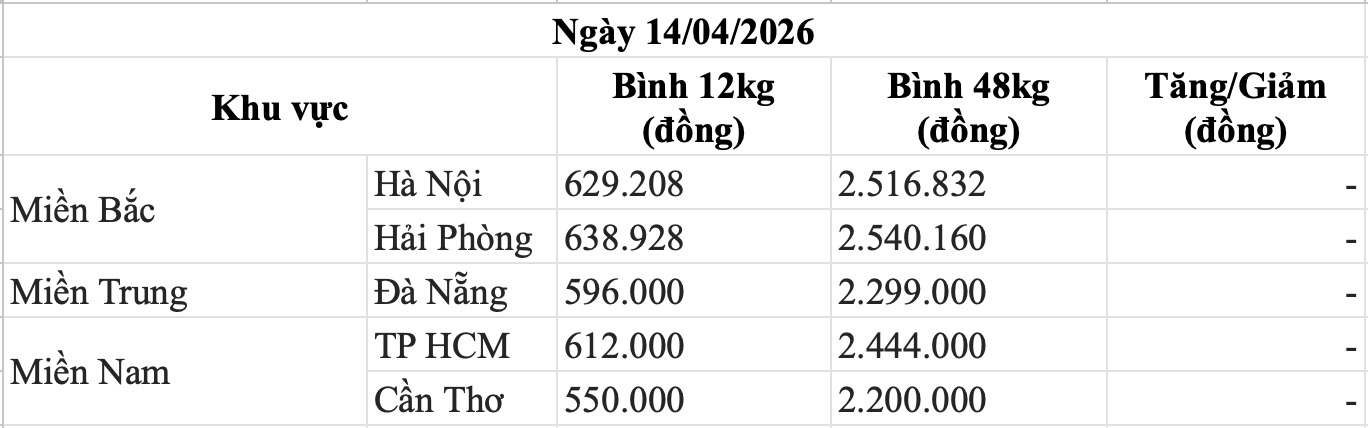
Domestic gas prices by brand
Domestic retail gas prices today continue to remain stable in many brands, with some local adjustments according to regions.
Petrolimex gas is currently listed at 629. 208 VND/12kg cylinder and 2,516.832 VND/48kg cylinder (industrial type), unchanged compared to the most recent session.
At the Saigon Petro system, the price of a 12kg gas cylinder is at 654,500 VND, while a 45kg cylinder is sold for 2,455,000 VND. Similarly, Pacific Petro is listing a 12kg cylinder price of about 650,000 VND and a 45kg cylinder at 2,408,000 VND, maintaining stability in recent days.
Notably, PV GAS's gas price has differentiation between regions. In Hanoi, the price of a 12kg cylinder is maintained at 610.200 VND and a 45kg cylinder is 2,288.250 VND.
Meanwhile, in Ho Chi Minh City, PV GAS gas prices recorded a fairly strong decrease compared to the previous adjustment period. Specifically, a 12kg cylinder decreased by 20,000 VND to 640,081 VND, and a 45kg cylinder decreased by 75,000 VND, to 2,400,259 VND.
The price reduction trend in the Southern region reflects the adjustment according to supply and input costs, while creating room to reduce costs for consumers and business households in the short term.
Asian LNG supply declines, risk of prolonged shortage
According to ship tracking data compiled by Bloomberg, the average net LNG transport volume in the next 30 days to Asia fell below 600,000 tons last weekend - the lowest level since June 2020, when energy demand plummeted due to the COVID-19 pandemic.
This development reflects the risk of prolonged LNG shortages in Asia, in the context of unsuccessful negotiations between the US and Iran in Pakistan, causing conflict to continue. Since the end of February, about 20% of global LNG supply has been disrupted due to geopolitical instability.
In other major markets, supply also decreased significantly. LNG delivered to China - the largest importer in 2025 - decreased by about 30% compared to the same period, while India recorded a decrease of 20%. Japan and South Korea also witnessed imports falling to the lowest seasonal level in about 6 years.
Under pressure from shortages, some gas-fired power plants in Japan have had to cut production, while South Korea has eased restrictions on coal-fired power to reduce dependence on LNG.
Notably, the near-closure of the Strait of Hormuz has seriously disrupted LNG supplies from Qatar and the UAE. In addition, Qatar's production capacity has also suffered heavy losses after missile attacks, forcing state-owned QatarEnergy to declare force majeure for some contracts and conduct damage assessments.
Attacks on the Ras Laffan Industrial Park have significantly reduced Qatar's ability to restore LNG supplies, even if the shipping route is reconnected. It is estimated that damage to this complex could cost Qatar about $20 billion in revenue each year and it will take 5 years to completely overcome.
In the context of tight supply, LNG prices in Asia nearly doubled in the month, as regional buyers agreed to pay higher prices than in Europe to secure spot delivery.


