
Domestic gas prices
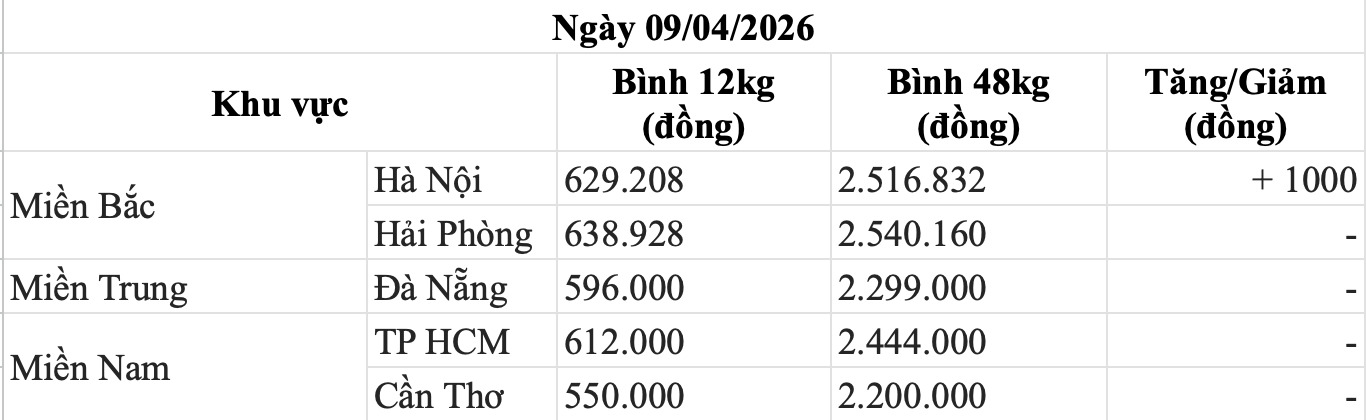
According to records on the morning of April 9, domestic retail gas prices continued to maintain a high level after the adjustment increase from the beginning of April, although some slight fluctuations appeared in each region.
In the Northern region, the price of 12kg gas cylinders in Hanoi is at 629,208 VND, an increase of 1,000 VND compared to the previous day, while 48kg cylinders remain at 2,516,832 VND. In Hai Phong, the price is still higher, with 12kg cylinders about 638,928 VND and 48kg cylinders reaching 2,554,160 VND.
In the Central region, gas prices in Da Nang are commonly around 596,000 VND/12kg cylinder. Prices in localities may vary depending on transportation costs and distribution systems.
According to LPG businesses, after the adjustment on April 1, the current gas price level is basically stable but still anchored in the high zone compared to the previous period, reflecting pressure from the developments of the world energy market.
European gas prices fall sharply after signs of cooling Middle East tensions
On the international energy market, European standard natural gas prices fell sharply immediately after information emerged that the US and Iran reached a two-week ceasefire agreement, increasing expectations that the Strait of Hormuz will soon be reopened.
The Dutch TTF standard gas contract - the main benchmark of the European market - at one point fell by 20% when it opened in Amsterdam, before narrowing the decline to about 16% in the late morning of the same day.
The contract for delivery in May 2026 decreased to 51.45 USD (44 euros)/MWh, compared to 62 USD (53 euros)/MWh in the previous session.
Previously, European gas prices had increased by about 60% from February 28 to April 7, as tensions in the Middle East escalated and seriously disrupted global energy flows.
Although the market reacted positively to the ceasefire information, LNG supply prospects have not really improved in the short term.
For more than a month, no LNG shipments have passed through the Strait of Hormuz, after two Qatari LNG ships were forced to turn around, disrupting export activities.
Not only that, the Ras Laffan liquefied complex - the world's largest LNG facility - was also heavily damaged in a missile attack in mid-March, forcing Qatar to temporarily suspend production. According to initial assessments, the repair process could take up to 5 years.
According to Mr. Fabien Yip - Market Analyst at IG Bank, the damage to energy infrastructure caused by the six-week conflict is unlikely to be quickly overcome. LNG supply disruptions are therefore likely to continue to put pressure on global energy prices even after the ceasefire is maintained stable.


