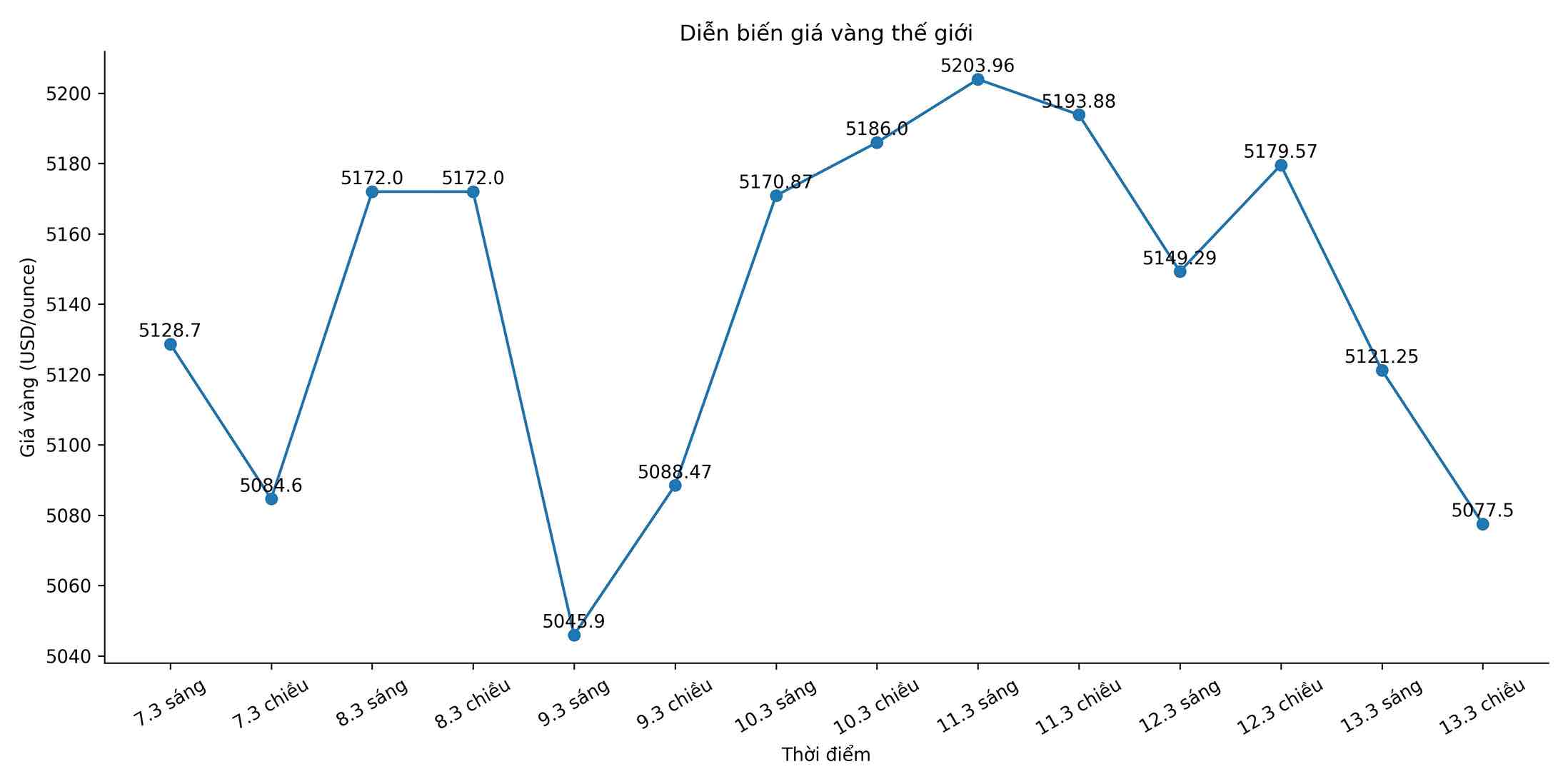
Gold prices rose in Friday's trading session, but are still heading for their second consecutive week of decline as war in the Middle East keeps oil prices near the 100 USD/barrel mark.
The precious metal has rebounded to the 5,100 USD/ounce mark, partially recovering after two previous declining sessions, amid a stable USD and volatile oil prices after recording the highest closing level since August 2022. The White House also allowed buyers to receive Russian oil shipments being transported to reduce pressure on energy prices.
However, for the whole week, gold prices are still likely to fall by about 1%. If this happens, this will be the first time since November last year that gold has fallen for two consecutive weeks. The upward momentum of the precious metal has stalled since the conflict between the US, Israel and Iran broke out nearly two weeks ago and there are currently no signs of cooling down.
US President Donald Trump and Iran's new supreme leader, Mojtaba Khamenei, continued to make tough statements on the 13th day of the conflict. The war situation has almost paralyzed transportation through the Strait of Hormuz, causing the biggest disruption ever to the global oil market. Brent oil prices fluctuated sharply during the week, while the USD strength index slightly decreased on Friday after increasing by 0.5% in the previous session.
For the gold market, rising energy prices and concerns about inflation have significantly reduced expectations that the US Federal Reserve (Fed) and other central banks will soon cut interest rates. The latest report on the US labor market, showing that the number of new jobless claims remains low, also reduces the possibility of reducing borrowing costs.
US Treasury bond yields fell sharply on Thursday, pushing short-term yields to their highest level since August. Currently, traders are almost no longer expecting the Fed to cut interest rates at next week's meeting and only assess about 70% of the probability that interest rates will be cut this year. Higher borrowing costs are often detrimental to gold and other precious metals because these are assets that do not yield yields.
The prolonged conflict also makes investor sentiment in the gold market more cautious. Instead of the previous prolonged upward trend, the market is witnessing volatile trading sessions as some investors sell gold to compensate for margins in other markets. However, gold has still increased by about 18% since the beginning of the year and has mostly stayed above the 5,000 USD/ounce mark.
A prolonged conflict along with high oil prices could continue to put pressure on the gold market. The International Energy Agency (IEA) said the war is causing unprecedented supply disruptions to the global oil market. A day earlier, member countries of this agency agreed to release a record 400 million barrels of oil from emergency reserves.
Spot gold prices fell 0.8% to 5.082.47 USD/ounce. Silver prices rose 1.2% to 84.83 USD/ounce, while platinum and palladium also recorded gains. The Bloomberg Dollar Spot Index moved sideways during the session but is still on a 0.5% upward trend for the whole week.