
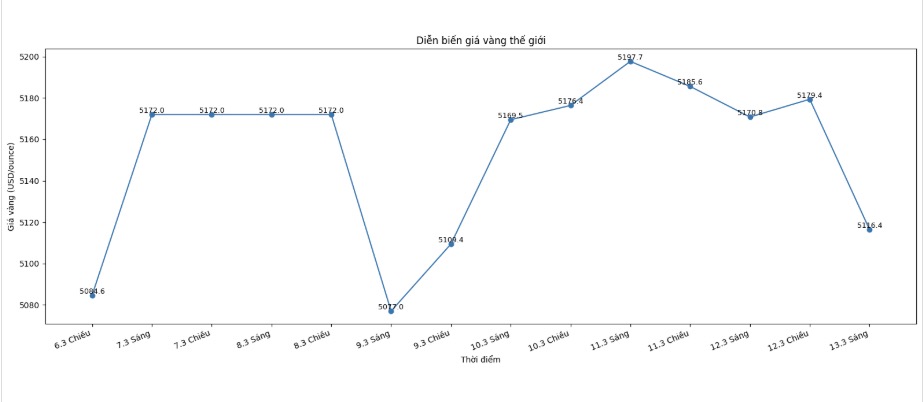
Recorded at 9:00 AM on March 13 (Vietnam time), the world gold price was listed at 5,116.4 USD/ounce.
The USD index increased, making gold - valued in USD - more expensive for holders of other currencies.
Mr. Nicholas Frappell - Head of Global Organization Markets at ABC Refinery - said that the strength of the USD along with interest rate movements is creating a slight resistance to gold prices, although geopolitical tensions tend to support this precious metal.
Iran warned the world could face oil prices up to $200 a barrel after its forces attacked commercial ships on Wednesday.
Meanwhile, the International Energy Agency (IEA) called for a large-scale release of strategic oil reserves to reduce one of the most serious energy shocks since the 1970s.
Oil prices have risen above $100/barrel, increasing inflationary pressure as Iran intensifies attacks on oil and transport facilities across the Middle East.
According to sources, Iran has deployed about 12 naval mines in the strait, a move that could make reopening this narrow maritime route - an important route for global oil and liquefied natural gas transportation - more complicated.
Oil tankers in the strait area have been stranded for more than a week, while some manufacturers have to temporarily suspend production because their storage facilities are close to full capacity.
Goldman Sachs has postponed its forecast for when the US Federal Reserve (Fed) will begin to cut interest rates. The organization currently expects the Fed to cut interest rates by 0.25 percentage points in September and December, due to increased inflation risks related to the conflict in the Middle East.
Regarding economic data, the US consumer price index (CPI) increased by 0.3% in February, as predicted and higher than the 0.2% of January. CPI increased by 2.4% compared to the same period last year, also in line with market expectations.
Investors are awaiting the January Personal Consumption Expenditures (PCE) index - data delayed - expected to be released on Friday.
The world gold and silver market operates based on two main pricing mechanisms. The first is the spot market, which quotes for immediate buying and selling and delivery. The second is the futures market, which determines the price for delivery at a time in the future.
Due to the year-end position adjustment and market liquidity factors, the December gold futures contract is currently the most actively traded contract on the CME exchange.


