
Improving the organizational capacity for customs officials
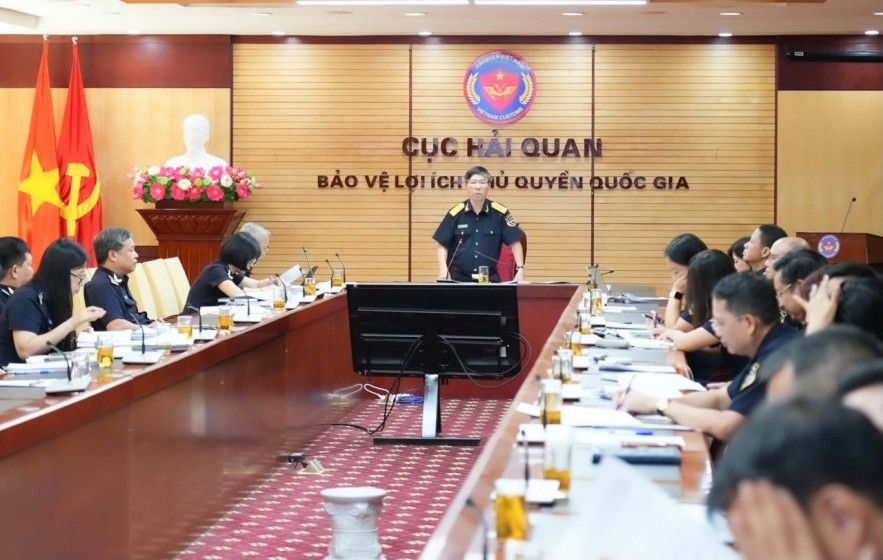
On June 25, 2026, the Customs Department organized a training conference to implement Decree No. 153/2026/ND-CP (effective from July 5, 2026). This is a document amending and supplementing a number of articles of Decree No. 01/2015/ND-CP detailing the scope of customs operation areas and responsibilities for coordination in preventing and combating smuggling and illegal transportation of goods across borders, which has been amended and supplemented in Decree No. 12/2018/ND-CP.
According to Deputy Director of the Customs Department Luu Manh Tuong, the Conference was organized to thoroughly grasp the new contents of the decree, unify awareness and methods of implementation throughout the industry; and at the same time improve the organizational capacity for customs officials, promptly remove difficulties and obstacles arising in the application process, ensuring that new regulations quickly go into life.
According to the Customs Department, the promulgation of Decree No. 153/2026/ND-CP stems from the requirement to continue to concretize the 2014 Customs Law and ensure synchronization with the legal system that has been amended and supplemented in the past time.
Along with the process of arranging administrative units, developing border gate infrastructure, forming new economic models such as concentrated digital technology zones, international financial centers, high-tech zones..., many current regulations on customs operation areas have revealed gaps or not kept up with reality. Through summarizing the implementation of Decree No. 01/2015/ND-CP and Decree No. 12/2018/ND-CP, the Customs sector recorded some inadequacies related to determining the scope of management, organizing inspection, supervision and coordination between functional forces in border areas.
In that context, Decree No. 153/2026/ND-CP was issued to standardize customs operation areas, ensure no overlap, no vacancy of management areas, and at the same time create more favorable conditions for import and export activities.
Optimizing control resources
One of the notable contents of Decree No. 153/2026/ND-CP is to clearly stipulate the scope of customs operations in the area of road border gates and inland waterway border gates according to specific criteria such as boundaries, coordinates, length, depth, and adjacent position associated with the new administrative boundary. The Decree also supplements concepts suitable to practice such as customs clearance, specialized roads for transporting goods, and railway border gates to be consistent with legal regulations on the management of land border gates.
Notably, the management agency reviewed and removed 20 sub-border gates from the customs operation area that did not generate import and export activities. This adjustment helps to focus resources, human resources and infrastructure for border gate areas with large cargo volumes, improve inspection and supervision efficiency and reduce resource dispersion.
In addition, the decree also supplements a mechanism to determine customs operating areas for border gates, open paths, specialized roads or new locations licensed by competent authorities for import and export activities, ensuring management work is implemented from the beginning.
Strengthen coordination, promote digital transformation
Also according to the assessment of the customs agency, a noteworthy point is that outside the border gate area, Decree No. 153/2026/ND-CP expands the scope of customs operations in locations outside the border gate in a direction suitable for the modern management model.
Many new locations have been added such as headquarters, warehouses, production facilities of enterprises subject to customs supervision in high-tech zones, concentrated digital technology zones, international financial centers; production facilities of export processing enterprises; non-extended warehouses; gathering, inspection, and supervision locations for import and export goods.
These adjustments are expected to better support production, logistics and supply chains, while improving the control capacity of management agencies.
Regarding the work of preventing and combating smuggling and illegal transportation of goods across borders, the decree supplements regulations on exchanging and providing information in the form of documents and electronic data between functional agencies, creating a platform to promote digital transformation in professional coordination. At the same time, the new regulation continues to clarify the leading role of the Customs agency in the customs operation area for the task of preventing and combating smuggling in accordance with the principle of clearly defining responsibilities, improving the effectiveness of inter-sectoral coordination.
At the training conference, customs units focused on exchanging new contents and agreeing on implementation plans to ensure that Decree No. 153/2026/ND-CP is implemented synchronously and effectively, contributing to building a modern, transparent customs system and meeting the requirements of trade development in the new period.


