The Ho Chi Minh City People's Committee has just submitted a document to the Ho Chi Minh City People's Council on a draft Resolution regulating the collection of fees for the use of infrastructure works, service works and public utilities in the seaport area in the city.
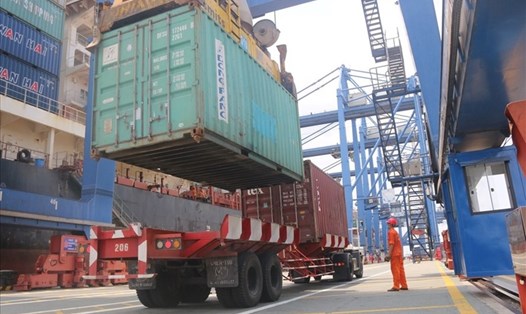
From 0:00 on April 1, 2022, Ho Chi Minh City collects seaport infrastructure fees, with the lowest level being 15,000 VND per ton of loading and unloading goods, air conditioners and the highest being 4.4 million VND per 40-foot container for temporarily imported and re-exported goods, foreign warehouses, and transhipment.
By the end of 2025, the total amount collected from seaport infrastructure fees is about VND 8,200 billion.
After the merger, the implementation of fee collection at Binh Duong and Vung Tau seaports needs to be reviewed and evaluated.
According to the Ho Chi Minh City People's Committee, Binh Duong port area actually does not have a seaport but only includes an ICD system and inland waterway ports, which are responsible for transferring goods to Ho Chi Minh City seaport and Ba Ria - Vung Tau seaport. Goods entering Ho Chi Minh City seaport must pay the seaport infrastructure fee, so if they continue to collect fees at ICDs and Binh Duong inland waterway ports, it will lead to overlapping fees.
Binh Duong currently plays the role of a domestic production - logistics center, an important logistics satellite of the seaports of Ho Chi Minh City and Ba Ria - Vung Tau. The lack of charging for seaport infrastructure is considered a competitive advantage, helping to attract shipping lines and logistics enterprises, gradually forming a logistics center of the Southeast region.
Notably, the infrastructure connecting the ICD system and inland waterway ports in Binh Duong is mainly invested from the central budget and corporate capital, local budgets only account for a small proportion. Therefore, applying seaport infrastructure fees - which are collected by localities - to projects invested by the central government is not appropriate.
For Ba Ria - Vung Tau, this is a special seaport, playing the role of an international gateway port for the Southeast region and the whole country. Cai Mep - Thi Vai port cluster is planned as a IA-class seaport, with national and regional scale, and is the only port in Vietnam capable of receiving 200,000 DWT ships and participating in international transit.
In the context of direct competition with major transit centers such as Singapore or Thailand, any additional cost increase can cause the flow of goods to shift.
Similar to Binh Duong, the infrastructure system connecting Ba Ria - Vung Tau seaports by sea, road and inland waterway is mainly invested from the central budget and corporate capital, while the local budget's participation is very limited. Therefore, the collection of seaport infrastructure fees for these items is considered unreasonable.
In addition, Ho Chi Minh City is promoting the establishment of Cai Mep Ha Free Trade Zone (FTZ Cai Mep Ha), a model towards liberating logistics, reducing supply chain costs and limiting fee barriers. The collection of seaport infrastructure fees will go against this goal, reducing the competitiveness of FTZ Cai Mep Ha compared to free trade zones in the region.
From the above analysis, the Ho Chi Minh City People's Committee believes that the Ho Chi Minh City People's Council has the authority to consider the actual conditions and decide not to implement the collection of seaport infrastructure fees at the Binh Duong and Ba Ria - Vung Tau seaports in the current period.