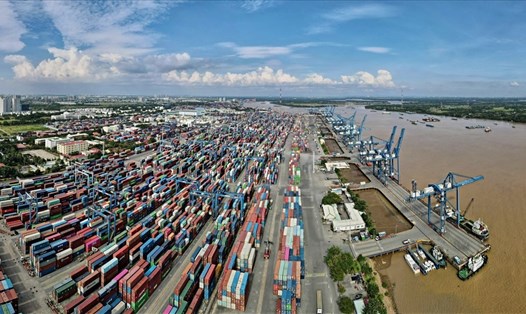
The Ho Chi Minh City Department of Construction said that it is seeking opinions from relevant units on the draft Resolution of the Ho Chi Minh City People's Council on exempting fees for using works, infrastructure, service works, and public utilities in the seaport border gate area in the area.
According to the proposal, the free period lasts for 3 years. Based on the estimated cost of seaport infrastructure fees in 2026 assigned is 2,390 billion VND, the total revenue shortfall in 3 years is expected to be about 7,170 billion VND. This is considered a indirect support from Ho Chi Minh City for businesses.
It is expected that this content will be submitted for consideration and approval at the Ho Chi Minh City People's Council meeting at the end of April 2026.
Previously, from 0:00 on April 1, 2022, Ho Chi Minh City started collecting port infrastructure fees, with the lowest level of 15,000 VND/ton for bulk goods, unpackaged containers and the highest of 4.4 million VND/40-foot container for temporarily imported and re-exported goods, sent to bonded warehouses, and transshipment.
By the end of 2025, total revenue from this fee source reached about 8,200 billion VND.
Port infrastructure fee revenue is used by Ho Chi Minh City to invest in infrastructure, repair, and build new roads connecting ports.
At the 5th Conference of the Ho Chi Minh City Party Committee Executive Committee on April 1st, Secretary of the Ho Chi Minh City Party Committee Tran Luu Quang said that the Standing Committee of the City Party Committee has agreed on the policy of exempting seaport infrastructure. According to city leaders, in the context of fluctuating fuel prices and increasing logistics costs, sharing resources is necessary to support businesses to overcome difficulties.
The Ho Chi Minh City Department of Construction believes that the toll exemption for 3 years is appropriate both in practice and scientific basis. This period is long enough for businesses to restore production, while still ensuring the ability to monitor, evaluate and adjust policies, and maintain budget balance.
Import and export enterprises are under great pressure from increased operating costs, volatile markets and financial difficulties. If port infrastructure fee collection continues to be maintained, logistics costs will continue to increase, directly affecting the ability to maintain and restore production and business activities.
Therefore, the exemption is expected to contribute to reducing costs, creating space for businesses to stabilize operations, maintain production and gradually recover and develop. At the same time, this is also a move showing the flexibility, proactiveness and companionship of the Ho Chi Minh City government with the business community in the context of a still challenging economy.