
Nearly 24,000m2 of service business area in resettlement buildings in Hanoi is closed and seriously degraded, while the demand for rent from people is very large. This reality shows the prolonged obstacles in the auction mechanism, management policies and market factors, causing public resources not to be effectively exploited.
According to Hanoi Housing Management and Development Co., Ltd., the unit is managing about 100 resettlement buildings with more than 51,800m2 of business area on the 1st floor. However, only about 27,700m2 has been put into use, and more than 24,000m2 is vacant, and some points are still occupied.
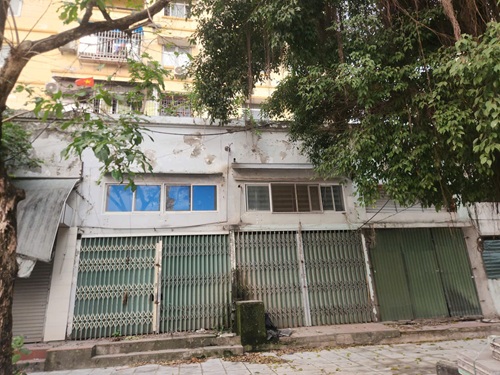
One of the reasons is due to problems with mechanisms and policies. According to residents in Trung Hoa urban area (Hanoi City), before 2013, kiosks here were rented out. After that, to ensure transparency, Hanoi City switched to auctioning rental rights. This is a correct policy, but the implementation process encountered many difficulties.
Decision No. 03/2021/QD-UBND took effect from 2021, but it was not until mid-2024 that the management unit's estimate for auction work was approved. In the 2022-2024 period, due to lack of funding, auction activities were almost "frozen". Previous pilot phases also gave limited results, and the number of successful leased premises was low.
In addition, the overlap between legal regulations makes it difficult to determine rental prices. At times, the Housing Law, decisions of the Hanoi People's Committee and new regulations must be applied simultaneously, leading to prolonged procedures and delays in bringing assets to the market.
In addition to the mechanism factor, the actual site situation is also a major barrier. Most of the resettlement buildings built in the period 2001-2015 are degraded but have not been renovated. Many areas after recovery are divided and arbitrarily repaired, causing difficulties for re-exploitation.
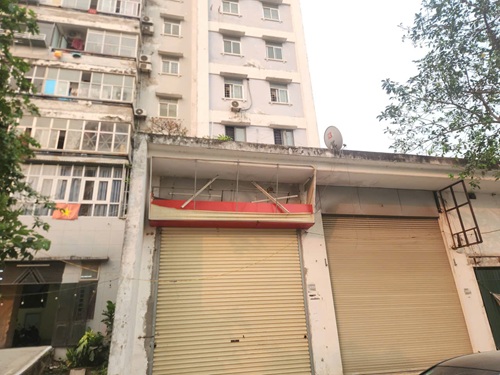
At the same time, many small-scale premises, unfavorable locations, lack business attraction. While the maximum lease term is only 5 years, making investors not enthusiastic due to high renovation costs but short capital recovery time. This is the reason why many kiosks fall into a prolonged "sold out" situation.
According to experts, to "awaken" this land fund, it is necessary to flexibly adjust the auction mechanism. Instead of dividing it into smaller units, it is possible to lease them in clusters or apply a cooperative exploitation model to improve efficiency of use. At the same time, it is necessary to shorten administrative procedures and unify legal regulations to avoid overlap.
Architect Tran Huy Anh (Hanoi Association of Architects) believes that early putting these areas into use will contribute to building a civilized and modern Capital. In addition to auctioning lease rights, Hanoi City needs to study innovating the public asset management model, which can be assigned to private enterprises to operate to limit waste.
Urban expert Dinh Quoc Thai also proposed building a more flexible auction mechanism, while decentralizing management and exploitation to local authorities and allowing appropriate function conversion. According to experts, the business area on the 1st floor in resettlement apartment buildings needs to be seen as part of a strategy to improve quality of life, not just an economic problem.
If effectively exploited, these spaces will not only meet essential shopping needs but can also become mini-supermarkets, convenience stores, community libraries or common living areas for residents.
Reality shows that putting these areas into operation not only increases budget revenue but also creates jobs, promotes the urban economy, and at the same time completes the service ecosystem in resettlement areas.
In the context of Hanoi City aiming for the goal of developing a civilized and modern city, handling the situation of wasting public assets is an urgent requirement. If there is an appropriate mechanism, kiosks that are completely vacant can become an important resource, contributing to promoting socio-economic development and improving the urban appearance.


