
Highway is crowded, moving speed at times decreases
The situation of vehicles moving slowly on the expressway is receiving attention from the driver community, especially at times when traffic volume increases.
Although many expressways, especially the Phap Van - Cau Gie route, allow vehicles to run at a maximum speed of 100 km/h, the actual speed can be reduced to 60-70 km/h, even 20 km/h when the traffic flow is crowded.
Sharing on a Facebook page specializing in traffic, account Minh Cao said that when traveling on the Phap Van - Cau Gie expressway, the actual speed at times was only about 60-70 km/h.
Going on the highway at a speed of only 60-70 km/h is also quite inconvenient," this account shared, and also said that in some cases, if the speed on the highway decreases for a long time, people can consider alternative routes suitable for the journey.
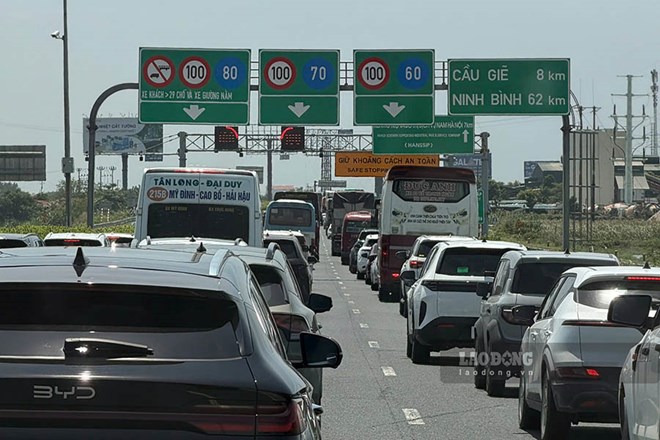
Some other drivers also shared a similar situation. Account Ngoc Anh said that he chose to go down the national highway and found this route quite open even during the holidays. Previously, on the highway, there was a section where vehicles could only move at about 20 km/h.
Another driver said that he got on the expressway at 8 am but only got off at 10 am in the Vuc Vong area, Ninh Binh. These shares show that the actual operating speed on the expressway may change significantly depending on the time, vehicle density and traffic situation.
Vehicles should not drive slowly and stay in the overpass lane
Besides sharing about travel speed, many drivers believe that in the context of highways with many vehicles, complying with the principle of using lanes and keeping a safe distance will help vehicles operate more stably.
Account Le Phuong believes that drivers should proactively maintain a safe distance, and use lanes appropriate to speed and traffic situations.
According to this account, when overtaking, drivers can use the left lane according to regulations, and after completing the overtaking, return to the appropriate lane. It is important to always maintain a safe distance from the vehicle in front and not be impatient when the traffic flow is crowded.
According to this person, the above principles will help drivers have more space to handle changes in traffic speed, while limiting situations where they have to brake suddenly or change lanes continuously.
In conditions of high traffic volume, a car maintaining low speed for a long time in the left lane can also affect the traffic flow behind. Therefore, drivers need to observe the traffic situation, proactively choose a suitable lane and change lanes when safety conditions are met.
Regarding this issue, previously the traffic police force tested on August 21 on the Hanoi - Hai Phong and Cau Gie - Ninh Binh expressways. In which lane No. 1 adjacent to the median strip was identified as the overtaking lane.
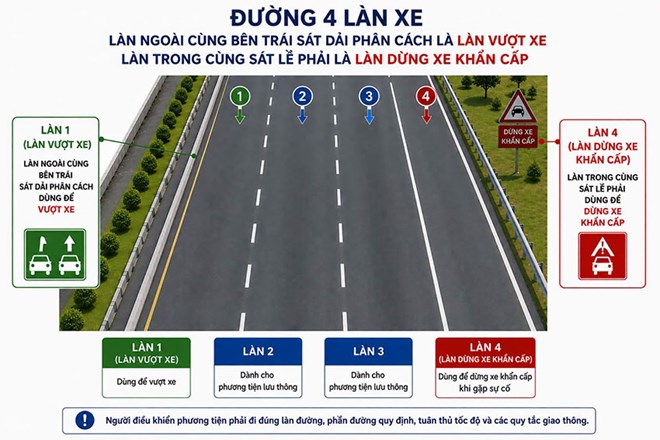
When moving in lane number 2 and needing to overtake, drivers must signal, observe the vehicle in front and behind and only switch to lane number 1 when safety is ensured. After overtaking, the vehicle returns to lane number 2.
In case in lane No. 1 there are vehicles traveling in the same direction slower but still ensuring minimum speed and below maximum speed, the vehicle behind can use appropriate signals to signal to the vehicle in front. When safety conditions are met, the vehicle in front moves to lane No. 2 to make way.
According to the Traffic Police Department, organizing traffic in this way aims to create the highest circulation for the flow of vehicles, especially on highways, contributing to making traffic more smooth and releasing traffic flow better.
Notably, lane usage skills and handling when overtaking will continue to be emphasized in the driver's test. According to the plan, from March 2027, the driving practice content on the road will apply new requirements related to accelerating to overtake and accelerating to change lanes.
Keeping a distance is not only to avoid collisions but also to create enough time for drivers to handle when the vehicle in front slows down or brakes suddenly.


