
Keep a safe distance on the highway
Currently, the Traffic Police force has begun to fine drivers for not complying with regulations on safe distance with cars running in front on the Phap Van - Cau Gie - Cao Bo - Mai Son - National Highway 45 - Nghi Son expressway.
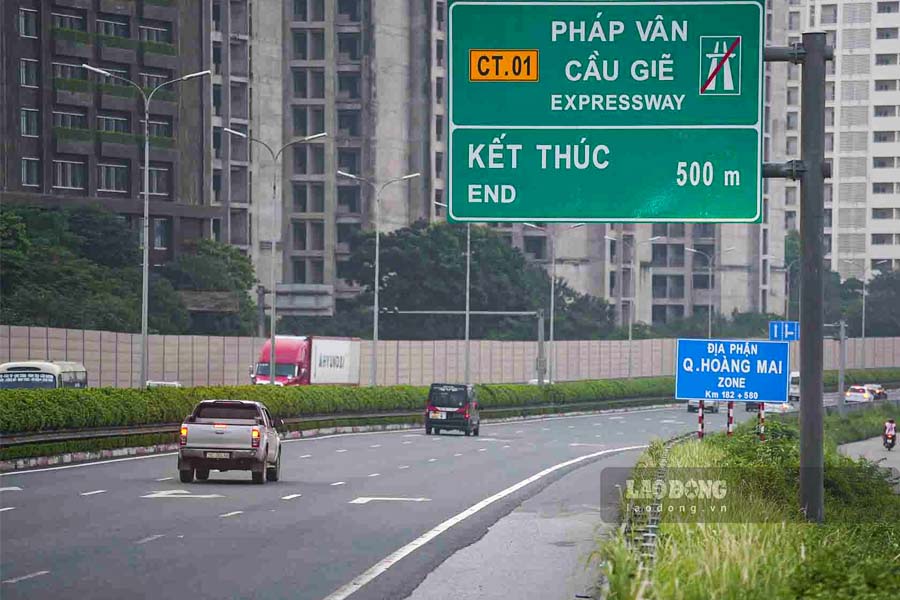
According to regulations, in dry road conditions and normal weather, when a vehicle is traveling at a speed of over 60km/h, the minimum distance from the vehicle running in front is 55m. If the distance is maintained below 55m, it will be determined as a violation.
According to Decree 168/2024-ND/CP, for the offense of not keeping a safe distance in case of no collision, drivers will be fined from 4-6 million VND and deduct 2 points from the driver's license.
If the violation causes a traffic accident, the fine increases to 20-22 million VND, and drivers will be deducted 10 points from their driver's license.
According to the Traffic Police Department (CSGT), Ministry of Public Security, the handling aims to raise drivers' awareness when traveling on highways, limiting the risk of collisions due to not keeping a safe distance.
Drivers need to keep a distance from the car in front suitable for the speed of movement. The faster the car drives, the greater the distance must be to have enough time to observe and handle when the car in front slows down or brakes suddenly.
Using the left lane to overtake on the highway
Over the past time, the Traffic Police Department, Ministry of Public Works, has been coordinating with the Vietnam Road Administration to study piloting the "overtaking lane" model on eligible highways, in order to form a civilized travel habit and ensure traffic safety.
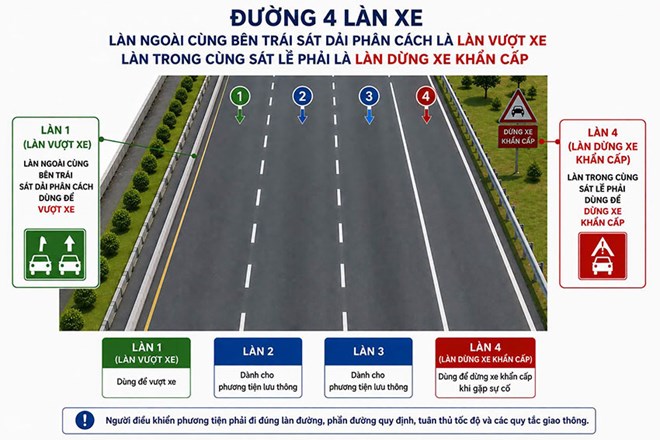
According to the Traffic Police Department, currently many expressways in Vietnam only have 2-3 lanes and one emergency lane, even some routes do not have this lane. Faced with that reality, the proposal to use the lane adjacent to the median strip (lane 1) as an overpass lane is being carefully studied.
In this lane, vehicles will be prohibited from moving continuously. The main purpose is to keep the lane always clear so that vehicles can safely overtake other vehicles in the same direction. After completing the overtaking operation, drivers must immediately switch to the old lane (lane 2 or lane 3) if these lanes are empty.
The Traffic Police Department requests drivers traveling on the two highways Hanoi - Hai Phong and Cau Gie - Ninh Binh to grasp information, comply with letting go, changing lanes and jointly implement the above method to form overtaking lanes, serving high-speed traffic.
Regarding lane usage skills as above, the Traffic Police Department said that it has included it in the practical driving test on the road and will officially apply it from March 2027.
Equipped with incident warning equipment
The Traffic Police Department said that when a vehicle has problems on the highway, just a few seconds of lack of warning can lead to particularly serious traffic accidents.
Currently, the law only stipulates that cars must have hazard warning lights according to technical standards. However, the Traffic Police Department recommends that people should proactively equip themselves with reflective triangles, LED warning lights, handheld lights, mobile signs, stakes or cones for use in emergency situations.
This helps vehicles behind to recognize remotely and reduce the risk of secondary accidents.
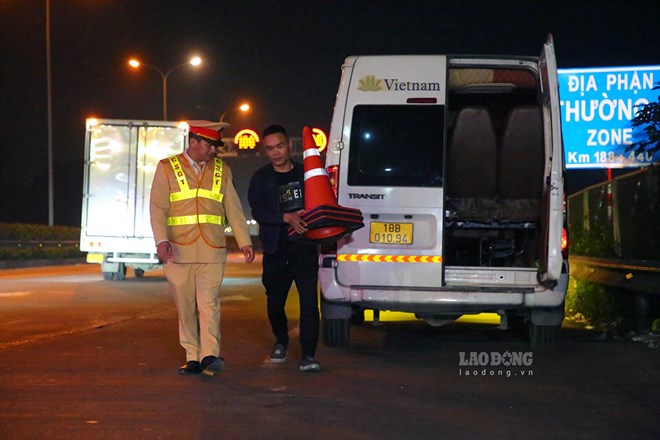
According to the 2024 Law on Road Traffic Order and Safety, if the vehicle cannot move into the emergency stop lane, the driver must turn on the emergency warning light, place a sign or warning light behind the vehicle with a minimum distance of 150m, and quickly notify the Traffic Police force or highway management unit to coordinate warnings, traffic diversion and assist in handling the incident.
The Traffic Police Department also recommends that vehicle drivers need to be fully equipped with knowledge and skills to handle when the vehicle encounters problems; calmly put the vehicle in a safe position if possible, turn on warning signals, and place warning devices in accordance with regulations. Then, quickly leave the vehicle and stand behind the guardrail or in a safe position to wait for functional forces to support.


