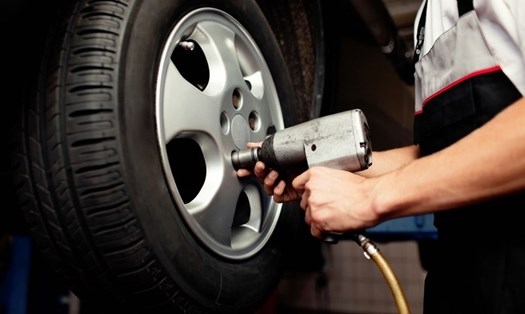
Periodic tire changes are one of the important maintenance items but are often overlooked by many car owners. Reversing tires at the right time not only helps extend tire life but also contributes to improving safety and reducing vehicle operating costs.
Usually, manufacturers recommend rolling tires every 5,000 - 10,000 miles (about 8,000 - 16,000 km). This timeline usually coincides with the engine oil change schedule, making maintenance more convenient.
However, car owners do not necessarily have to wait until the recommended milestone. If tires are found to be unevenly worn, the car shows abnormal shaking or makes noise during operation, tire rolling should be done earlier to limit negative impacts on operation.
The reason for periodic tire rotation stems from the characteristic of load distribution on the car. For most cars today, the engine and gearbox are arranged in the front, so the front tire must bear a larger load than the rear tire. In addition, the braking and cornering process also causes the front tire to wear out faster, even the tire may wear out evenly, leading to the lifespan of the tire set being shortened.
Shifting tires helps to distribute the level of wear more evenly between the wheels, thereby increasing the possibility of all four tires reaching the limit of use at the same time. This makes it more convenient for car owners to replace new tires and avoids the cost of individual replacements.
In addition to economic factors, the uniform wear of tires also directly affects the operating capacity and electronic safety systems on the car. When tire thorns wear differently, the wheel diameter also changes, leading to the rotation speed between the wheels no longer being uniform.
This difference can affect the accuracy of driving assist systems such as traction control or electronic balance, which operate based on the rotation speed data of each wheel.
For four-wheel drive models, maintaining uniform tire wear becomes even more important. If the front and rear wheels have different rotation speeds over a long period of time, the details in the powertrain will have to continuously compensate for this difference, increasing the risk of wear and cost of repair.