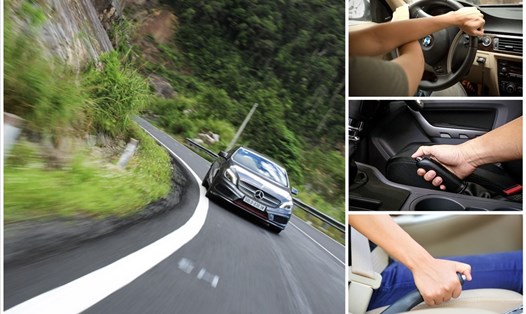
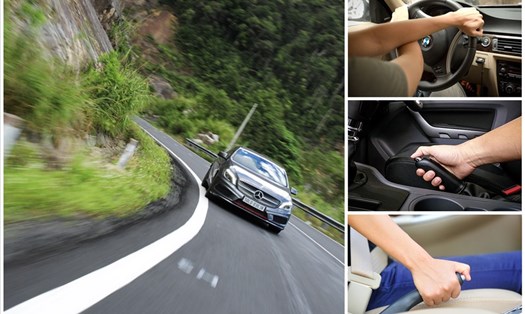
Brake failure is one of the most dangerous incidents when driving a car, especially when the car goes downhill or is running at high speed. In this situation, the most important thing is to stay calm, avoid handling it as a panic reaction and quickly apply deceleration measures to control the vehicle.
According to a technician at Ninety Eight Auto Auto Repair, Maintenance and Care Center (Cat Lai ward, Ho Chi Minh City), if the brake pedal is detected to decrease or lose its effect, drivers can try pedaling again a few times to check if the system still creates hydraulic pressure.
If the braking force is still not restored or is very weak, it is necessary to immediately switch to other speed reduction measures instead of continuing to brake continuously.
The priority measure is to utilize engine brakes. For manual transmission vehicles, drivers should gradually reduce to lower gear levels according to the actual speed of the vehicle. For automatic transmission vehicles, manual (M) mode or low gear levels such as 3, 2, 1 or L can be switched, depending on the gearbox design.
The gear reduction needs to be done step by step, and should not be switched immediately from a high gear to a 1 or L gear when the car is still running fast to avoid shocking the powertrain or causing the car to become unstable.
When shifting to a low gear, the engine will create braking force to help the car reduce speed without completely relying on the braking system. This is also a recommended technique when going downhill to limit overheating braking.
In addition, drivers can use manual brakes to assist in deceleration. With mechanical manual brakes, it is necessary to pull slowly to gradually increase braking force. If you pull hard when the car is still running fast, the rear wheel may be locked, causing the car to become unstable or the rear wheels to fall off.
For cars using electronic hand brakes (EPB), some models have emergency braking function, automatically adjusting braking force when the driver holds the EPB switch. However, this feature is not available on all car models, so users need to learn about the manufacturer's instructions.
In case the brake pedal still creates some braking force, the driver can try pedaling and releasing at short intervals. If the brake is only reduced in effectiveness due to overheating (brake fade), this operation can help the system partially restore braking ability. However, if the cause is brake oil leakage or mechanical damage, pedaling the brake many times is almost ineffective.
Throughout the handling process, the driver should not turn off the engine when the car is still moving because it can lose steering power and brake power.
If the car continues to rush forward, turn on the hazard warning light, find emergency lanes, wide sidewalks or safe areas to reduce speed. Only when there is no other choice should you proactively rub the car along the median strip or taluy in parallel to create friction and limit the risk of direct collision.
After the car stops completely, absolutely do not continue driving the vehicle. The car owner should call for rescue and take the car to the service workshop to check the entire braking system before resuming operation.