
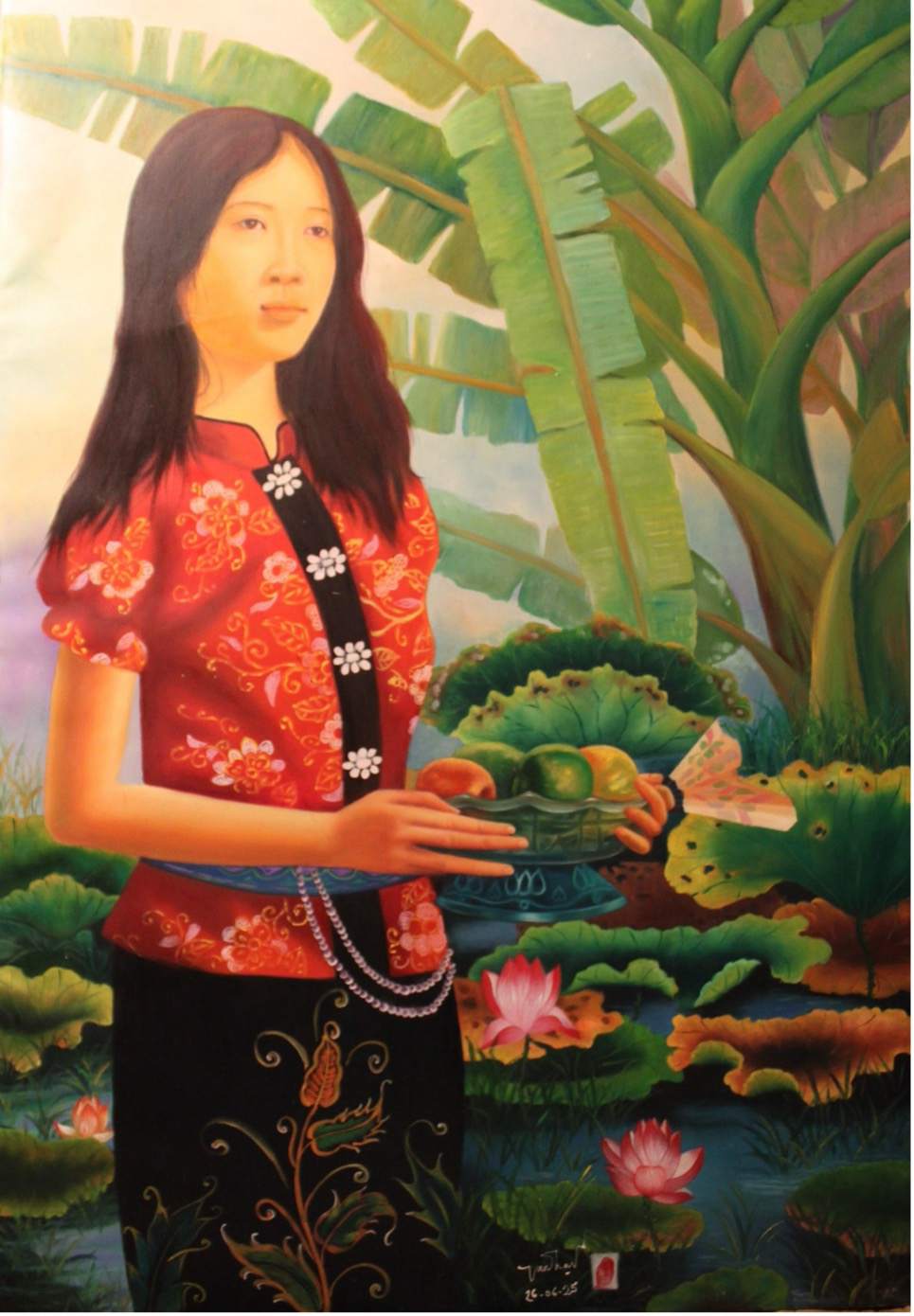
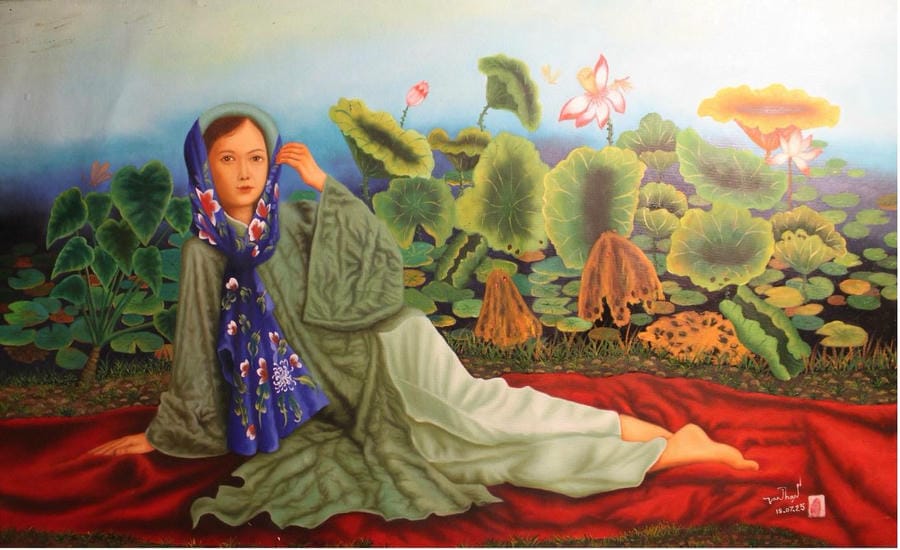
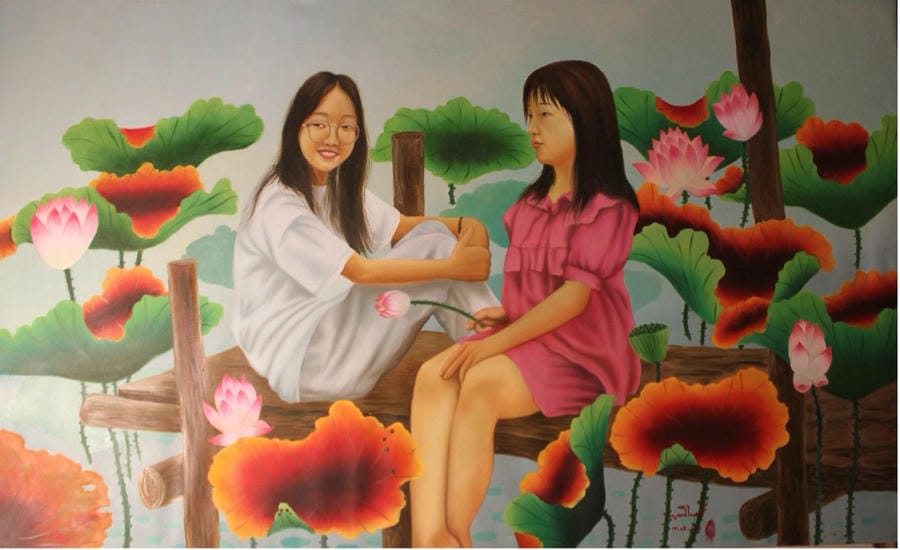
In August 2026, painter Nguyen Van Thanh participated in the 40th Chelsea International Fine Arts Exhibition with 40 artists from many countries. The 3 works he chose to introduce were all inspired by lotus flowers, including "Lotus Fragrance in the Early Sun", "Sunset on the Lotus Lake" and "The Girl in the Lotus Garden".
This is not the first time lotus flowers, women or Vietnamese nature have entered painting. These images have appeared in many creative stages, becoming a familiar part of national fine arts. The issue for contemporary artists is how to continue to exploit traditional themes without repeating them or only stopping at the level of illustration.
Identity is not just about familiar symbols
Vietnamese painting has a rich source of materials from history, nature, customs, beliefs to changes in today's life. Women, villages, lotus flowers, rivers, cities or daily activities can all become the starting point for a work.
However, the use of familiar images is not enough to create a work with Vietnamese identity. If only bringing ao dai, conical hats, lotus flowers or rural landscapes into the painting, the work can create an identity mark but is not sure to convey cultural depth.
Identity also lies in the way artists observe life, organize space, choose colors and express emotions. That is the part of memory, experience and aesthetic concepts that have formed in the process of a person living in the community and his own culture.
Artist Nguyen Van Thanh believes that the most important thing for a work with Vietnamese spirit is truthfulness.
A work with Vietnamese identity is not only in images or costumes but also in the spirit, emotions and perspective of life of Vietnamese artists. When emotions are sincere enough and humane, viewers in any country can empathize," he shared.
This view suggests a necessary approach for Vietnamese painting when stepping outside. Artists do not necessarily have to try to prove the origin of culture by filling their works with traditional symbols. Identity can be naturally present through perspective, rhythm and topic handling.
A picture of a changing city, the lives of workers, family relationships or the mood of the younger generation can still be imbued with Vietnamese spirit, even if images often considered national symbols do not appear.
Conversely, if artists only use traditional elements such as decoration, the work easily becomes a product describing culture for outside viewers. At that time, art is at risk of being shrunken into beautiful, recognizable images but lacking its own voice.
3 lotus paintings by Nguyen Van Thanh are an example of efforts to refresh familiar themes. Exploiting lotus flowers together, but each work is associated with a different state of light and emotion.
Lotus Fragrance in the Early Sun" aims for the purity of the new day. "Hoang hon tren ho sen" exploits color movements at the end of the day. Meanwhile, "The Girl in the Lotus Garden" places people in a relationship with nature, thereby expanding the story from scenery to life and emotions.
According to Van Thanh, the choice of lotus flowers stemmed from his closeness to life and memories, not from the desire to find a convenient symbol to introduce abroad.
Nguyen Van Thanh pursues both lacquer and oil paint. He sees materials as a means to convey emotions, while the Vietnamese spirit is the element that needs to be maintained throughout.
Whether creating with oil paint or lacquer, I always try to maintain the Vietnamese spirit and emotion in each work," he said.
This perspective shows that identity is not a fixed template. Artists can absorb materials, techniques and artistic thinking from the world but still tell stories originating from their own experiences. Intersection does not necessarily lose identity if the creator clearly understands what he wants to say and where he stands in cultural life.
To create a long-term dialogue for Vietnamese painting
Painting has a special advantage when connecting cultures. Unlike literature or cinema, a painting does not require viewers to know the same language to be able to access it. Color, lines, light and space can create emotional reactions from the first observation.
However, accessibility does not mean that the work will be automatically understood. Foreign viewers may recognize the beauty of a lotus pond but are not sure to understand the layers of meaning that this image evokes in Vietnamese culture. They may be attracted by lacquer techniques but do not know the complex labor process behind the surface of the work.
Therefore, bringing paintings to the world is not simply transporting works to an exhibition room. Artists and accompanying units also have to build stories, dossiers and information systems to help the public access the true value of the work.
The name of the painting, the artist's introduction, the explanation of the material and the translation are all important factors. If the story is presented too simply, the work is easily perceived as a decorative image. If the introduction is too theoretical, the distance between art and the public becomes larger.
The necessary thing is to find a balance between locality and international communication ability. A work can start from the very own experiences of Vietnamese people but must touch the emotions that people in many places share: family affection, loneliness, memories, loss, desire for freedom or the relationship between humans and nature.
Nguyen Van Thanh said that he wants to introduce a Vietnam rich in identity, humanity and vitality through painting. This is a positive message, but to create a more complete view of Vietnam, painting also needs to expand the scope of reflection.
Besides traditional beauty, artists can ask questions about urbanization speed, environmental changes, community movements, pressures in modern life or changes in the identity of the younger generation. A fine arts background only truly has vitality when both preserving memories and dialoguing with ongoing issues.
Participating in international exhibitions helps Vietnamese artists put their works in relation to many different creative methods. This is not only an opportunity to promote but also an opportunity to observe, learn and self-assess their artistic language.


