
This is a ritual that has existed since ancient times to show respect for gods and is also an opportunity to perform traditional culture for villagers to watch. And only coastal villages along the South Central Coast have this custom.
Nghinh Ong - Cau Ngu festival welcomes the gods brilliantly in the coastal village
Every year at the end of the second lunar month, Vinh Truong fishermen (Nam Nha Trang ward, Khanh Hoa) solemnly organize the Cau Ngu procession ceremony - an important ritual in the belief in worshiping the Ong fish (whales) or also respectfully called the South Sea god. This is a unique traditional festival of the people of the South Central Coast sea region expressing gratitude to the "lucky god of the sea", and at the same time sending wishes for a peaceful sea season, calm waves, smooth fishing, and safe boats going to sea.
In the series of rituals, the Nghinh Ong ceremony - welcoming the South Sea god from the sea to Truong Dong village communal house - is considered the most sacred and important part. Right from many days before that, the preparation atmosphere was bustling throughout the coastal village. People together decorated boats with brilliant flags and flowers, prepared incense tables, offerings, and tidied up the village communal house to welcome the South Sea god. Fishermen were invited to form the Ba Trao team for practice. Hat boi artists were also invited to prepare classical Tuong classes to serve the people throughout the 3 days and 3 nights of the festival.
From early morning, elders, chief priests, dignitaries, along with the Ba Trao team, the lion-dragon team, and the five-color flag gathered at the wharf. All in a solemn and excited atmosphere, a fleet of dozens of boats, large and small, began to depart, heading to the Cua Be sea area - Mui Phu Ong area, where legend has it that Ong fish often appear to help fishermen.
On the vast sea surface, the boats are brilliantly colored, harmonizing with Ba Trao chants and echoing drums, creating a scene that is both sacred and vibrant. At Mui Phu Ong, the chief priests perform the ritual of setting up the altar, offering incense, respectfully praying, inviting incense of the South Sea god to the villagers. After completing the ritual, the boats turned back in the joy of everyone.
At the wharf, villagers have been waiting with flower palanquins, banners, and lion and dragon dance teams to solemnly welcome the Nam Hai god back to the communal house. The god procession ritual takes place solemnly, showing the deep respect of the sea residents. According to ancient customs, along the procession road, people also set up incense altars to worship and bow to welcome the gods back to the village.
When the Nam Hai god is placed in the communal house, the worshiping rituals officially begin. Ba Trao Team performs typical ritual songs and dances lasting for hours, vividly recreating the life of sea labor, and praising the merits of the Ong fish. The festival atmosphere becomes even more bustling with many traditional activities such as: Lang Ba worshiping ceremony, Secret memorial ceremony to express gratitude to predecessors, Khai Dam - Cau Ngu ceremony, Ton Vuong ceremony ending the worshiping part to give way to classical opera singing in front of the incense altar.
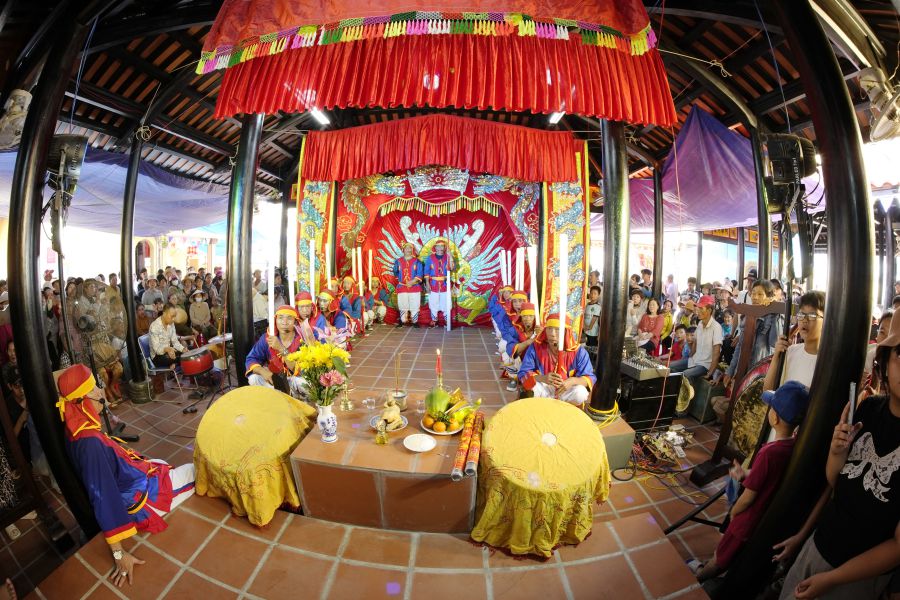
Unique cultural heritage
This is the completion ceremony of the villagers' festival every year before the "opening sea" season to go to sea to harvest fish with the hope of a bumper harvest and good luck. According to Mr. Pham Long, Chief Priest of Truong Dong village communal house (Vinh Truong - Nam Nha Trang, Khanh Hoa), for villagers, worshiping is a sincere spiritual ceremony that anyone working in the fishing profession must remember and respect the god of the South Sea, the ancestors who opened the village.
If worship is existential, then singing An is a cultural spirit. Before performing Tuong, Ba Trao with folk songs imbued with the sea spirit of fishermen takes place throughout the procession procession from the sea to the communal house. Ba Trao is simple, lively, and energetic performed by men who are originally fishermen. As for Tuong, it must be performed by professional artists.
From ancient times, the Central region was the cradle of Tuong singing art. When Vietnamese people migrated to the South, they brought that heritage to a new land, breathing life into the cultural life of the coastal villages. If the North had Cheo, Quan Ho, Xoan singing; then the Central region had Tuong - and in the sea communal houses, Tuong became Hat An - a form of ritual Tuong. Hat An often performs famous Tuong stories such as: Son Hau, Quan Cong Pho Nhi Tau, Vo Dong So - Bach Thu Ha, La Bo Hi Dieu Thuyen, Ba Vuong Viet Ngu Co... In particular, stories about Quan Cong are very well chosen to be performed because they express loyalty - filial piety - righteousness - integrity, suitable for the spirit of worshiping the South Sea god.
Many villagers prepare meticulously, invite famous troupes, talented actors, and set up stages right in front of the communal house. Lanterns are brightly lit, the sound of chau drums resonates, and heroic singing echoes in the space of the sea night. The elders just sit and watch, rewarding the artists with "chau drums" praising them.
People in the village, from old to young, are fascinated by each role, each voice, each beat. Some people reward artists with money by clipping them into cards, some people throw sparkling banknotes onto the stage, as a joy of dedication.
With that aftertaste, in the era of information and culture flooding like that, but for the coastal villagers, the Cau Ngu - Hat An festival is still considered an indispensable thing, so no matter who works far away, they try to return to the village to enjoy the overflowing memories of their homeland.


