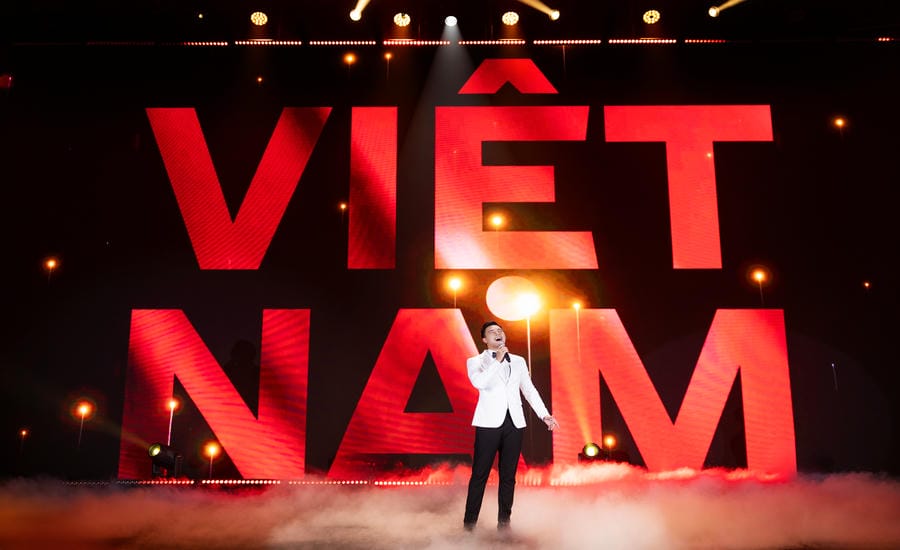
The treasure of revolutionary music during the resistance war period owns classic works associated with the names of veteran artists such as: People's Artist Trung Kien, People's Artist Quang Tho, People's Artist Doan Tan... When approaching "monument" songs including: "Ho keo phao", "Tinh ca", "La do" or "Giai dieu To quoc", what is the biggest pressure for a young singer like you?
- The biggest pressure for me is the fear of ruining or breaking the spirit of the work that the previous generation of aunts, uncles, and brothers and sisters have performed so fully.
When singing songs that have stood the test of time, I am always aware that behind each note and lyrics is a generation of artists who have put all their heart and soul into singing with the fiery experiences of their lives. Therefore, I never set a goal to sing very differently to show off my ego or personal artistic personality.
First of all, I must understand the song, absorb the spirit of the work and respect the standards that the previous generation painstakingly built. Then, with the ability and feeling of today's era, I will find a way to express it that is suitable for my voice.
Learning from the "monuments" and conveying with the energy of young people, I hope that will become a bridge to bring heroic melodies closer to the audience of the same generation.
The previous generation had many artists who sang red music with their own personal experiences, when they went through the war, crossed the Truong Son forest with their comrades. Born and raised in peacetime, where did you find emotional materials to breathe the heroic soul into those heroic songs?
- I think this is something I always have to be honest with myself and the audience. I was born when the country was silent, so I cannot say that I understand the deep war like those who have gone through the line of life and death. If I try to brace myself to describe an experience I have never had, the lyrics will become awkward.
My emotional material comes from family stories, from history books, from the memories of war witnesses and the knowledge I accumulate every day. Moreover, I realize that war is not just smoke and fire, bombs and bullets; war is also the image of a mother seeing off her child, a wife wearyly waiting for her husband, a young soldier burning with homesickness or youthful dreams that must be temporarily put aside.
When touching those very hidden corners of people, I find deep empathy. I don't try to sing like a soldier just stepping out of a trench, I sing red music in peacetime is to look back at the past with gratitude.
At the moment when heroic melodies like "Road to the Future" or "Ho keo phao vang" echoed on large stages and stadiums, how did you feel when witnessing tens of thousands of young audiences harmonizing in unison?
- That is an emotional and choking feeling. When tens of thousands of young people chanted songs that were born more than half a century ago, I realized that revolutionary music is never unfamiliar to today's generation.
That melody is inherently deep in your subconscious through grandmother's lullaby, mother's song, teachers' lectures or documentary films. Just a space large enough and a fire strong enough to spread, the love and national pride inherent in each person will naturally merge into one.
How does the fact that revolutionary music excerpts become a strong spreading trend on social networks give you confidence in the path you are pursuing?
- I feel very happy. There used to be a prejudice that young people today have difficulty accessing traditional, folk or revolutionary music. But the reality in the past time proves the opposite: A series of works with contemporary folk or red music influences have been warmly received.
The audience listens because they find true emotion. That gives me a firm belief in the path I choose. My task is not to follow "viral" formulas, but to improve expertise, perform with all the meticulousness and enthusiasm.
How does the energy from the brilliant concert space bring you different emotions compared to the solemn political stages?
- These two spaces bring two sources of energy that closely complement each other. On the political stage, I always maintain high concentration, standards and strict discipline to ensure the solemnity of the event.
Conversely, the concert stage brings free and liberal interaction. Cheers, flashlights and the audience's impromptu response become powerful catalysts to help me sublimate and transform more in the way I handle songs. The political stage trains me in bravery, and the concert teaches me a lesson about connection.
Among the works you have performed, which song is associated with the artistic ideal that you are most passionate about?
- It's hard to choose only one song, but there are two works that left a very deep impression on me.
First is "Continuing the story of peace". I love this song because it not only honors the past but also sets responsibility for the present. We are born in peace, which is a privilege, but that peace has been exchanged for so much blood and bones of previous generations. Today's young people do not need to take the gun to the battlefield, but must continue that story with civic responsibility, with a decent lifestyle and the desire to contribute to building the country.
The second is "Road to the Future". The lyrics and image of soldiers in the song carry a heroic and romantic beauty that is extremely touching. The resilience and optimistic spirit of soldiers in the smoke and fire of war are always an endless source of inspiration every time I sing.
After the journey of affirming your inner strength and liberality at the program "Older Brothers Overcoming Thousands of Obstacles", what projects do you cherish to make the flow of red music and national spirit continue to have a new life?
- The journey from the program "Older Brothers Overcoming Thousands of Obstacles" shows me that I still have a lot of potential to explore. I don't want to stop at singing existing songs, but am studying more deeply folk materials, traditional music to combine with Rock, Orchestral or contemporary music spaces. I am also nurturing long-term projects with a xuyên suốt theme about the history and culture of Vietnamese origins.
I always keep in mind that I still have a lot to learn. If my next music products can arouse the curiosity of young people, making them want to learn more deeply about a historical period or a folk tune, then that is the greatest reward for me. I just hope to do my part well, so that the beautiful values of folk music continue to accompany the times.