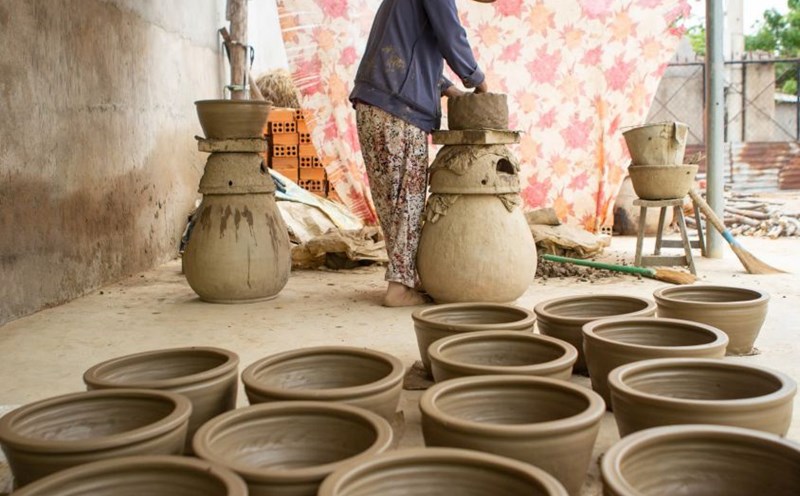
Because for nearly 10 centuries, they have lived on the Quao River flowing through the village: Taking water to grow rice and taking clay to make pottery. But now, Bau Truc's pottery needs a new breath to suit the new era: Positioning the Cham pottery brand and becoming a tourism product.
The magical clay source of the Quao River
Bau Truc pottery village is located in the center of Phuoc Dan town, Ninh Phuoc commune, Khanh Hoa province. Bau Truc in Cham is Paley Hamu Trok, meaning "low-lying village, protruding to the end of the riverbank". The ancestor of Bau Truc pottery was Po K'long Chank, a close courtier of King Po K'long Giarai (1151 - 1205).
Nearly 1,000 years ago, Po K'long Chank taught the Cham people in Bau Truc how to take soil, ply it and then burn it into household items. The pottery making profession here was previously mainly undertaken by women, men did more heavy work such as digging soil, burning pottery and carrying pottery or transporting it for sale according to the matriarchal system of the Cham people.
To this day, this tradition is still maintained. When daughters grow up, they are guided by their mothers to make pottery, and then "mothers pass it on to their children" for generations. However, the Cham people in Bau Truc consider Mr. Po K'long Chank as the ancestor of the pottery profession and they are Po's descendants, with 80% of the 400 households here doing pottery.
Traditional pottery products of Bau Truc pottery village are divided into 2 lines: Folk life lines such as pots, stoves, pots, water-filled jars... to serve people's lives and family activities; and product lines serving spiritual purposes such as incense burners, agarwood kilns, and worship items.
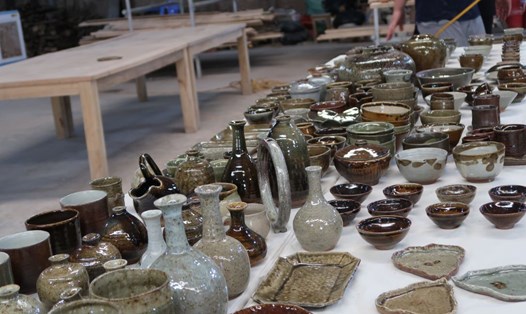
Bau Truc pottery still has its own characteristics, for example, traditional Cham Bau Truc pottery has yellow-red, red-pink colors, interspersed with brown, black-gray streaks, which are characteristic colors crystallized from soil and water through fire and coloring with plant preparations.
The uniqueness of the products is very high and absolutely no industrial color glaze is used. Bau Truc potters are often proud that only their product lines sparkle with gold in the literal sense. Because in any pottery piece, there are faint gold spots on the pottery skin.
That is because the method of making Bau Truc pottery has its own style, and because the raw materials here have its own characteristics. Pottery soil is not pure clay but a mixture of clay mixed with young sand taken from streams on the source flowing in. That sand contains a lot of placer, so when baked at 600 - 800 degrees Celsius, other minerals will disappear, leaving only placer gold mixed in the pottery skin.
But sand containing placer gold only makes Bau Truc pottery sparkling, while clay under the Quao River is what nurtured the pottery craft for thousands of years and became the oldest craft village in Southeast Asia. That is clay that is revived by the miraculous properties of the Quao River, just take it away and it will be compensated in the following year.
The place that contains that clay is called Hamu Nulank field. For more than 1,000 years, the Cham people here have mined clay on this field to make pottery. Countless batches of clay have been excavated, Countless carts have been carrying clay to the village, but here, the geological surface is still flat and full like from the time of creation.
Because when the Quao River water rises, the pits are filled with soil, as if no losses have occurred. The soil on the field has transformed into jars, pots, statues, reliefs... but the Quao River has quickly compensated with new soil in each flood.
After taking the clay layer underneath, the potters will fill the clay layer on top to plant. In about a year and a half, the lost clay layer will be replenished again thanks to alluvium in the Quao River water. This is a great advantage in raw materials for Bau Truc pottery.
Sand is also taken from the Quao River and streams to the river. Then both soil and sand are stored, waiting for use. The clay here has a very special feature when water is added to knead, it is very flexible, has a thickness and is smooth. When kneaded and brought into the kiln, the pottery does not crack.
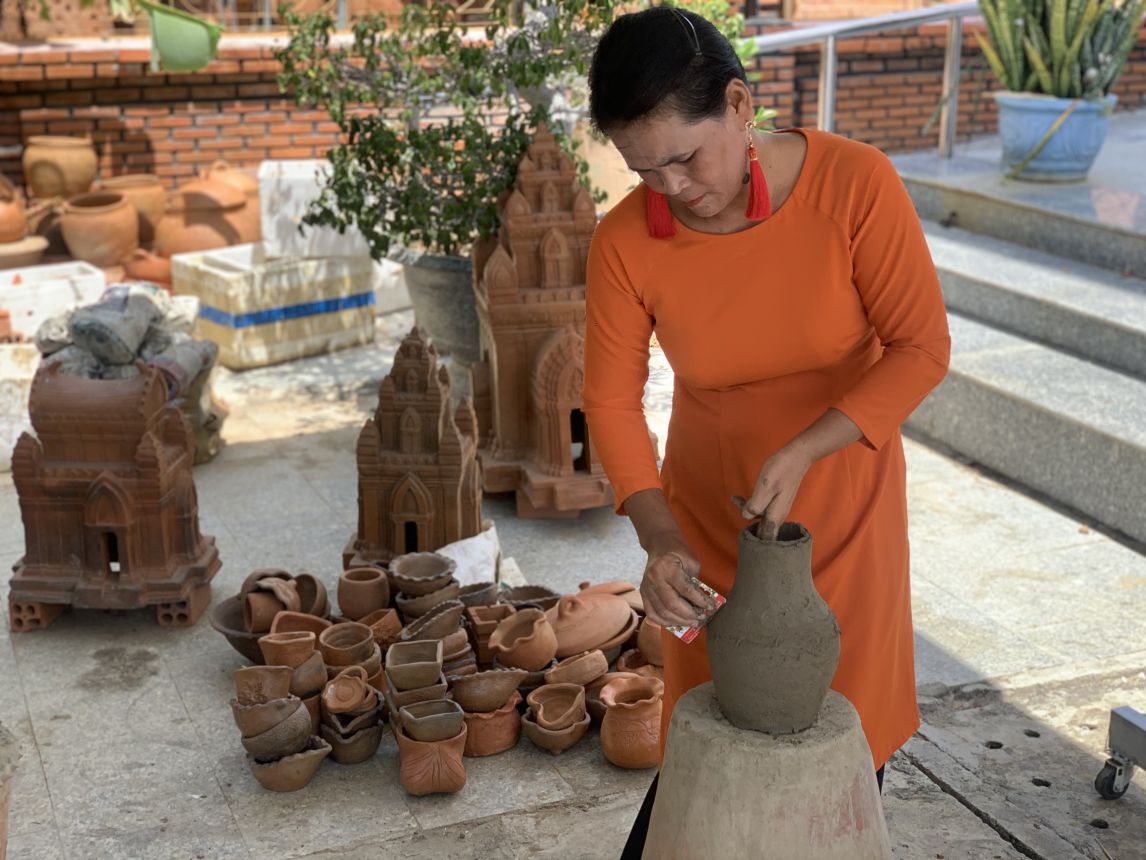
Pottery making in Bau Truc
Bau Truc pottery does not use a rotating table like in other pottery villages in Vietnam and around the world. The pottery table of the Cham people in Bau Truc is immobile, not rotating blindly due to pedaling or rotating with hands. The pottery table is immobile but people move.
When shaping, the pottery artisan uses his hands to stroke and shape and rotate around the pottery table to adjust the shape of the product. The movements of the feet, buttocks, waist, and back are sometimes in the direction of the clock clock, sometimes in the opposite direction of the clock clock, very rhythmic and graceful.
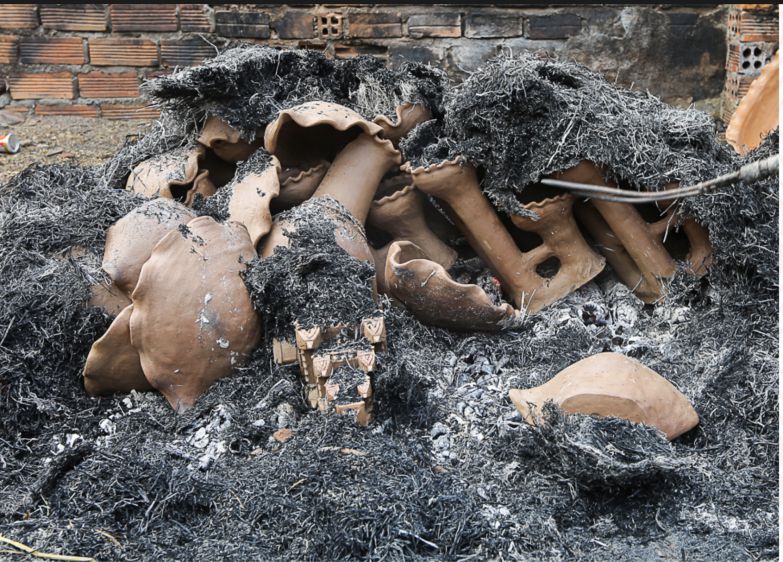
This pottery making technique is described in a folksy way as "made by hand, rotated by butt". The Cham people in Bau Truc also do not need to build kilns but still burn open-air pottery with firewood, straw, and rice husks, leaving all success or failure to each sun, rain of the earth and weather.
Therefore, the Cham people are very fond of using Bau Truc pottery products for their spiritual activities, and absolutely do not replace them with other things. From the girls' coming-of-age ceremony, to the Cham people's Tet Katê or funeral and wedding events... they all use Bau Truc pottery.
Anyway, Bau Truc pottery still has weaknesses when going out into the space of the Cham people in Bau Truc. That is the weight of the pottery items, which are made according to the original formula of using a large amount of clay. Therefore, a Bau Truc pottery item is heavier than Bat Trang, Chu Dau or even Tho Ha pottery.
Secondly, because the purpose of making it is to serve people's lives and spirituality, Bau Truc pottery has a rough, rustic appearance, how it is fired is how it is used, without needing to paint glaze or elaborately decorate. People who do not understand the nature and do not love Bau Truc pottery can easily ignore this pottery.
Therefore, when the era of aluminum and plastic appeared, it was also the time when the general alarm bell for civil products made of ceramic also sounded. Heavy, fragile, not durable, less convenient, and expensive have made ceramic utensils "clinically dead" because they cannot be compared with aluminum basins and plastic buckets.
Right in Bau Truc village, aluminum and plastic utensils also overwhelm pottery utensils, not to mention other places. But that does not mean that Bau Truc pottery village is ruined by pottery fire, even though that fire only flies to preserve the thousand-year quintessence. That is why, at the end of 2022, "The pottery art of the Cham people" was recognized by UNESCO as an intangible cultural heritage that needs urgent protection like the painting profession in Dong Ho village (Bac Ninh).
Cham pottery brand and tourism products
Immediately after the "arrangement of the country" was carried out, Bau Truc pottery village belonged to Khanh Hoa province, a province very strong in tourism and considering tourism as the main spearhead.
Seeing the 1,000-year-old brand of Bau Truc pottery village with high cultural and historical value, completely capable of becoming a tourism product, the leaders of Khanh Hoa province decided to approve the "Project: Management, protection and promotion of the value of the intangible cultural heritage of Cham pottery making art" for the period 2025 - 2028 and the following years in December 2025.
In this project, 2 main goals stand out. First, it is necessary to build a Cham pottery brand, and at the same time complete the geographical indication for Bau Truc Cham pottery products. Only by doing this can a heritage that has existed for nearly a millennium and is closely associated with the cultural and economic life of the Cham community here be preserved.
Second, after completing the goal of bringing Bau Truc Cham pottery out of the state of urgent protection in 2026, it will continue to build quality standards, register the "Cham Pottery" trademark for Bau Truc products, and then complete the planning to protect the cultural space of the craft village and develop community tourism models.
This project was just announced at the end of 2025, however, there is a reality that the Cham people in Bau Truc have been quietly shifting for a long time. On the one hand, pottery artisans continue to maintain the spiritual product line, minimize the civil product line and switch to the interior decoration pottery and fine art pottery product line.
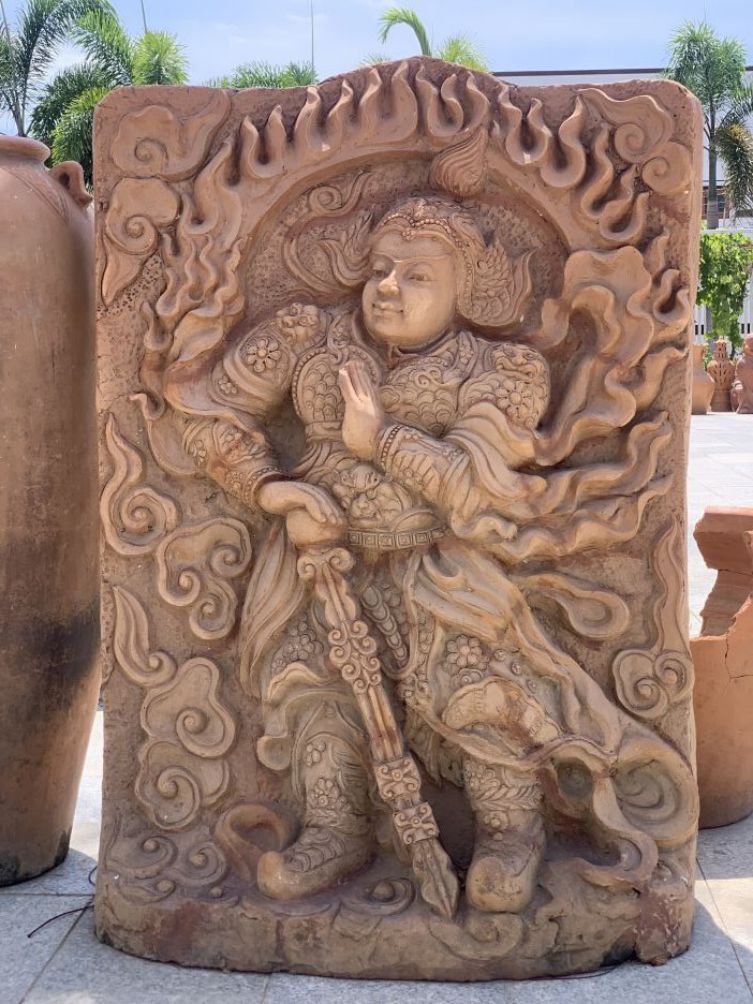
Instead of jars and pots, pots and pans are works serving "decor" of large spaces such as statues, reliefs, interior accessories, miniatures of all sizes as required, for decorative purposes for large architectural works or on a garden, house, room scale...
Typical products such as Cham tower models, statues of Brahma, Vishnu, Shiva gods, especially the Apsara goddess statue - a symbol of Bau Truc pottery are very popular, besides ordinary products such as flower vases, water jars, lampshades, ceramic lamps, decorative water-filled jars...
Although handcrafted, they are all highly artistic with meticulousness and sophistication in each stroke. Decorative patterns on Bau Truc pottery are carved or embossed lines imbued with Champa culture, freely created by artisans, sending their souls into each pattern.
Pottery making techniques including traditional methods, artisans, products, production processes, production operations... are also transformed into tourism products to serve visitors. The journey by cow cart to collect clay in Hamu Nulank field is also very attractive to tourists.
Previously, although Bau Truc pottery village had 80% of households participating in pottery making, there were no showrooms displaying products like in Bat Trang or Tho Ha, the whole village only had one showroom located in the community house managed by village head Dang Chi Quyet.
But now, in addition to the family pottery workshop, households with conditions open their own showrooms to display products and welcome tourists. They are willing to perform traditional pottery shaping techniques in an interesting and unique "hand-shaped, butt-turned" style and guide tourists to follow.
This is also a tourism product with strengths, both bringing economic benefits and introducing the quintessence of our nation. It can be said that with the direction of tourismizing pottery products and creating new product lines suitable to market needs, Bau Truc pottery has created new value.
Soil, sand, straw fire, thousand-year method, indigenous culture, intangible culture, traditional spiritual culture... all create momentum for Bau Truc pottery village and pottery - a type of UNESCO-recognized intangible cultural heritage - to have a new breath.