
Blue sea and island-crossing trails
Knowing about Hon Nua through images shared on social networks since 2025, but it was not until this summer that Nguyen Thu Thao (28 years old, Hai Phong) made the long-cherished trip. For the young girl, the most attractive thing is not the famous beaches or coastal resorts, but an island that is still quite pristine located between the borders of Dak Lak and Khanh Hoa.
From the center of Tuy Hoa ward, visitors will travel more than 30km to Vung Ro port (Hoa Xuan commune). After nearly half an hour of surfing the sea, Hon Nua gradually appears in front with green mountainsides covered with forest trees and rocky rapids protruding into the sea.
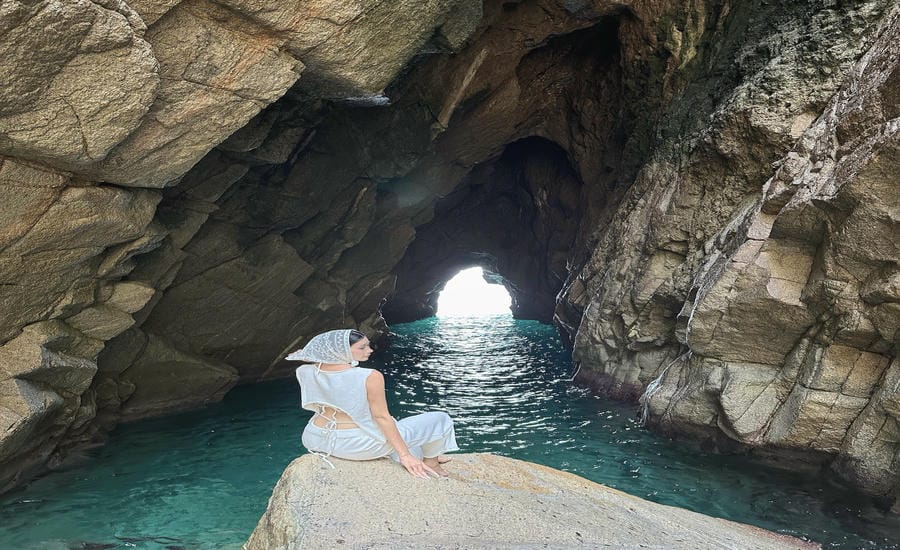
As soon as she set foot on the island, what impressed the female tourist the most was the clear sea water stretching around the shore.
The seawater here has many different layers of color. Some sections are turquoise, some are dark blue. The actual scenery is even more beautiful than what I have seen through photos," Thao shared.
Not too crowded like many famous sea tourist destinations, Hon Nua brings a peaceful feeling with natural rocky beaches, low forests and the sound of waves crashing endlessly on the island's slope.
What I like is that the island is still very pristine. There are not too many services or entertainment activities, people mainly spend time watching the sea, walking to explore and enjoy the natural space," Thao shared.
The most sought-after destination today is the natural subsidence area located in a corner of the island. To access this place, visitors must walk through trails through bushes and rocky slopes.
The trekking route is not too long but has slopes and rough terrain. The deeper you go into the island, the more pristine the scene becomes with the green of forest trees interspersed with cliffs facing the vast ocean.
According to Thao, this journey is not too difficult for people with normal physical strength. However, tourists should prepare drinking water, suitable shoes and go in groups to ensure safety.
Touch the "gate to the ocean
After a trekking distance, the scene appeared before their eyes, making many tourists surprised.
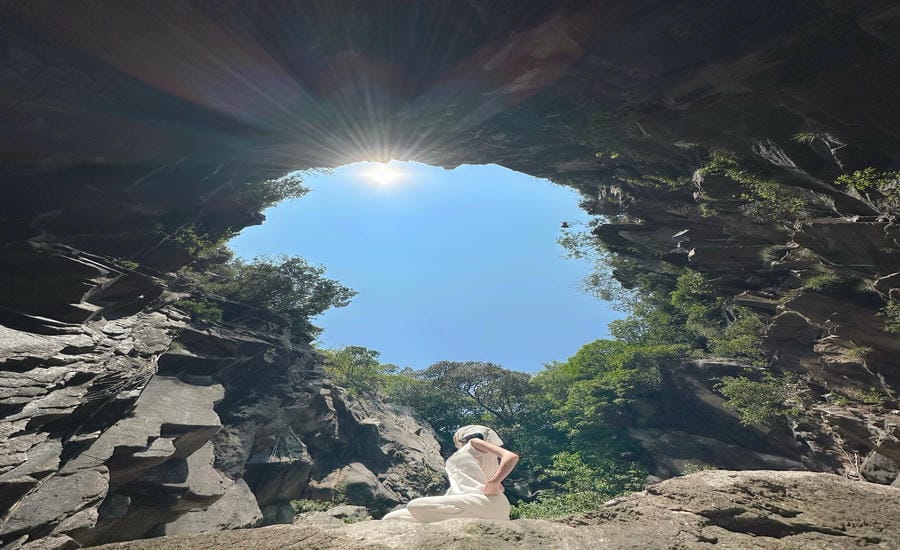
Between the large rocks, a natural space tens of meters wide opens up. Above is the blue sky surrounded by vertical cliffs, in front is the vast ocean stretching to the horizon. The combination of rocky terrain, sea and natural light creates a scene that is both majestic and unique, reminding people of the gate leading down to the vast ocean.
I was really surprised. The first feeling was "wow" because I didn't think there would be such a unique place on the island," Thao recounted.
Standing from the sinkhole area looking far away, Hon Nua sea appears with many different green colors. Waves continuously hit the foot of the cliff, creating echoing sounds in the vast space.
The moment that the female tourist remembers most is when she followed the stone path down to near the pit area.
One side is the vast blue sea, the other side is the natural dome of the sinkhole with the sky open right in front of my eyes. The feeling at that time was really overwhelming and difficult to describe in words," she said.
After many trips to the central coastal areas, Thao believes that the natural subsidence pit is the biggest difference of Hon Nua. Not only is it a check-in point, this place also brings a rare exploration feeling when nature still retains its original marks.
Spending the whole morning exploring the island, the female tourist believes that Hon Nua is currently suitable for those who love to experience nature and short-day trips. With a cost of only about 1 million VND, tourists can comfortably visit, check-in and enjoy the most beautiful corners of the island.
Leaving Hon Nua when the sun has covered the sea surface, many tourists still linger by the rocky beaches to admire the blue water in the characteristics of this place. Among the increasingly crowded destinations, the small island at the foot of Deo Ca pass still retains its own peaceful beauty, enough to make nature lovers want to return once again.
Hon Nua is located at the foot of Deo Ca pass, in the border area between Dak Lak and Khanh Hoa. The island has a small area but stands out with a relatively pristine ecosystem, clear blue sea water and natural cliffs along the coast. The suitable time to explore Hon Nua is usually from March to July, when the weather is dry, the sea is calm and favorable for sightseeing, trekking, and swimming activities.


