
Each World Cup takes place clearly reflecting a part of the development of world football. If previously, the innovations mainly revolved around tactics, fitness or organization, then the 2026 World Cup marks a strong shift to the digital age.
The tournament taking place in the US, Canada and Mexico will gather 48 teams with 104 matches, becoming the largest World Cup in history. Along with the expansion in scale is the emergence of a series of new technologies, in which artificial intelligence plays a central role.
AI changes the pitch from within
One of the most notable changes at the 2026 World Cup is the widespread presence of AI in professional activities. FIFA and technology partner Lenovo have introduced the Football AI solution set to support teams, referees and organizers.
All teams participating in the tournament will have access to Football AI Pro, a generative AI platform built on hundreds of millions of data in football. The system has the ability to provide analysis in the form of text, video, charts and 3D images, supporting tactical preparation, opponent evaluation and performance analysis of teams. FIFA believes that this tool helps narrow the gap in analytical resources between major football nations and teams participating in the World Cup for the first time.
On the field, the "smart" ball named Trionda of Adidas is integrated with an IMU sensor capable of recording motion data 500 times per second. Every touch of the ball, acceleration or trajectory is transmitted in real time to the referee support system. This data combined with field surveillance cameras helps improve accuracy in offside situations or determine the contact point of the ball.
An interesting new point is that all players participating in the World Cup have their bodies scanned to create 3D models with high accuracy. These digital copies allow the system to recognize player positions even in high-speed or obscured plays. When disputes occur, AI can recreate situations with 3D images that are much more realistic than traditional graphics.
The semi-automatic offside system has also been significantly upgraded. Instead of waiting for a lengthy test process, referees can receive almost instantaneous sound warnings through headphones when the system detects offside errors. FIFA hopes this will help the match run more smoothly, reduce controversy and limit unnecessary long balls.
Robot dogs and off-field technologies
Not only changing what happened in the match, technology is also present in many sideline activities of the 2026 World Cup.
In Mexico, security forces are expected to use robot dogs to support ensuring safety during the tournament. These four-legged robots can access dangerous areas, transmit live images to the command center before functional forces deploy actions. The goal is to minimize risks for security personnel and improve the effectiveness of response to arising situations.
The organizers also apply digital copying technology to build virtual models of all 16 stadiums. Thanks to this, operators can track the flow of crowds, assess operating conditions and detect congestion points early. Fans can also use smart navigation tools to find entrances, seats or services inside the stadium.
The smart operating center supported by AI will monitor the activities of the tournament in real time, synthesize data from many different locations to support decision-making. Meanwhile, broadcasting platforms are supplemented with many new interactive features, allowing viewers to access match data, diverse camera angles and personalized content.
From the pitch to the operating area, from refereeing to audience experience, technology is present in every corner of the 2026 World Cup. The tournament is therefore not only a global football festival but also a testament to how AI and digital technologies are shaping the future of modern sports.
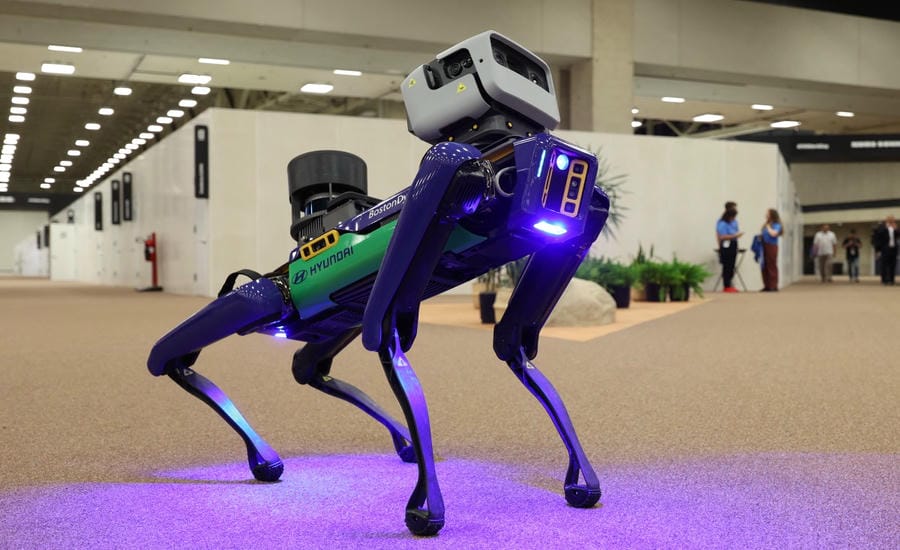
The 4-legged robots are designed to enter dangerous areas and broadcast live videos to security forces, who can monitor before acting throughout the tournament.
Cameras mounted on referees will appear in all 104 matches, bringing a direct view from the field to global audiences. This is considered a new step in increasing transparency and helping viewers better understand decisions on the field.


