
Farmers tell stories
In the last days of June, the Mekong Delta welcomed me with sudden showers, which just poured down and then gave way to dry sunshine. Running along provincial road 922 (section passing through Phuoc Thoi ward,
Can Tho City), the fragrance of straw on autumn days blowing into the wind creates a very characteristic strong fragrance. On both sides of the road, the atmosphere of labor is bustling. The most visible are dozens of farmers busily working along the long straw beds, some stirring water, some rolling nets, some picking mushrooms... In general, straw mushroom growing has long become a part of the rhythm of life for people in Tay Do land.
Seeing my curiosity, Mr. Nguyen Van Hung (who has more than 20 years of experience in the profession) waved his hand to call back to see the white, round mushrooms. Rolling on his forehead were drops of sweat, he began to tell about the elaborate production process.
Accordingly, straw after being harvested from ripe rice fields is purchased by people to enter the incubation stage. Straw is stacked into large piles (1.5 - 2m wide, 4 - 8m long), then covered with nylon tarpaulin or banana leaves to retain moisture and temperature inside.
After about 2-3 days, I have to open the tarpaulin to stir the composting pile evenly, the purpose is to let the straw absorb water evenly. Just like that, wait until about the 5th or 6th day, when the straw begins to soften completely, turns bright yellow, and emits a characteristic aroma, it is standard," Mr. Hung shared.
Next, the stage of moulting and planting seedlings requires certain skill. Mushroom growers often plant seedlings outdoors in a "turtle's back" style, about 50cm wide and about 20 - 30cm high for easy drainage. The first layer of straw is spread about 7 - 10cm thick, seedlings (seedlings) are carefully planted along the edge and spread evenly on the surface of the seedling bed. Thus, the process is repeated about 4-5 layers of straw interspersed with seedlings. Above, they cover a thick layer of straw that people in the profession call "moulting seedlings".
After removing the silk dressing tarpaulin, small white spots like rice grains begin to appear, signaling that life is growing. At this time, watering to retain moisture from 70 - 80% is very important. Farmers must use a gentle spray nozzle, cherish each straw to avoid wasting the sap or causing waterlogging.
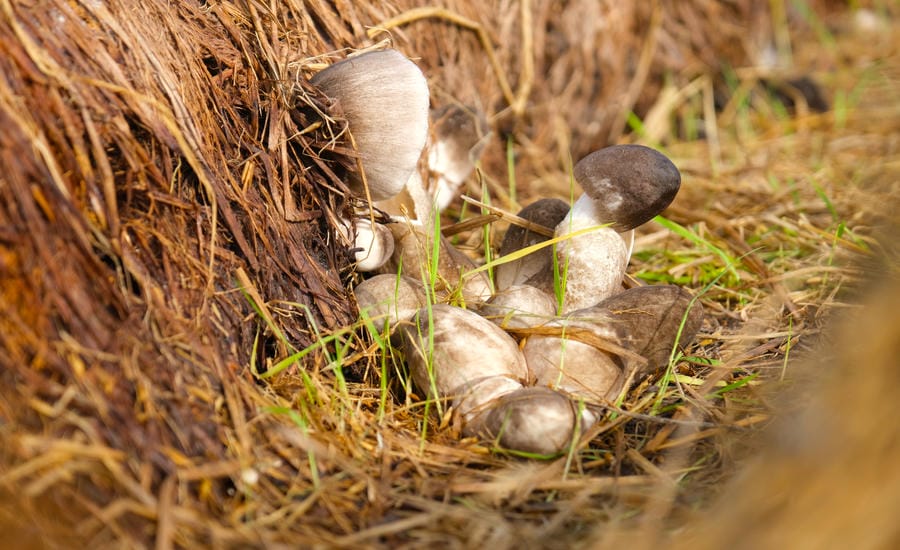
About 12 - 15 days from the time of planting seedlings, the first straw mushroom buds begin to protrude. A mushroom crop is usually packed within 25 - 30 days. To get the best mushroom batch, people must wake up before 6 am or in the cool afternoon, skillfully rotate gently to fully remove the pointed head mushroom buds from the mound, keeping the sweetness and crispness of the countryside dish.
Weather-dependent
For many farmers in the Mekong Delta, straw mushrooms are not simply an agricultural product, but it is a "career", a "lifebuoy" for many lives. Thanks to straw mushroom fields, many families have overcome difficulties, improved their economy, raised their children to adulthood, and helped them go to school to learn and then grow up and get married.
However, in the past 5 years or so, the weather in the Mekong Delta (Mekong Delta) is no longer "smooth as before". Erratic climate changes make it difficult for workers. "Straw mushrooms are the most sensitive to heaven" - Mr. Hung confided pensively.
Mr. Hung analyzed that the sudden temperature difference between day and night, prolonged intense heat waves or sudden rains caused mushroom yield and quality to drop sharply. When encountering prolonged rain, the humidity in the air is too high, the straw mounds are waterlogged, making mushrooms easily blacken their heads and rot before they can grow. Conversely, on hot sunny days, straw becomes dry, the temperature inside the mound rises too high, causing young mushrooms to become stiff and die.
Listening to Mr. Hung's sharing, Ms. Vo Thi Xuan (Phuoc Thoi ward) also put down a basket of straw mushrooms and sighed and then continued: "The erratic climate makes the yield very precarious! There are crops that go wild, the yield drops deeply, farmers only know how to look at each other and laugh, not enough to compensate for the money spent.
Not only the weather, mushroom growers also face constantly escalating input costs. Due to the changes in rice crop seasons and harvesting methods by machinery, the source of raw straw is becoming increasingly scarce and expensive at some times of the year.
Currently, although the price of type 1 straw mushrooms sold to traders at the garden distributed to markets and supermarkets is still quite high, about 80,000 VND/kg, but because the actual yield has decreased, the profit that people hold in their hands is not much left. Because of this, the drops of sweat falling on the straw seem to become more and more salty and bitter.
Finding sustainable livelihoods
It's hard, but we won't give up our profession! We are still learning about new solutions and production methods to adapt" - Ms. Xuan said loudly to me, as the weather started to turn rain again.
It is undeniable that straw mushroom growing has opened up a promising direction for the circular economy model in rural Can Tho in particular and the Mekong Delta region in general. In recent years, the image of smoke billowing from burning fields after each harvest in the area has gradually thinned out, thanks to which the air is also fresher. Straw mushroom growing not only brings direct economic benefits to people to take advantage of their free time, but more importantly, it contributes to reducing greenhouse gas emissions from indiscriminate straw burning.
However, from the reality of the difficulties that Mr. Hung and Ms. Xuan are facing, we realize that this shift cannot only be based on the persistence and loneliness of farmers. The problem posed at this time is how to make mushroom farming stand firm against the wave of climate change. That is when timely support and extended arms from in-depth technical guidance from functional sectors are needed.
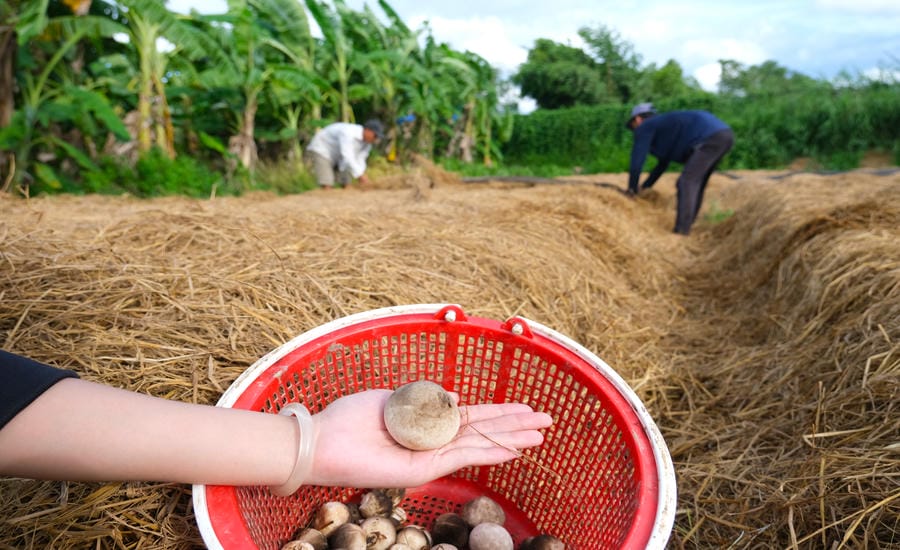
Thanks to the warm weather, straw mushrooms can be grown and harvested year-round in the Mekong Delta. However, the peak season usually falls in the rice harvest season, from April to June or October to December of the Gregorian calendar.
In the eyes of those farmers, we read the expectation of supporting access to preferential loans so that we can invest in a more methodical and scientific way. So that in the future, the straw beds by the roadside will not only be temporary livelihoods, but will become sustainable launching pads.


