
Don't let the Old Quarter "carry" the night economy
According to the new Night Economy Development Plan issued by the Hanoi People's Committee, by 2030, the city aims to make the night economy an important driving force of the service economy, contributing about 5% of GRDP. Regarding tourism, Hanoi aims to increase the rate of overnight spending by visitors to 25 - 30% of total spending and extend the average length of stay to 2.5 - 3.5 days.
To realize this goal, the city plans to develop controlled night entertainment service areas, operating after 24h or 24/24h in areas that meet infrastructure conditions. At the same time, Hanoi will expand creative cultural spaces, organize night music festivals, international night running races, develop heritage experience routes applying digital technology and strengthen public transport connections with night economic zones.
Assessing the night tourism picture of the Capital, Mr. Nguyen Tien Dat - Vice Chairman of Hanoi Tourism Association, Director of AZA Travel said that after many years of operation, Hoan Kiem Lake pedestrian street and the Old Quarter still play the role of "leader" of Hanoi's night economy.
This is still the most vibrant center of Hanoi's night economy when it gathers quite fully all types of services such as cuisine, shopping, entertainment, accommodation, especially the system of bars and restaurants on streets such as Ta Hien, Luong Ngoc Quyen...", Mr. Dat assessed.
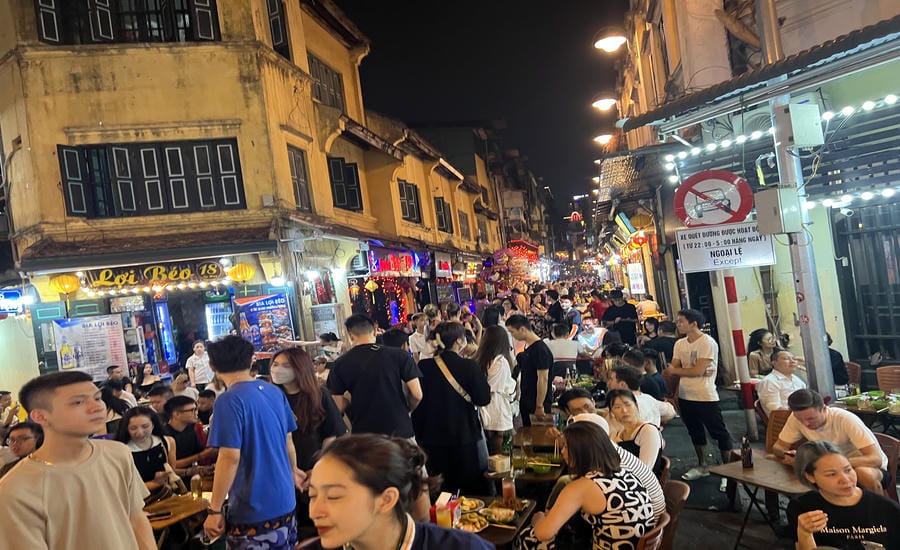
However, according to experts, the development of the central area also shows space limitations. As the number of visitors increases, the Old Quarter is unlikely to continue to be the place to bear all the needs of the city's nighttime economic development.
The cramped space and high population density make a large number of tourists in the evening put pressure on people's lives, from noise, environmental sanitation to security and order. In addition, night business activities also need to comply with many regulations on sidewalk management, roads and urban order, so expansion is not simple at all," Mr. Dat said.
Meanwhile, many other night economic spaces such as Tran Nhan Tong, Trinh Cong Son or Truc Bach streets, although oriented for development, have not yet created a corresponding attraction.
According to Mr. Dat, most of these locations only meet the entertainment needs of local people, and have not formed products that are different enough to attract tourists. This shows that expanding more space is only a necessary condition, while sufficient conditions are to create products that can retain tourists.
Each destination has its own identity
According to Mr. Nguyen Tien Dat, planning is a decisive factor in the success of the night economy. However, planning is not only about arranging more space but more importantly, clearly defining the key products and identity of each region.
Experts believe that each destination needs to be developed based on its own advantages instead of following the same model, becoming "destinations". For example, the Tran Nhan Tong area has the advantage of being spacious, located next to Thong Nhat Park, so it is suitable for outdoor art performances combined with cuisine. Meanwhile, Trinh Cong Son pedestrian street can target young people with Hip Hop, Dance Sport, Cosplay, street art or creative fair activities.
Each space needs to have its own color: places that are strong in art, places that stand out in cuisine, places that are aimed at young people or OCOP products. Only when differentiation is created can night economic zones complement each other instead of competing," Mr. Dat shared.
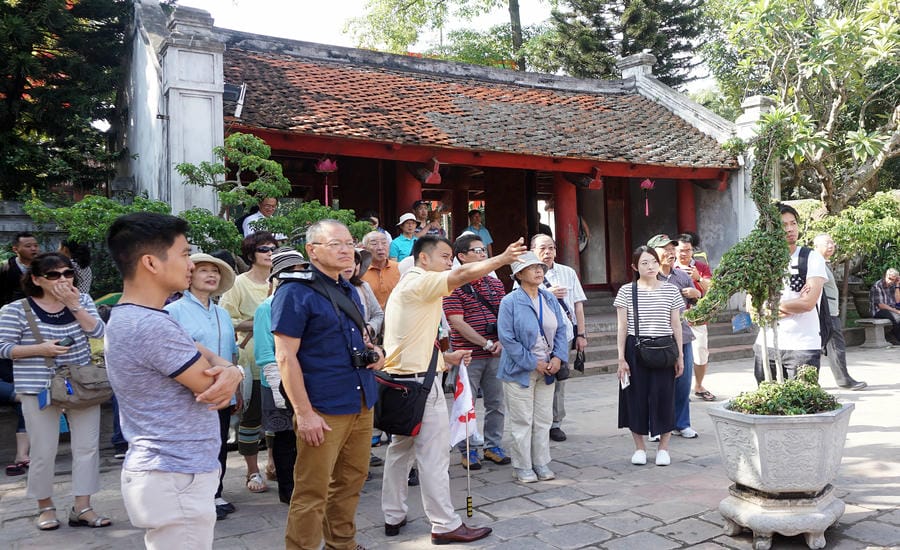
The Vice Chairman of the Hanoi Tourism Association also said that Hanoi has some nightlife products that have made a mark such as: Hoa Lo Prison Tour, Thang Long Imperial Citadel, Temple of Literature - Quoc Tu Giam or the "Essence of the North" program. These are models that show that nightlife tourism can completely exploit cultural depth to create attraction. However, products are still scattered, not large in scale and have not created enough experiences to keep tourists after 6 pm.
Besides product planning, Mr. Dat believes that the city needs to proactively attract capable brands to participate from the early stages to create attractiveness for new spaces, instead of letting business activities develop spontaneously.
If developed spontaneously, the quality will not be uniform. Many places are initially crowded with customers, but then revenue decreases, business households gradually withdraw, causing the whole area to lose its appeal," Mr. Dat analyzed.
From a long-term perspective, Mr. Dat assessed that the area on both sides of the Red River is a space with great potential thanks to its large land fund and favorable conditions for synchronous planning.
If Hanoi can form a large-scale night economy along both sides of the Red River, it will not only solve the overload problem of the Old Quarter but also create a tourism, commercial and entertainment complex capable of competing with many cities in the region," Mr. Dat assessed.
According to experts, developing the night economy is not about creating many more similar entertainment spots, but about forming destinations with identity, capable of complementing each other and strong enough to keep tourists. Then, the length of stay, spending level and value that tourism brings to the night economy will have the opportunity for sustainable growth.


