
Lao Cai province has always been proud of its diverse market culture. Monday goes to Ban Phiet market, Tuesday strolls to Coc Ly, Wednesday stops by Cao Son, Thursday goes to Lung Khau Nhin, Friday goes down to Lung Phinh, Saturday goes to Can Cau and Sunday is bustling with Bac Ha market fair.
Those are the 7 most unique markets, besides a dozen other markets that open on the same day such as Sa Pa market, Chau market, Pha Long market... creating a "marketer's life" culture in this land. Market culture has created an attraction for Lao Cai tourism, besides the majestic mountains and forests, and poetic rice flowers.
But in the December days, the most attractive market fair must mention Can Cau, which only meets on Saturdays every week. The market has fairs, the rice has seasons. It can be said that the timing of the time of mountain people is calculated according to the timing of the market fair.
They don't need to know what time it is now, what month, what year, but only care about a time milestone: Today there is Can Cau market fair. So, people from all over the commune and outside the province excitedly flock to the market in a vibrant atmosphere like a festival.
Saying people go to the market like going to a festival is not wrong at all, because the market is the festival of the people in the highlands. In the lowlands, the market is just a place for daily buying and selling, while here, the market is a space for cultural exchange, trade, love affairs, dating, brothers and friends.
Up here, each ethnic group usually resides in a separate place, so the Can Cau market fair is the traditional and basic connection point of the H'Mong people, the Dao people, the Giay people, the Phu La people, the Nung people, and now even the Kinh people from the lowlands who come up to settle down or just stop for a moment.
Therefore, Can Cau market fair is very crowded, very noisy and very fun like a bustling festival in the lowlands. That festival spirit originated from when this place was still desolate and isolated to the flat world today.
Therefore, people are anxiously waiting and eager to go to Can Cau market fair on Saturday morning. From early morning, people from all over flock to the market. They go in groups of dozens of people, in groups of a few people, paired up to travel or alone.
A few years ago, when Can Cau buffalo market was still operating, people had to lead buffaloes down to the market at midnight from Si Ma Cai, Bac Ha, Muong Khuong, and even from Ha Giang. When arriving at the market, it was sometimes only 3-4 am, and the buffaloes had to be tied to temporary shelters to wait for the market meeting time.
Only then can the market session be held in time, because Can Cau market only opens from early morning until late noon, after 12 pm the market is closed for people to go home before dark. Now, the buffalo market moves to Bac Ha market session on Sunday, so the scene of people and buffaloes walking in the night mist is no longer there.
The sound of horses galloping on the stone road, the sound of buffaloes and cows chirping in the mist, the sharp horn of cars, especially the whispering laughter of people going down to the market make the quiet space suddenly burst into noise and excitement. The voice of the market is the noisy sound, the louder it is, the more joyful and lively it becomes.
Sound is probably the most popular item of the market. People want to talk, people want to hear, people want to look at each other to talk, to laugh. Even if that sound is a price gouging, a bargaining, a praise or criticism of goods, it gives marketgoers the feeling of living among the people, being connected with the community.
Can Cau market is divided into many small areas, each area selling a separate item. The most vivid are agricultural products of the highland people brought to the market. All are fresh, brilliantly colored, fragrant, creating a vivid picture.
This place is red with clusters of chili peppers or dark red with dried chili vines; that place is green with peas, dark green with mountain cabbage; another place is brilliantly purple with piles of smooth, hot eggplant. Then comes the aroma of mountain ginger, black turmeric, shovel seeds, mắc khén seeds, dổi seeds, pickled scallions, onions, garlic... passionate throughout the space.
But the most beautiful and attractive are the rows of five-color sticky rice selling green, red, purple, yellow, white and the banh day stoves of the H'Mong people emitting fragrant smoke next to baskets of red pho specialties of this region, yellow corn pho. Five-color sticky rice and grilled banh day are both wrapped in lush green forest banana leaves, becoming precious market gifts.
These products are not sold by weight but by bunches, bundles, bundles, bulbs, bulbs. That is the business style of sellers here, they sell what they grow and raise, and then become customers of others, and sometimes that person is the one who just bought their goods.
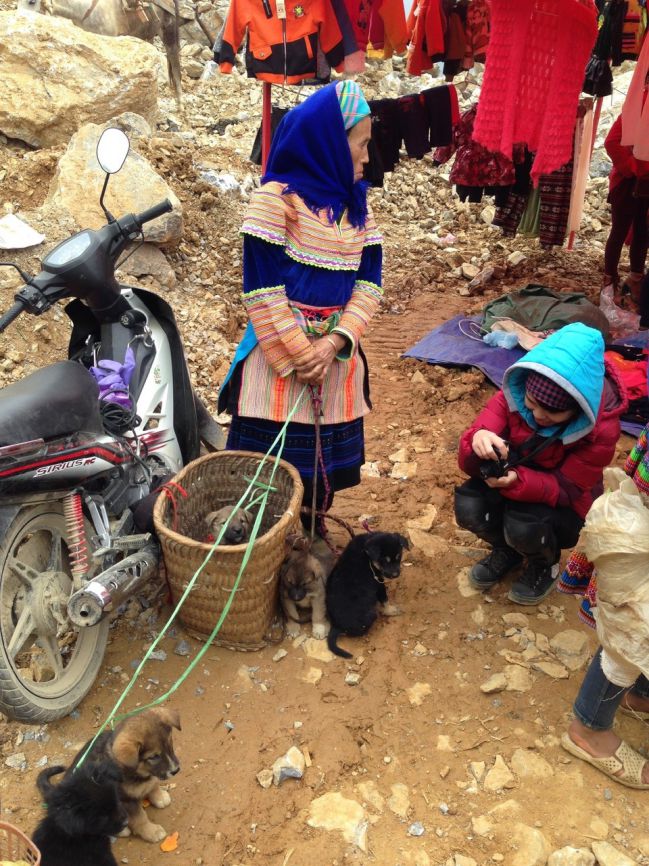
People huddled in bundles of vegetables, carrying pairs of black pigs under their armpits, carrying groups of chickens containing a few large and small black chickens, or leading dogs to sell at the market, which is a familiar scene. After bargaining, the money given is vegetables transferred to baskets, pigs transferred to armpits, dogs transferred to strings, and that's the end of the original transaction.
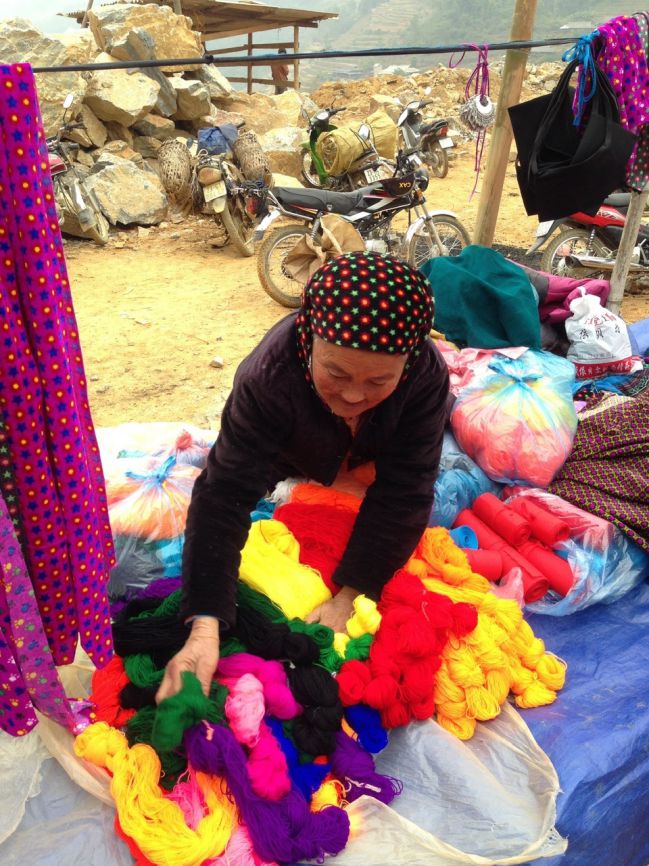
However, there are also professional sellers, such as the brocade selling area. This is the most colorful space of Can Cau market, located on the edge of the market, with stalls. Square, rectangular brocade panels rowing meters long hanging next to finely embroidered brocade skirts create an unintentional and intentional artistic installation space.
The brocade sellers often smile, not to invite customers to buy but to show off their sparkling gold teeth in their mouths. In the old days, at Can Cau market, there were also people who worked as gold teeth sealers, but recently they have disappeared, probably because gold prices have increased.
The busiest market is always the culinary area. Pho, vermicelli, porridge, thang co, men men corn wine are everywhere in rows. People go to the market sometimes to buy nothing but only eat a bowl of red pho with pork or a bowl of thang co with men men. Some people eat quickly to worry about buying and selling, but most of them sit next to each other drinking all afternoon.
Because it takes a whole week to have this day to meet and confide in each other, tell stories. Over a cup of corn wine, old stories reappear, making people forever miss the market fair.


