
Night falls very slowly in the small village of Chieng Di (Van Ho commune, Son La province). The moon calendar just passed the Summer solstice, marking the longest day of the year and also the hottest time of summer. However, next to the stilt houses, people still have to light fires, wear windbreakers to sit and enjoy a cool summer night.
Not only Chieng Di enjoys a cool summer, but almost the entire Moc Chau grasslands are also stretching themselves in a cool climate but still radiant with golden sunshine. Looking up is the blue sky, white clouds, looking down is the sweet taste of summer fruits with ripe plums and peaches.
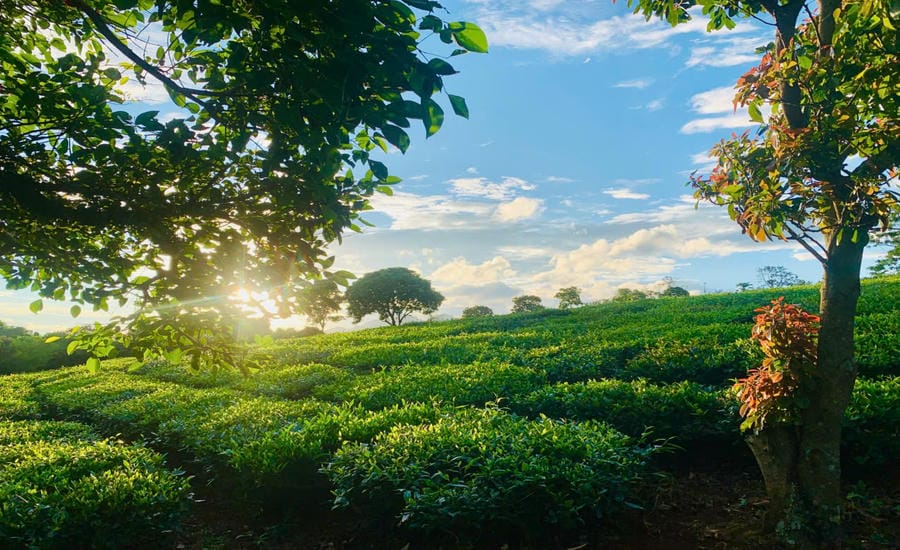
In the early mornings, it seems that the entire steppe is covered in a thin layer of white veil, covering green tea hills, lying next to each other like folded bowls and fields of elephant grass for dairy cow, goat, and livestock breeding. That veil is water vapor condensed in the night by the chilly cold.
Even at the hottest time in the middle of the day, the temperature of this grassland area is still very pleasant, only about 29 degrees Celsius. The shiny standing sun can sting thin skins, but everywhere are gentle cool breezes, making the heat suddenly disappear.
Just standing in the canopy, or having clouds flying across the sun, the temperature immediately changes from hot to cool. Because the air here is not heated due to weather phenomena such as heat radiation, heat islands or concretization, and the density of using air conditioners is too high.
They are cooled by the area of plants almost covering the steppe, by the high humidity stored in the soil and the winds blowing in from the old forest. That is the air that has been cooled and circulated by nature and the wind that is not a curb in the city.
It is easy to understand why Moc Chau prairie and suburban communes like Van Ho are becoming ideal hot spots for people to escape heat and avoid heat storms. The distance from Northern cities like Hanoi up here is not too far, only from 150km to 180km, convenient roads have made streams of people "disappearing from the weather" flock here, not only on weekends but also all day of the week.
The endless green of the tea hills has soothed the heat in the tourists' bodies. From dawn to dusk, floating among the tea beds are not farm workers but tourists. They come here to hunt clouds, watch the sunrise, sunbathe golden sunshine and admire the sunset scenery.
Eyes that have turned pale because of the scorching sun and the stuffy heat in urban areas are hungry for green patches. And in this prairie, the green of trees and leaves is vast because of the orientation of developing high-quality agriculture, providing vegetables, tubers, and fruits for the whole country, in addition to traditional agriculture and forestry.
4 pm, a time considered harsh for workers in the city due to the increase in heat generation on the road surface.But on the che mâm xôi hills here, people sit relaxed amidst the lush green of the tea beds as high as people's hips.
They enjoy the most beautiful moment of the day, with white clouds preparing to be dyed pink to fly back to surround the mountain peak.The crescent moon has also appeared, like a boat floating in the deep blue ocean.And the sun is still generously spreading the warm and smooth sunshine of the sunset.
Climate characteristics
Moc Chau Steppe, more than 80km2 wide, is covered by endless green tea hills stretching endlessly. Moc Chau is located at an average altitude of 1,050m above sea level, so there is always cool breeze. Moc Chau is always cooler by a few 3-4 degrees Celsius compared to other areas. Van Ho commune is considered the coolest point of Moc Chau plateau due to the height difference.
Tea plants enrich and beautify the steppe
Moc Chau currently has more than 2,100ha of tea cultivation, which is a long-term industrial crop with high yields. In addition to economic value, tea trees also create landscapes for the prairie with tea hills winding like a green carpet, attracting many tourists. This is a tourism strength of Moc Chau to contribute to promoting the local economy, increasing income for people and widely promoting the natural beauty of this place.


