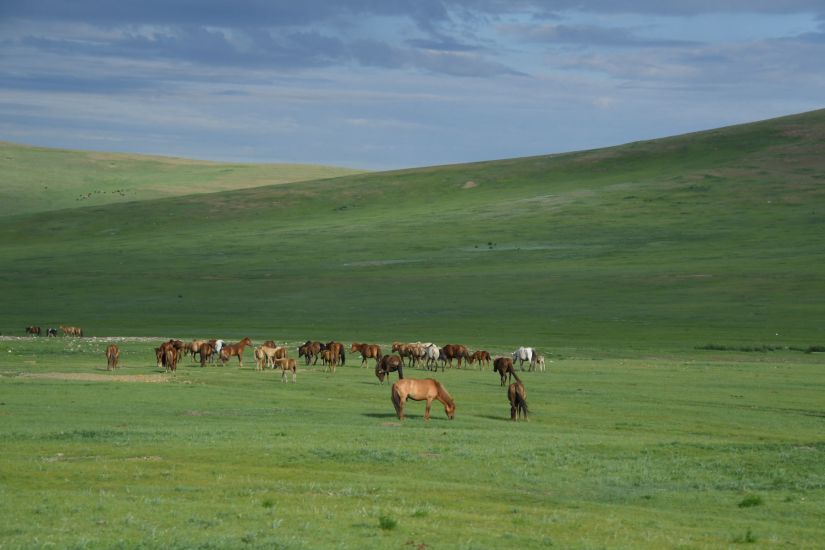
Empire built on horseback
In the article "Following the footsteps of Genghis Khan's horse on the Mongolian steppes", author Edward Wong of the New York Times once expressed surprise when he realized that Mongolian horses were much shorter and smaller than horses in western America, especially when recalling the legends associated with Mongolian cavalry. "Through historical records, I learned that the relatively small size of this horse gave the Mongols a tactical advantage that was hard to compare to Genghis Khan's time: Warriors could maneuver up and down horses in combat" - Edward Wong pointed out.
The Mongol Horse: The Master of the Prairie" by author Jonathan DeHart in The Diplomat also points out that the particularly important role of horses has never changed despite the profound changes taking place in Mongolia. Jonathan DeHart quoted an article titled "The Mongol Horse - small but extraordinary", which describes this horse breed: "Small, strong, brave, wild and incredibly resilient". In fact, the Mongol horse has fully adapted to life in the prairie, surviving in winter temperatures that can drop to minus 40 degrees Celsius and summer temperatures up to over 30 degrees Celsius. They are also famous for their extraordinary endurance, capable of running up to 40km per day.
The Mongols have a saying: "A Mongol without a horse is like a bird without wings". Genghis Khan is also said to have said: "From the back of a horse you can conquer the whole world" and that is exactly what he and the Mongol army did, when riding their home horse to conquer half a world to build a legendary empire.
Many scholars once commented that without horses, there would be no Mongol empire. In 1224, Genghis Khan established a mail station line, a vital network in managing and expanding the Mongol empire. Writing about this mail station line, author Ashleigh N. DeLuca of National Geographic, said that during the peak period, a letter could be delivered from Kharkhorin in the east to the Caspian coast on the western edge of the empire, a distance of about 6,800km, in just 2 weeks, equivalent to an average of about 480km per day. This achievement is closely linked to the continuous horse replacement of the mail station system.
Horses are the most mobile and irreplaceable military equipment of Mongolian cavalry, and also a source of food. Cows give from 8.5-13.7 liters of milk per day, enough to feed many people. Each cavalry usually owns more than one horse; both to change when marching and as "mobile food warehouses". In harsh combat situations, when mobility is a vital factor, cavalry can gently cut veins in the horse's neck, drink a little blood to supplement nutrition, and then apply herbs they carry onto the animal's wounds, helping both humans and horses survive.
Many Mongol cavalrymen possessed up to 5 or 6 warhorses. When attacking or besieging the city, they rode one, tying bamboo branches to the tail of the others. When galloping, branches dragged on the ground creating dust, making the enemy mistakenly believe that a giant army was rushing in. This is a psychological tactic used by Mongol cavalrymen to intimidate the enemy.
From labor to spiritual symbols
Today, Mongolian horses still belong to the same breed as horses that followed Genghis Khan to conquer. "Horses are everywhere, as common as cows on farms in the West. There is only one horse breed throughout Mongolia. Just go about 20km from any town and you can see horses everywhere" - Ms. Shatra Galbadrah, a resident of Ulaanbaatar, who is the Mongolian liaison for the 1,000km long Mongol Derby inspired by Genghis Khan's mail station, shared with The Diplomat.
From birth to death, horses have been deeply attached and inseparable from the life of Mongolians.
All parts of the horse's body are beneficial: Horse manure can be dried as fuel; horse fur is used to weave ropes; horse skin is used for boots; horse bones can be processed into canes; and horse meat is used as food. Koumiss - fermented mare milk - is an alcoholic drink favored by breeders.
Each ger - nomadic tent style - has ropes braided from the tail hair of the horses most loved by their owners. Across the countryside, there are also scattered rock shelters called ovoo, where the villagers place the tails or skulls of horses particularly attached to them to commemorate and show gratitude.
According to Katy Willings, head of the race organizing committee and former Mongolia Derby racer, despite their affection for horses, Mongolians still see this animal differently from Westerners. "Horses are not pets. They are not for going to school or for entertainment. They are working animals, part of the family and a great symbol of the wealth of each family," she said.
Like land for farmers or goods for merchants, many Mongolian farmers often proudly say: "We are grassland residents, our most precious asset is horses!".
Loyalty, strong community awareness
Horses are deeply ingrained in Mongolian cultural life. There are many stories passed down about the close relationship between humans and horses, as well as the absolute loyalty of horses. According to author Li Yulin, Sun Xiaoyan in a research article on Mongolian horses published on asianstudies. org, in the yard of the Guangzhou Museum (Guangdong province, China) there is a stone stele engraved with the words "Painted of loyal horses". The owner of this Mongolian horse is Chen Liansheng (1777-1841), former Governor of Guangdong province. After Chen Liansheng died in battle, the horse fell into the hands of an opposing leader but was not tamed. Every time it was released, it would gallop north. When he heard someone express their intention to take it back to the Northern Prairie, the horse followed that person, bowed its head and waved its tail. A few months later, the horse died. To commemorate the loyalty and steadfast will of this horse, local people erected a stone stele at the place where the horse breathed his last.
The respect that Mongolians have for horses also affects the law. Through many generations, the great khans have issued decrees prohibiting the export of horses. In Mongolian customary law, horse theft is considered a serious crime, which can be cut across the waist.
Due to its widespread use in daily life as well as in entertainment activities such as hunting or horse racing, the respect for horses in Mongolian culture transcends all social strata. According to traditional beliefs, when a Mongolian herder dies and returns to his motherland, his beloved horses will be released back to the prairie. Therefore, when wandering in the Mongolian prairie, sometimes people encounter a lonely horse standing still in the meadow, hissing loudly, looking up at the sky and then quietly leaving, as if still looking for the shadow of its old owner.
Mongolian horses live in herds with strong community awareness. In the steppe, thousands of horses can be released together and the owner only gathers the herd when really necessary. Farmers once recounted that when chased by a pack of wolves, the leading male horse leads the whole herd away from danger, some female horses are ready to stop, to distract and create opportunities for the herd to escape.