
In recent years, the irrigation system has played a pivotal role in agricultural development, natural disaster prevention and climate change response. However, in the context of increasingly harsh climate, increasing demand for water, management and operation need to shift to modernity, flexibility, strong application of science - technology and digital transformation.
According to Decision 3978/QD-BNNMT, the Ministry of Agriculture and Environment deploys the Plan for the development of the Vietnam Irrigation Information System (VN-WIS) - a shared data platform, integrating modern technologies such as AI, machine Learning, IoT, Big Data, GIS and Digital Twin. The system helps improve forecasting and early warning capacity, optimize operation and management of irrigation works in real time.
On October 17, at the forum "Science and technology, digital transformation in management and operation of irrigation works implemented according to Resolution 57", Mr. Nguyen Manh Hung - Head of the Department of Management and Operation and Irrigation (Department of Management and Construction of Irrigation Works), said that digital transformation is a key driving force to help the irrigation industry develop sustainably. Unified and real-time data connection will help localities proactively plan irrigation, reduce the risk of drought and salinity and improve water efficiency.
The irrigation industry is aiming to build a digital ecosystem "correct - sufficient - clean - living - unified - shared", while promoting public-private cooperation, mobilizing businesses, research institutes and international organizations to participate in research, technology transfer, digital skills training. This is the foundation for building a modern, transparent and sustainable irrigation industry in the digital age.
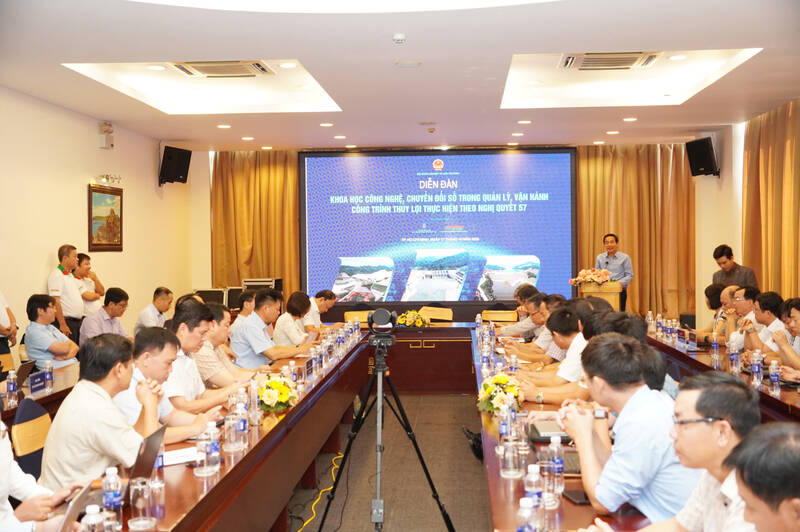
Dr. Le Ngoc Hieu - Southern Institute of Water Resources Research, assessed that the application of warning data on digital platforms has helped authorities at both levels proactively prevent saline intrusion and arrange a reasonable crop. The Institute is developing an AI model that predicts rain, floods and salinity with high accuracy, serving the Mekong Delta region to flexibly adapt to climate change.
Since 2005, the Ho Chi Minh City irrigation industry has entered a period of strong application of modern science and technology, notably the construction and expansion of the SCADA system.
Mr. Nguyen Van Dam - Director of Ho Chi Minh City Irrigation Services Management Company Limited said that SCADA allows monitoring and operation of intuitive irrigation, saves costs and increases labor productivity. The system is directly connected to the city's database, helping to build an operating scenario, early warnings, limiting damage caused by high tides and flooding.


