
On the morning of August 25, the VII National Congress of the Vietnam Cooperative Alliance (HTX), term 2026-2031, opened in Hanoi with the participation of nearly 600 delegates.
Attending the Congress were Member of the Party Central Committee, Vice Chairman of the National Assembly Nguyen Hong Dien; Prof. Dr. Nguyen Thi Doan, former Vice President, Chairman of the Vietnam Association for Promoting Education; Ms. Ha Thi Nga, Member of the Party Central Committee, Vice President - Secretary General of the Central Committee of the Vietnam Fatherland Front and representatives of central departments, ministries, and sectors.
The Congress focused on comprehensively assessing the results of the 2020-2025 term, frankly recognizing the limitations and causes, and setting out directions and tasks for the 2026-2031 term.
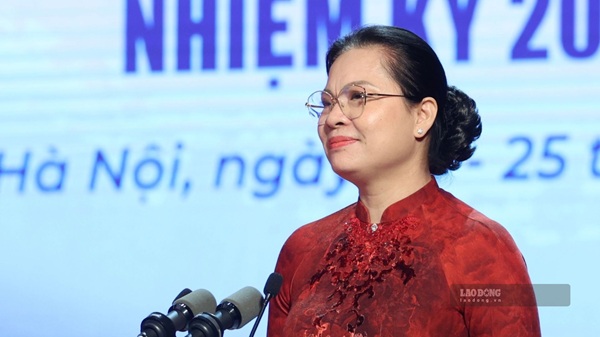
Speaking at the Congress, Ms. Ha Thi Nga said that this is an important political event for the Cooperative Alliance system and the collective economic sector nationwide.
In the past term, the collective economic sector operated in many difficult and challenging conditions. However, with the leadership and direction of the Party, the management and support of the State, and the efforts of the Cooperative Alliance system, cooperatives, cooperative unions, and cooperative groups, the collective economic sector has achieved many positive results.
By the end of 2025, the whole country has more than 35,000 cooperatives, 164 cooperative unions and nearly 66,000 cooperative groups, attracting nearly 7.1 million members, creating regular jobs for about 2 million workers. More than 78% of cooperatives are ranked as good and excellent.
Many cooperatives have proactively innovated production methods, applied science and technology, digital transformation, developed OCOP products, circular economy and adapted to climate change. The collective economy sector is increasingly playing a role in production linkage, job creation, income improvement and social security assurance.
However, the scale of many cooperatives is still small; limited financial capacity, management and competitiveness. Access to land, credit capital, science and technology, markets and support services is still difficult. Digital transformation and green transformation in many cooperatives have not met the requirements.
To overcome these limitations, Ms. Ha Thi Nga proposed that the Vietnam Cooperative Alliance in the new term focus on strongly shifting from developing quantity to improving the quality and efficiency of operations, taking members as the center and members' benefits as a measure.
Continue to remove bottlenecks in institutions and policies, bring the 2023 Cooperative Law into life; proactively gather and reflect the difficulties of cooperatives in accessing land, capital, science and technology, logistics, insurance and markets.
In addition, it is necessary to promote the application of science, technology, digital transformation and green transformation; promote value chain linkages, improve product value and the competitiveness of cooperatives.
Another important task is to build a new generation of cooperative management team with capacity and enthusiasm; attract young intellectuals, youth, and good farmers in production and business to participate in starting businesses, managing and building cooperatives.
Ms. Ha Thi Nga requested that immediately after the Congress, the Executive Committee of the Vietnam Cooperative Alliance term VII urgently concretize the Resolution into a full-term Action Program, with the requirements of clear people, clear tasks, clear progress, clear responsibilities and clear results.
The Vietnam Fatherland Front and member organizations will continue to coordinate and support the Vietnam Cooperative Alliance to promote its representative role, gather and mobilize people to participate in collective economic development, while contributing to perfecting policies and laws and ensuring the legitimate rights and interests of members.
With the spirit of solidarity, innovation and high determination, the Vietnam Cooperative Alliance for the 2026-2031 term is expected to create a stronger, more substantial and effective development step, contributing to improving people's lives and promoting sustainable socio-economic development.


