
According to the monitoring system of the Department of Environment (Ministry of Agriculture and Environment), at 7:00 a.m. this morning, at the measuring station at the gate of Hanoi University of Science and Technology on Giai Phong Street, the AQI was at 172. By 8:00 a.m., AQI increased to 175 (bad) - normal people began to have health effects, sensitive people may have health problems.
At station 556 Nguyen Van Cu at 7:00 a.m. this morning, the AQI was 161. At 8:00 a.m., the AQI was recorded to increase to 167 (bad).
Nhan Chinh - Khuat Duy Tien Park measuring station has better air quality but is still at a poor level. At 7:00 a.m., the AQI was 100. At 8am, AQI was 103 - for sensitive people with health problems, for normal people with little impact.
According to the IQAir Air Air Pollution Index Application at 8:00 a.m. this morning, Hanoi is the 7th most polluted city in the world with an AQI of 191 - a red threshold, unhealthy for health.
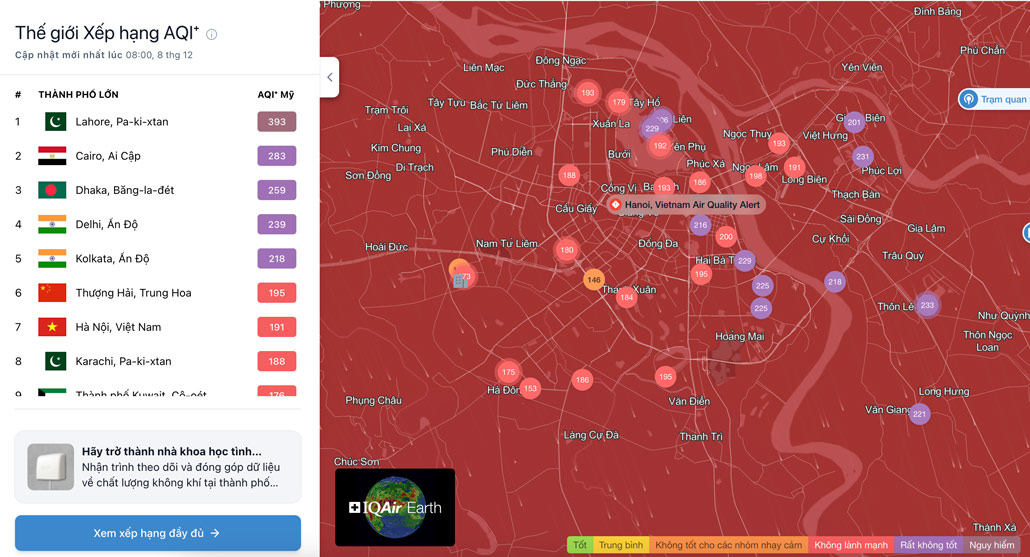
In particular, many measuring points in Hanoi also have air quality indexes at the purple threshold - very bad for health. Quang Khanh station continues to have a high air pollution index, AQI 239; Lo Duc AQI 229; Time City AQI 225.
To proactively take health protection measures, the health sector recommends that people take the following measures:
Limit going out during times of heavy pollution, especially early morning and late night.
Wearing a standard mask that can filter PM2.5 fine dust when traveling on the road.
Close the door, use an air purifier if possible.
Keep your nose and throat clean, drink enough water, increase nutrition to increase resistance.
People with respiratory and cardiovascular diseases need to comply with treatment, monitor symptoms and go to medical facilities when there are unusual signs.
Monitor daily air quality through applications to adjust living and working schedules accordingly.
Experts warn that PM2.5 fine dust can penetrate deep into the lungs, enter the blood and cause many dangerous diseases such as respiratory infections, stroke, cardiovascular disease, etc.
Therefore, the proactiveness of each citizen contributes significantly to minimizing the impact of air pollution on public health.


