Accordingly, prominent new publications on artificial intelligence, science and modern psychology include: "History of wisdom - From sea worms to ChatGPT", "Living peacefully in the AI era" and "Artificial intelligence under the lens of psychology".
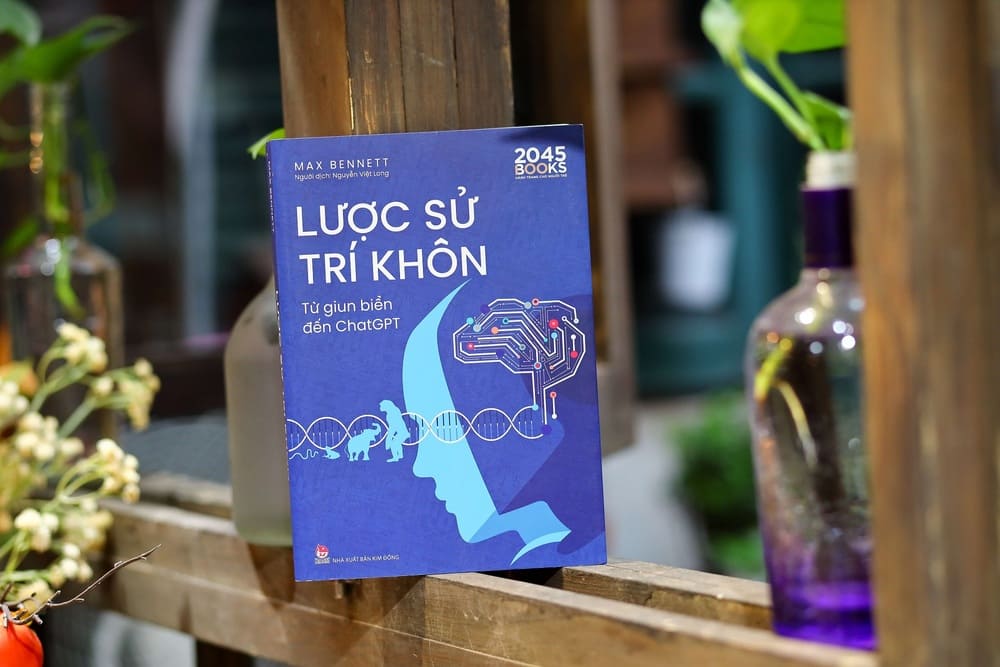
Accordingly, "Lược sử trí khôn - Từ giun biển đến ChatGPT" is a highly suggestive publication, taking readers on a journey to explore intelligence from primitive life forms to technological achievements that are changing the world today.
The book opens with an seemingly simple question: Why can artificial intelligence (AI) defeat a chess grandmaster, but is it clumsy with everyday things like putting dishes in a dishwasher? From that question, author Max Bennett leads readers into a journey to understand the nature of intelligence. Instead of focusing on algorithms or technology, the book turns back to the origin of intelligence - the human brain.
In recent years, AI has become one of the most mentioned topics in education, media, creative labor and daily life. New tools are constantly appearing, bringing many opportunities but also creating no small worries: Will humans be replaced, will individual abilities become outdated, will young people be too dependent on machines?
Not avoiding those concerns, "Living Relaxed in the AI Era" chooses a calm, balanced and proactive perspective. The book suggests 48 practical ideas to live with AI instead of chasing all technology trends, focusing on understanding the nature, capabilities and limits of technology to use AI as a support tool.
From that spirit, the book can be seen as a "direction map" for young readers in the digital age: Not panicking before change, not divinizing technology, nor turning away from the advances that are opening up many new possibilities.

In addition to publications directly discussing AI, the book series "Upon the Lens of Psychology" expands the approach to modern psychological, behavioral and social issues. In which, the book title stands out when placing AI in relation to the mind, emotions and perception of humans.
The book raises many issues close to young readers: Why are people easily attracted to AI tools? If AI provides incorrect data, who is responsible? What will happen to privacy and human future as AI increasingly penetrates deeper into the working world?
Instead of giving simple answers, "Artificial Intelligence under the Lens of Psychology" opens up a vast space of thought where science, philosophy and psychology intersect. Analyzed from an interdisciplinary perspective, the book frankly points out the current limitations and risks of this technology, helping readers realize that the capacity of human intelligence lies not only in the speed of information processing, but also includes intuition, emotions, memories, life experiences, empathy, ethical consciousness and the ability to understand complex contexts.
Through questions about responsibility, privacy, labor and human decision-making ability, the book helps young readers access AI from a psychological and social perspective, providing a solid foundation of understanding to avoid being swept away by technology.
The above 3 publications belong to the new book brand 2045 Books of Kim Dong Publishing House. This is a book series equipping young readers with foundational knowledge, critical thinking and adaptability in the context of science, technology, innovation and digital transformation that are deeply impacting all aspects of social life.
With the slogan "Baggage for young people", 2045 Books promises to bring books rich in modern scientific knowledge, equipping comprehensive thinking for the young generation to confidently master the future.