According to statistics from the Ministry of Health, currently about 15–40% of Vietnam's population, equivalent to 14–36 million people, suffer from refractive errors, mainly nearsightedness. The incidence rate in urban areas (30–40%) is nearly double that in rural areas (15–20%). Notably, more than 50% of children in Hanoi and Ho Chi Minh City suffer from refractive errors; while the rate of nearsightedness in students of some major universities has exceeded 70%, showing an increasingly clear trend of rejuvenation.
Faced with alarming reality, the demand for treatment and surgery for refractive errors in Vietnam is growing strongly, especially among young people. Not only stopping at the desire to improve vision, convenience, aesthetics and improve the quality of life in the modern pace of life are increasingly concerned.
At the SMILE Pro Vision ID refractive error surgery technology transfer ceremony held on January 26, MSc.BS Dinh Thi Phuong Thuy - Executive Director of Dong Do Hospital - said: "Dong Do Hospital in coordination with Carl Zeiss Group organized the SMILE Pro Vision ID refractive error surgery technology transfer ceremony. This event marks an important step forward in the journey to improve the standard of treatment of refractive errors using modern technology".
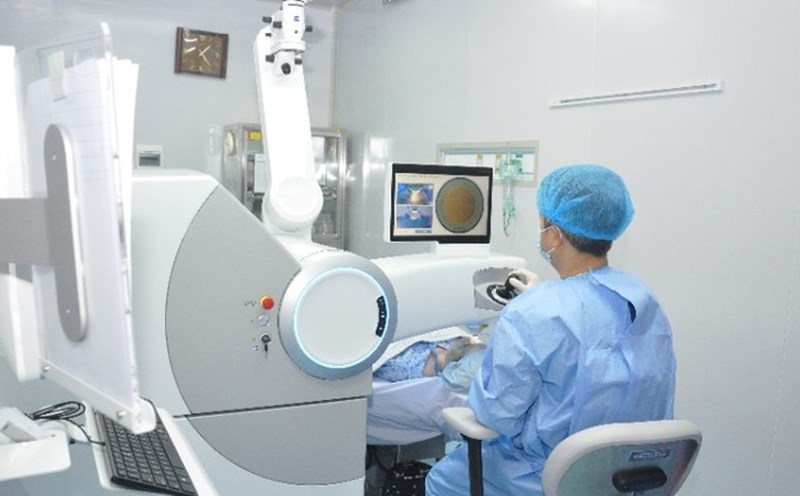
Accordingly, Dong Do Hospital officially received and put into application the VisuMax 800 surgical system - Carl Zeiss' latest generation of refractive surgery machine. The system is designed to improve accuracy, speed and safety in refractive surgery. On this platform, the hospital implements the SMILE Pro surgical method - an upgraded version of modern SMILE technique.
This is a surgical method that does not create a corneal strip, using a new generation femtosecond laser to create and remove tissue cores through a microscopic surgery. This technique helps minimize the level of invasion, preserve corneal structure, limit the risk of dry eyes after surgery and shorten vision recovery time. The laser projection time is only about 8-10 seconds for each eye, about 55% faster than the previous generation, helping patients significantly reduce feelings of stress and discomfort during the process, and quickly restore vision after surgery.
In particular, Dong Do Hospital continues to upgrade SMILE Pro technology to the specialized SMILE Pro Vision ID version, which is currently exclusively deployed at the hospital. This is considered a new step in the trend of personalizing refractive error treatment, when the entire examination process, data analysis and surgery planning are applied with artificial intelligence (AI).
On the Vision ID data platform, the AI system will analyze, simulate and support the prediction of changes in vision trends over time, thereby building an optimal surgical protocol for each eye. The goal is to aim for stable, long-lasting visual quality for patients, contributing to perfecting advanced refractive surgery techniques being applied in the world.