
Stefanos Tsitsipas often had to stop early in tournaments that were not too surprising, but at the US Open 2026, the Greek player's elimination was related to a historical event.
The 28-year-old player lost to Ben Shelton in the 4th round of the last Grand Slam of the year. This means that, for the first time since the first Wimbledon tournament in 1877, no player playing one-hand backhand has reached the men's singles semi-finals of a Grand Slam in the year.
Since the early days of Grand Slam tennis, one-handed backhand has been the dominant part of men's tennis. Initially, it was the only backhand style, then when two-handed backhand was born and became popular, it still occupy an important part.
In the 80s there were John McEnroe and Ivan Lendl; in the 90s there were Pete Sampras, Stefan Edberg and Gustavo Kuerten; and then Roger Federer in 2 glorious decades. And there are many other excellent tennis players of this school.
However, this number is gradually decreasing and very rapidly. Due to changes in technology, court surface and match speed of modern tennis, only very few players use a one-handed backhand.
The list of one-handed backhand players reaching the Slam semi-finals or better is very long in the 2010–2020 period - Stan Wawrinka, Grigor Dimitrov, Fernando Gonzalez, Tommy Haas - but in the past 5 years, only 3 players: Denis Shapovalov, Lorenzo Musetti and Stefanos Tsitsipas have maintained this streak of achievements.
Why has this shot almost disappeared from men's tennis?
I think this is partly a consequence of the two-handed backhand bringing a real advantage in modern tennis," Musetti, an Italian player who reached the semi-finals of Grand Slam tournaments in 2024 and 2025 said.
The number of players like this keeps decreasing over the decades. We are like dinosaurs that are gradually becoming extinct," Tsitsipas shared.
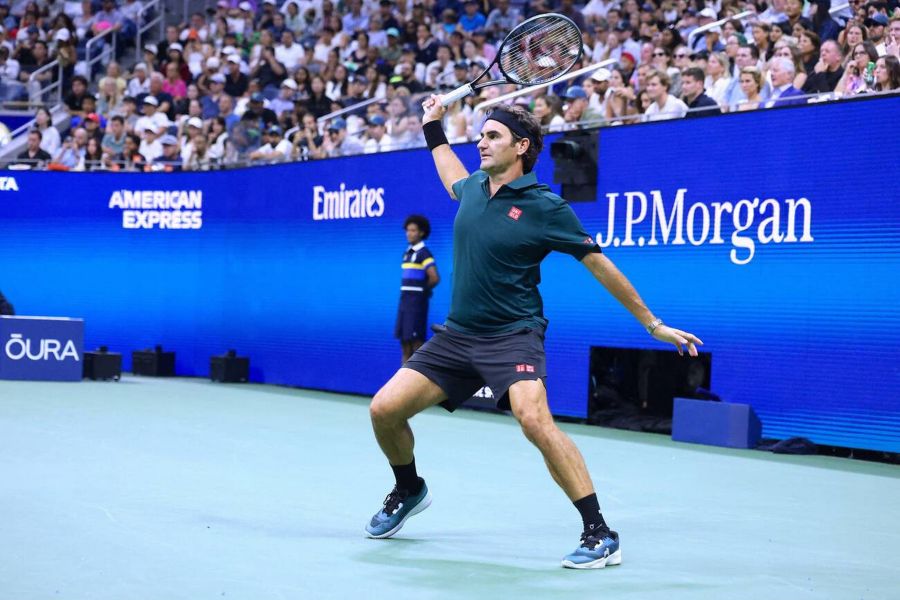
Before the tournament, Roger Federer - 20 Grand Slams and associated with a one-handed backhand throughout his two-decade career - expressed regret about the disappearance of this shot.
I still hope this is not the end," Federer said, adding that 90% of his coaches played one-handed backhand when they were young. He shared that today that is no longer true.
In the women's event, Diane Parry tested a two-handed return shot just to increase the stability in that shot, before returning to a one-handed backhand for all other shots.
Parry plays a one-handed backhand because it "suits her soul". She shared that her two-handed return serve is still in the process of completion.
When asked about this, Tsitsipas commented: "It takes handling too many things at once. Very complicated. I will never be able to do that".
Austrian tennis player Lilli Tagger possesses a powerful one-handed backhand shot, making even classical tennis scholars admire. However, she said she once had difficulty deciding to switch from two-handed backhand to one-handed backhand in her youth tournament period.
Tagger made a bet with her coach at the time: If she wins a tournament with this shot, she will be allowed to keep it. Otherwise, she must return to the old style and never mention changing techniques again.
And you won.
At first, I had to fight for it," she admitted. "But once I decided to change, honestly, I never doubted whether I made the right choice or not, because every time I felt it was my most natural hit.
Denis Shapovalov, who owns one of the most spectacular one-handed backhands, brings positive news to those who want to see this era last longer.
He believes that if a player spends his whole life controlling this shot, there will be things he does better than two-handed backhand.


