
White Horse Temple in Luoyang city, Henan province, is considered the first Buddhist temple in China.
Legend has it that on a night in the year 64, Emperor Minh of the Eastern Han Dynasty (25-220) dreamed of a gold man about 3.6m tall, with light shining brightly from the head of the grand hall where he stood.
The next morning, the emperor recounted the dream to his mandarins. A mandarin named Pho Nghi claimed that the emperor had dreamed of the Buddha, the god from the West. After that, the emperor sent Thai Am, Tan Canh and a delegation to Thien Truc (now India) to ask for Buddhist scriptures.
When they arrived in the area now belonging to Afghanistan, the delegation met 2 Indian monks, Kasyapamatanga and Dharmaranya, who were propagating Buddhism. In 67, they stacked Buddhist scriptures written in Sanskrit with a portrait of Shakyamuni painted on white felt on the back of a white horse, and then returned to Luoyang with the 2 monks.
The Emperor arranged for the monks to reside in Honglu, a place used to receive foreign envoys. The following year, when a separate living area for monks was built, the pagoda was renamed Bach Ma Pagoda to commemorate the white horse that carried Buddhist scriptures and the portrait of the Buddha to China.
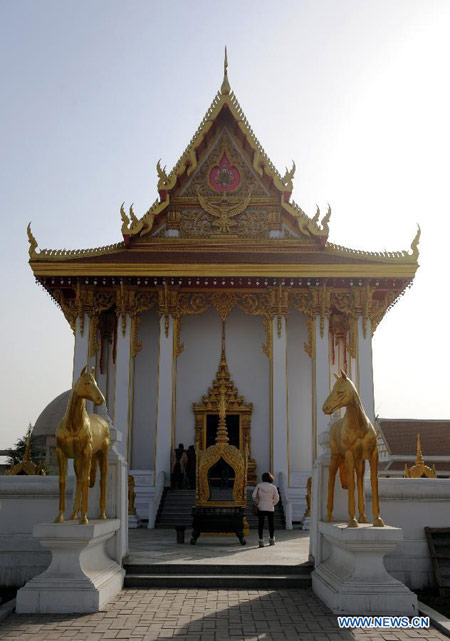
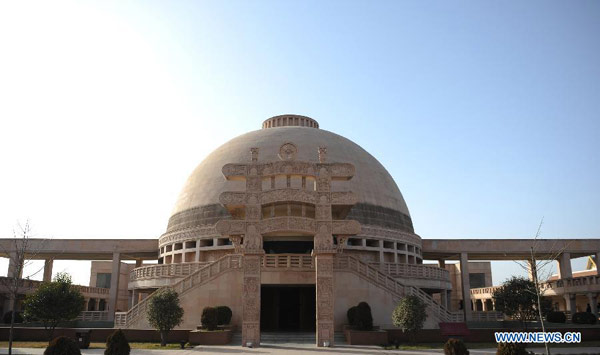
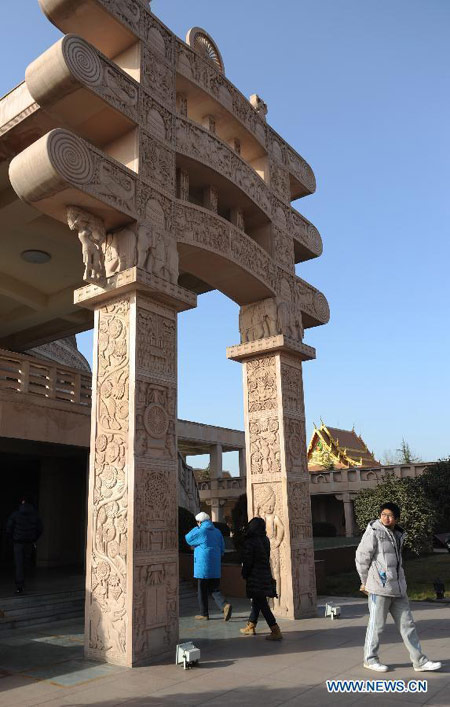
Bach Ma Pagoda has undergone many changes. The complex today has a rectangular courtyard facing south, mainly rebuilt during the Ming Dynasty (1368-1644), with an area of about 40,000m2. The entrance has a roof with 3 doors, built of blue stone, including some stone blocks from the Eastern Han Dynasty.
According to CGTN, Bach Ma Pagoda is not only the first Buddhist pagoda in China but also an early proof of international cultural exchange. After the pagoda was built, Buddhism spread to North Korea, Japan and many Southeast Asian regions.
In the 20th century, India, Thailand and Myanmar built their own shrines within the pagoda's campus. This makes Bach Ma Pagoda the only pagoda in the world that combines Chinese, Indian, Thai and Myanmar Buddhist architecture, becoming a vivid symbol of Buddhist cultural intersection.


