
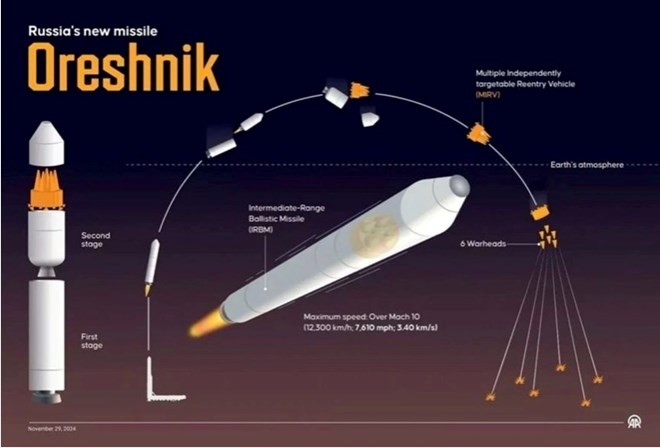
On January 12, Moscow officially announced the detailed damage assessment (BDA) report on the widespread attack that took place on January 9. The focus of the report is not only on the list of destroyed targets, but also the tough political message accompanied by the deployment of the Oreshnik strategic weapons line.
According to information from the Russian Ministry of Defense, the most important target to be wiped out this time is the Lviv State Aircraft Repair Plant located in western Ukraine. This is not an ordinary industrial facility but is likened by military experts to a vital "resuscitation station" of the Ukrainian Air Force.
In the context of Kiev receiving more and more modern fighters from the West, the Lviv factory plays the role of the only domestic facility with sufficient technical capacity and equipment to maintain and repair large-scale aircraft lines such as F-16 and MiG-29.
The fact that this facility was destroyed by the Oreshnik missile means that Ukraine's technical logistics supply chain is seriously broken. Experts believe that without a maintenance facility, expensive F-16 fighters will quickly lose combat capability due to lack of replacement parts or failure after each launch.
In addition to its role as a fighter force, this factory is also accused by Russia of being the "boss" producing long-range attack aircraft (UAVs). The report affirms that firepower from supersonic missiles has completely destroyed assembly workshops, finished product warehouses and test runway infrastructure here.
Notably, in an official statement, Russia publicly linked this attack with a sensitive political event. Moscow affirmed that this is a worthy retaliatory measure for Kiev's escalation when carrying out an attack on President Vladimir Putin's residence in the Novgorod region in December.
The use of the Oreshnik hypersonic missile - the missile line believed to be Russia's most powerful today - is seen as a warning that any direct threat to Russia's top leadership will lead to the destruction of the most valuable strategic assets on the Ukrainian side.
Also in this joint operation, Russian missile forces used Iskander complexes and Kalibr cruise missiles launched from the sea to attack the capital Kiev. Two businesses specializing in assembling UAVs and auxiliary energy systems here were also recorded to have been neutralized, in order to eliminate the enemy's ability to produce offensive vehicles.


