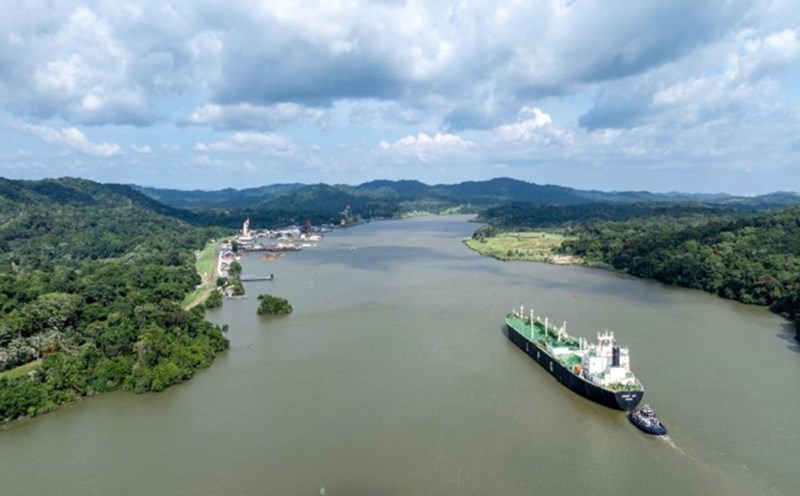
US President Donald Trump wrote on the social network Truth Social: "Without the US, these channels would not exist."
Mr. Trump emphasized that Washington has special rights to both of the world's two most important transport routes, and affirmed that he has directed Secretary of State Marco Rubio to "immediately handle and record this situation".
While the historical role of the United States in building and operating the Panama Canal after the initial failure of France is undeniable, Mr. Trump's assertion about the Suez Canal has surprised many observers.
The Suez Canal - connecting the Mediterranean Sea and the Red Sea - is a project initiated by French engineer Ferdinand de Lesseps in the 1850, completely without the participation of the United States.
After many historical ups and downs, from the control of France and the UK until Egypt's localization in 1956, the Suez Canal is now the property of Egypt.
The only connection between the US and the Suez Canal, if any, is just an international support role in the seawall campaign following the 1973 Yom Kippur war between Egypt and Israel - a modest detail compared to Mr Trump's statement.
The Suez Canal currently accounts for about 12% of total global trade, and is a vital artery connecting Europe, Asia and Africa.
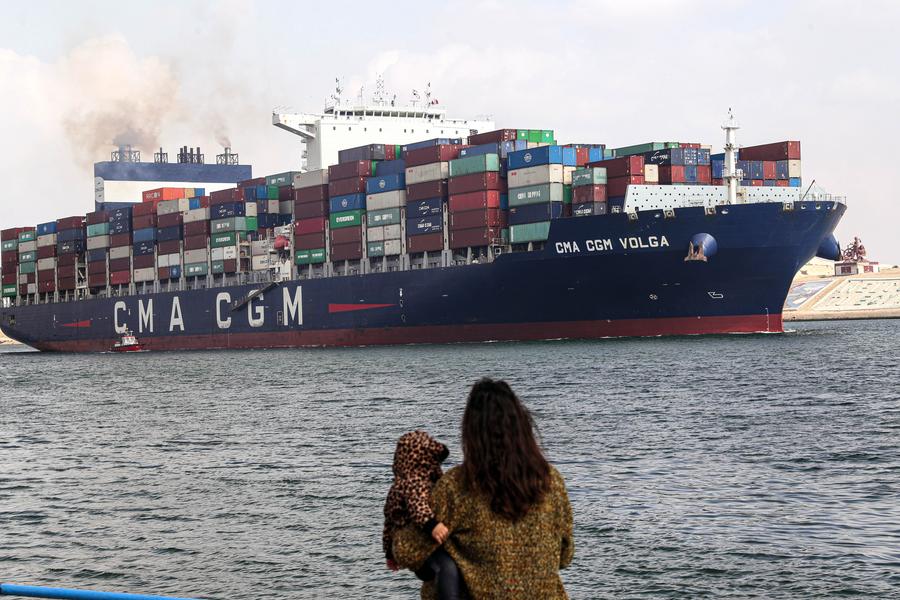
Mr Trump's ambition to "reclaim" control of strategic channels is not new. He has previously repeatedly threatened to "take back" the Panama Canal, which was built by the US in the early 20th century but has been fully transferred to Panama since 1999 under the Torrijos-Carter treaty.
Earlier this month, US Secretary of Defense Pete Hegseth announced the transfer of many warships, aircraft, and coastguards to the Panama Canal area, known as "the bold first steps to rebuild defense relations" between the two countries.