
Amidst the space filled with flashing green lights and cold machinery in Guangxi, a generation of young engineers are doing a special job: training human-shaped robots as if teaching a child to walk. They are jokingly called the people who "nurture" "iron children".
Inside the Guangxi Inner Intellectual Data Collection and Testing Center at Lieu Chau Robotics Industrial Park (Guangxi Zhuang Autonomous Region), industrial robots 1.76m tall stand under red lanterns reflected on glass walls. Under the metal "front", blue indicator lights blink continuously when the system is activated.
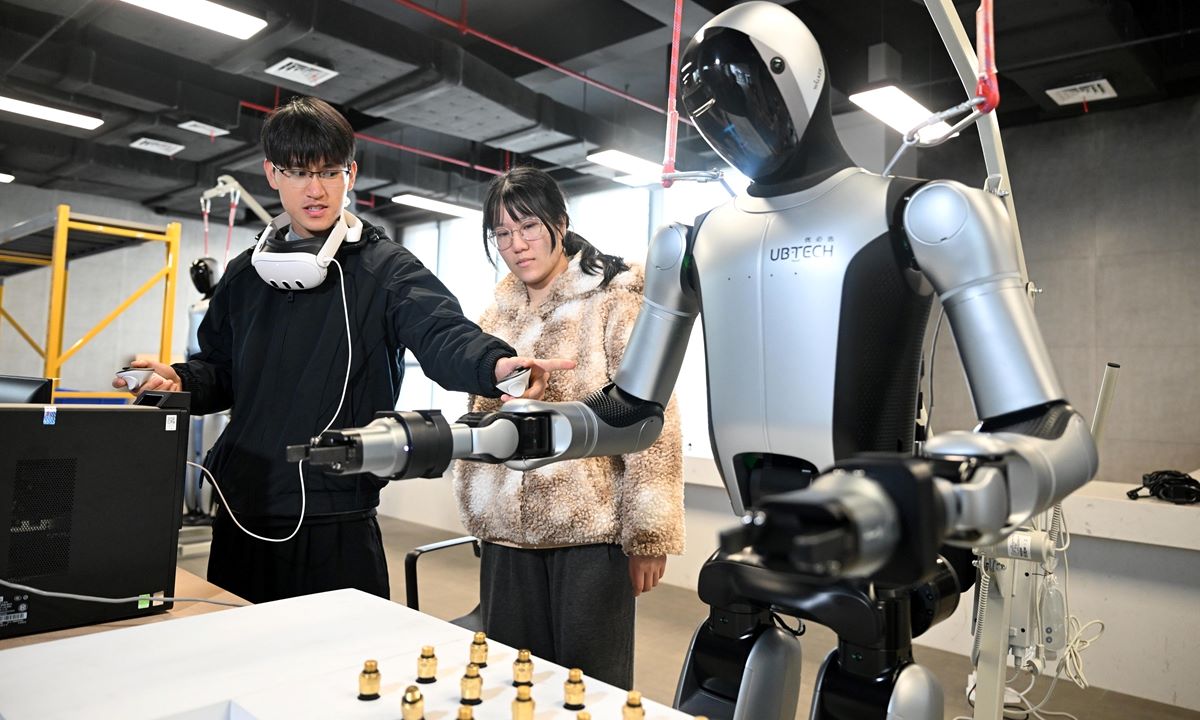
Wu Dongbo, 25 years old, stands in front of a humanoid robot, carefully controlling the lever. "Put down the F key, press D to start, then return F to reset". Hearing his colleague Tang Junyuan's command, Wu immediately operates. The robot slowly raises its head, its right arm raises and then stops, the joints shake slightly.
The enhanced learning mode still needs further tweaks" - Wu told reporters while still keeping his eyes off the dashboard.
Wu's job is to "train" robots - teach them hand force, rotation angle and convert all into operating parameters. "In essence, we make robots learn how humans use force and adjust angles, and then convert them into data," he explained.
To improve debugging skills, Wu repeatedly performed each operation until he could command absolutely accurately. According to him, for industrial robots to learn a simple movement, it takes at least 300 repetitions. When the robot's arm once again reaches up, clutching the components on the table without slipping, Wu smiles: "This time it's successful.
In another corner of the workshop, Qin Meilian, 23 years old, is refining another robot. She said these robots can participate in firefighting or operating in a narrow space.
They can carry heavy loads, are heat-resistant and are not affected by toxic gases," Qin said, while emphasizing the goal of bringing robots to the construction site as soon as possible. "They will become our reliable partners.
Training stations are arranged according to many real-world scenarios. At the sorting and distribution area, robots practice identifying and accurately arranging components. At the cargo handling station of Guangxi Automobile Group, they learn how to coordinate with machine tools. At the pre-packaging area of Luosifen specialty snail noodle soup, robots practice to pick up and quantify raw materials accurately.
These real-life situations are the biggest'assets' to train robots," Wu said.
When the sunset fell, the group of young engineers surrounded the computer, entering data to adjust parameters of the day, completion rate of movements, arising errors and remedial plans into the smart management system.
The center director, Liu Kun, stepped forward and announced the next plan: Deploying synchronous training for 120 robots, collecting 10,000 datasets per day. The young members nodded enthusiastically.
In the new industrial rhythm of southern China, Gen Z generation not only programmes or designs, but also directly "teaches" robots how to act. From initial trembling handshakes to millimeter-by-millimeter precise operations, that journey reflects the ambition to bring human-shaped robots out of the laboratory, straight to the factory and construction site.


