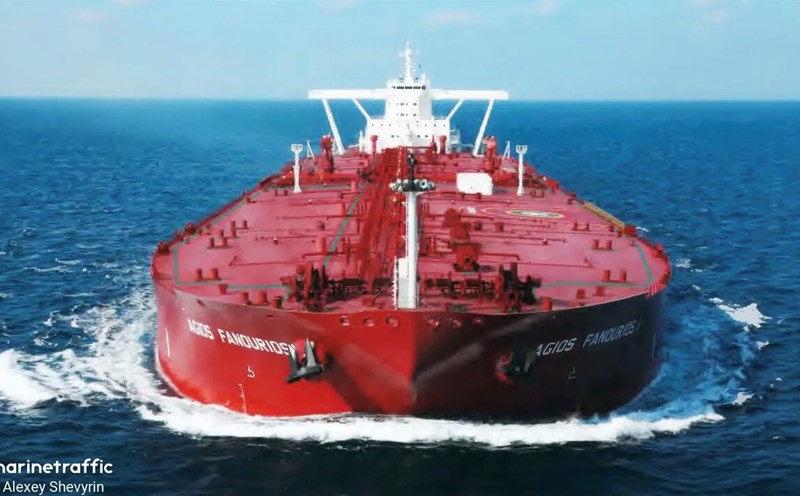
This unsanctioned crude oil from Persian Gulf producers (except Iran) is on 40 large crude oil tankers in the Gulf, according to data from Vortexa.
Crude oil in the region may be even higher if smaller oil tankers are included.
In 2025, about 15 million barrels of oil per day from this region were transported to Asia.
The oil and gas industry and maritime transport are closely monitoring signs of increased activity in the Strait of Hormuz, after the US and Iran signed a temporary agreement to resume traffic through this vital waterway route.
Crude oil tankers may be one of the first types of ships to try to pass through the Strait of Hormuz.
About 21 super oil tankers are signaling to head to Asia, of which 5 are heading to China. There are 5 other ships moving to transshipment centers off the coast of Singapore and Malaysia. At least 3 ships seemed to be moving east towards the strait at normal speed on the morning of June 19.
Crude oil flowing to Asia is a good sign for customers in this region, which is heavily dependent on Middle Eastern crude oil. During wartime, Asian refineries have to cut production and countries have to use reserves to cope with oil supply shortages.
The situation in the Strait of Hormuz is still unclear. Three Saudi Arabian super oil tankers reappeared in the Gulf of Oman on June 18, a sign that ships are starting to move. However, the maritime trade group BIMCO warned that there are still significant risks to safety and security for sea transport despite the agreement between the US and Iran allowing movement.
Although not yet clear, the possibility of the Hormuz Strait reopening makes ship owners and charterers confident enough to allow ships to pass through the strait in recent days. Ship tracking data shows that on June 18, ships carrying nearly 10 million barrels of oil appeared outside the strait or were moving through the strait, including large oil tankers owned by Saudi Arabia.
The exact number of ships and goods may change as more information is announced. Some ships have turned off signal transmitters for security reasons, while others may be affected by electronic interference. Ships may also change destinations.