
For decades, marble and limestone in desert areas have been considered "silent records" of nature, they are formed by pressure, time and erosion, almost unrelated to life. But a new discovery suggests the story may be much more complex.
In some desert areas in Namibia, Oman and Saudi Arabia, researchers have discovered extremely small tunnel systems located inside rocks. They are so thin that they can only be clearly seen when overlapping, but are arranged regularly, parallel, stretching for meters along the open rock surfaces. It is worth mentioning that these tunnels are not accidental.
At first glance, the rock surface in these areas is not unusual. But when closely observing, scientists noticed small, narrow grooves, with a width of only about half a millimeter and embedding several centimeters deep inside the rock. They run straight, parallel and maintain a fairly even distance - something rare if only caused by wind, water or natural movements.
These structures were first discovered more than 10 years ago in Namibia by the research group of Professor Cees W. Passchier (University of Johannes Gutenberg Mainz, Germany). Later, similar structures continued to be found in the Middle East, showing that this is not a single phenomenon.
Inside the tunnels is a layer of white material, different from the surrounding rocks. When analyzing, the research team found that the chemical composition of this layer is not similar to any known natural weathering form.
In particular, traces of carbon-containing compounds, along with phosphorus and sulfur - the basic components of living cells, were discovered.
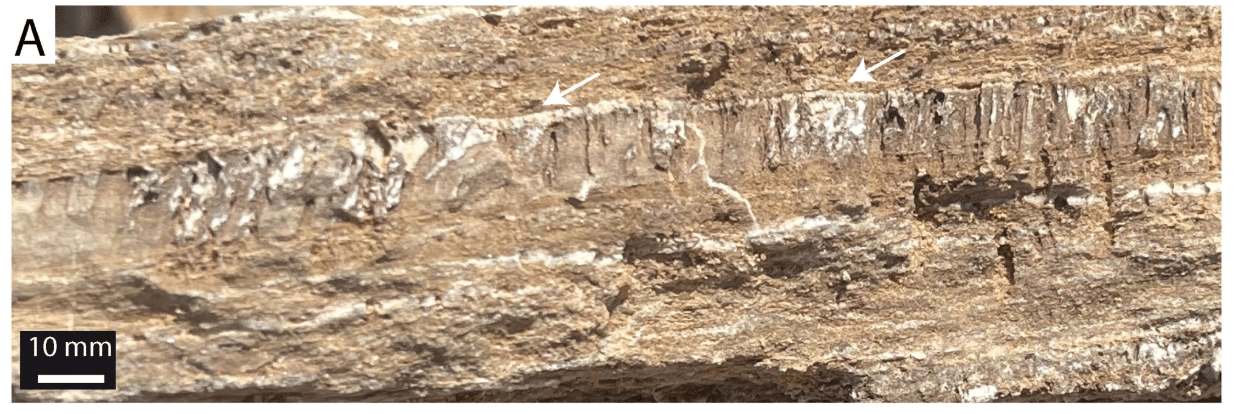
Although there is no longer DNA or protein (because these structures are too ancient and located in harsh environments), synthesizing chemical and geometric signs suggests that this is likely a "fossil" of a microscopic life form that once existed in rocks.
According to the hypothesis of the research group, these extremely small creatures may have lived right in the rock, slowly "digging" the path by secreting mineral-dissolving substances to get nutrients. The excess material is left behind, forming the white tunnels that we observe today.
What the scientific community pays special attention to is how the tunnels are arranged orderly and steadily, even continuing to run straight even though the rocks are bent or eroded later. This suggests that this is not an "improvisational" activity, but the result of an organized living organism collective.
If this hypothesis is confirmed, the discovery will be of great significance. Calcium and marble are places that store the Earth's huge amount of carbon. The ancient organisms' impact and transformation of these rocks can affect how carbon is released and circulates in nature for millions of years.
Scientists believe that it is time to review many old rock samples that have been ignored in museums and laboratories. Who knows, they may still preserve the story of an unknown form of life on Earth.


