On December 5, a research team at the University of Science and Technology of China published a shocking result in the leading physics journal Physical Review Letters.
Under the leadership of Professor Pan Jianwei, known as the father of quantum physics in China, the team successfully built a device that was sensitive enough to solve the nearly centuries-long debate between the two greatest physical phenomena in history, Albert Einstein and Niels Bohr (1885-1962), the Danish physicist, one of the largest monuments of modern physics and the founder of quantum mechanics.
The origin of this study began at the Historical Solvay Conference in 1927 in Brussels. Here, Albert Einstein presented a revised version of the famous two-span experiment to refute Niels Bohr's view.
Mr. Bohr believes that in a quantum world, humans cannot observe both the path of a grain and its intersection at the same time. He believes this is a basic law of nature, while Albert Einstein disagrees and believes it is just a limitation of measurement techniques.
To prove Niels Bohr was wrong, Albert Einstein envisioned a scenario of placing a two-row mobile wall in front of the screen. According to his theory, if a photon grain passes through a stream, it will create a small negative impact that causes the wall to retreat. If we can measure this boost, we will know which stream the photon passes through without breaking the wave model.
However, for decades, the idea was still on paper because the push of a photon was too small to measure with the technology of that time.
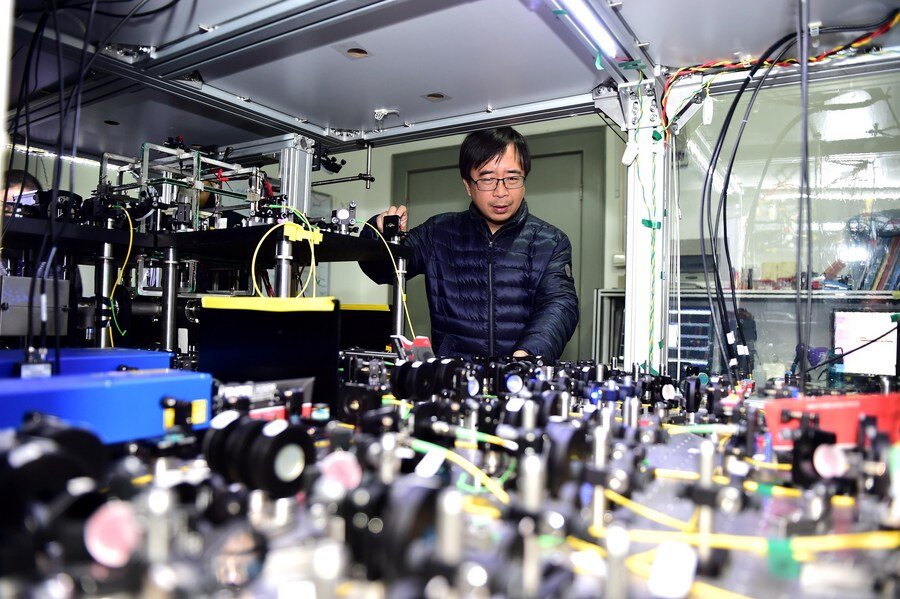
Pan Jianweis team solved this impossible problem by using a single refrigerated rubidium element to act as a mobile wall in Einsteins idea. Researchers have used laser rays to hold this element.
Experimental results show that when the laser trap is loosened so that the electrons can move more easily ( helping to measure the momentum and determine the path of the photon), the characteristic intersectional system of wave nature immediately disappears. Conversely, when the elements are kept tight so as not to measure the movement, the convective system appears clearly.
This experiment completely confirmed Niels Bohr's view that when observing this feature, the other feature will be erased.
International reviewers have praised the work as a significant contribution to quantum mechanics and a beautiful textbook realization for Einstein's hundred-year-old invention experiment.