
BMX Freestyle (BMX performance cycling) is an extreme sport, focusing on performing techniques, acrobatics and performing skills on specialized BMX bikes.
History of development
The earliest image documents about BMX Freestyle record the scene of Devin and Todd Bank driving a BMX motorbike on a slope (ramp) about 2.4 meters high erected by themselves at their home in West Los Angeles, California in 1974.
This is the beginning of the BMX sport performing on slopes.
Then, in 1975, Skateboarder magazine published photos of young people riding bicycles in empty family swimming pools.
Also in 1975, young people began driving in concrete ditches leading water in Escondido, San Diego, California.
In 1982, the American BMX Freestyle Association (AFA) was founded, paving the way for official tournaments.
In 2016, the International Cycling Union (UCI) officially recognized BMX Freestyle.
In 2020, this sport officially became a competition event at the 2020 Tokyo Summer Olympics (held postponed to 2021 due to the COVID-19 pandemic).
Main subdivisions of BMX Freestyle
Street (Road): Utilize urban obstacles such as steps, handrails, stone platforms to perform techniques.
BMX Park (Park): Competing in specialized skate parks with wooden, concrete or metal troughs to create jump points.
Vert Ramp: Performs the technique on a U-shaped slide from 2.5m to 3.5m high (with a vertical top).
Trails: Performing techniques on consecutively built mounds, focusing on rhythm and altitude when flying.
Flatland: Move and balance to perform complex rotation movements completely on flat roads.
The main techniques and skills are divided into two main groups: Air tricks and Flatland tricks.
If traditional cycling events at ASIAD are always races with time clocks, then BMX Freestyle brings a whirlwind of improvisation, adventure, and street art, like a "rugged guy".
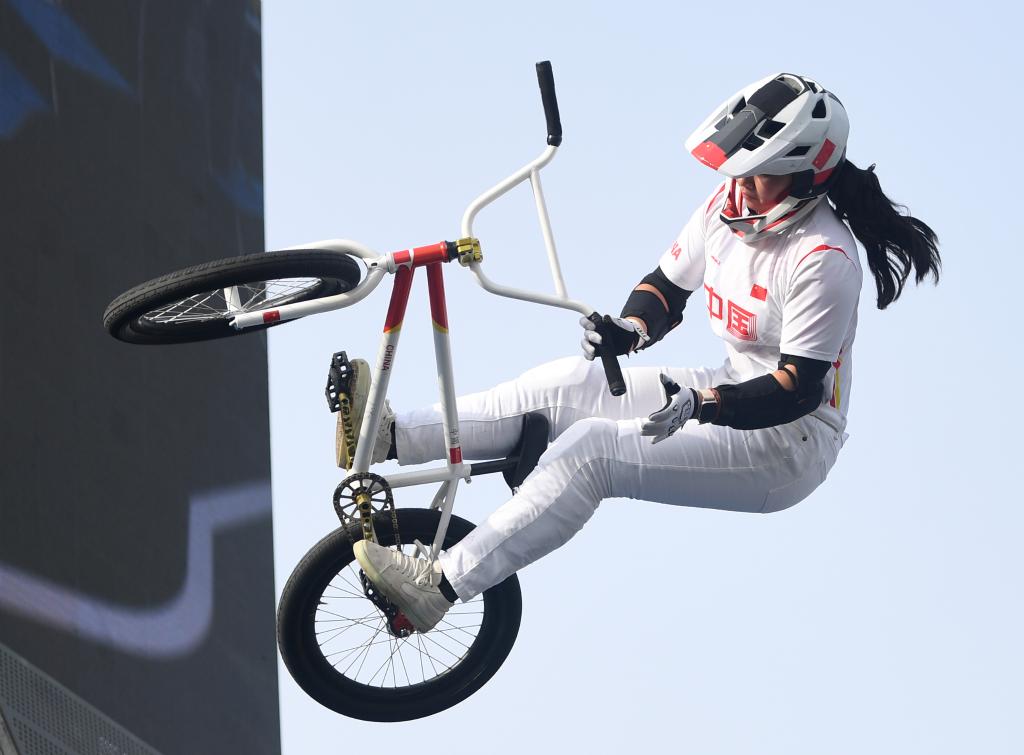
The mark of BMX Freestyle is freedom. There is no fixed travel route. Each athlete is like an artist, using terrain and air as a stage to perform dangerous movements and flight paths.
That is where talent, courage and spatial thinking meet to create emotional moments for the audience.
Some terminology and implementation techniques
Aerial techniques:
Rotating people & vehicles (Rotations)
180° / 360° / 720° Jump (Move both the person and the vehicle at angles of 180, 360 or 720 degrees in the air)
Backflip / Frontflip (Reverse the car and person to the back or front while flying in the air)
Flair (A combination of reversing backwards and rotating 180 degrees to land in the opposite direction).
Impact on Bar & Frame Tricks:
Rotate the steering wheel 360 degrees in the air and take a photo.
Let the frame rotate 360 degrees around the neck of the car in the air while the hand still holds the handlebars, then catch the pedals.
Kick the pedal upside down 360 degrees with your foot while flying and then pedal again.
Body Position Tricks:
Letting go of both legs from the pedals and stretching straight to the back like Superman is flying.
No Hander / Nothing: Release both hands from the handlebars or release both hands and feet from the car at the same time.
Tilting the car horizontally parallel to the ground right in the air.
Flatland tricks
Jumping up both wheels from the ground from a steady running position.
Move the bike backwards and pedal the chain upside down.
Endo / Footjam: Use the front brake or pin your foot to the fork to lift the rear wheel and balance it on the front wheel.
Footjam tailwhip: Insert the foot to stop the front wheel, lift the rear wheel and kick to make the frame rotate 360 degrees around.
Manual / Hang-5: Maintain driving balance only with the rear wheel or only with the front wheel with one foot placed on the wheel pin.
Stand on the wheel pins, brake lock and jump the bike on one wheel.


