
Domestic pepper prices: Week of "turning around" increases again
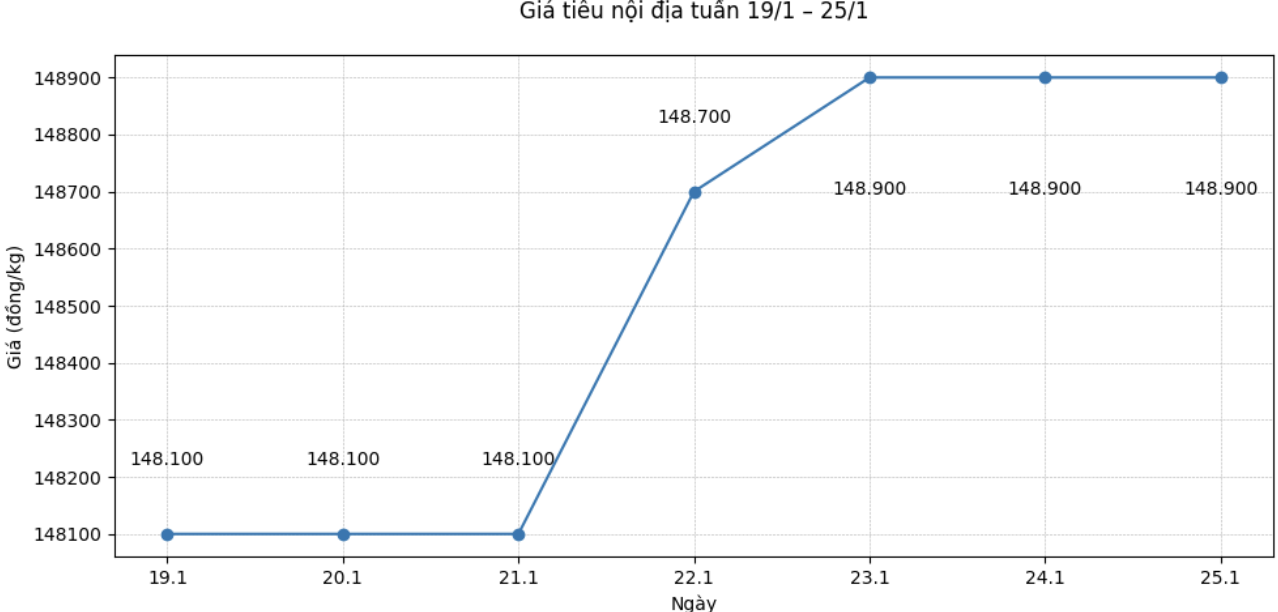
Today (January 25), domestic pepper prices traded in the range of 148,000 - 150,000 VND/kg, an increase of 500 - 1,500 VND/kg in all regions compared to the previous week.
At the end of last week, Dak Lak recorded the strongest increase of 1,500 VND/kg, bringing the purchasing price of pepper to 150,000 VND/kg.
Similarly, pepper prices in Ho Chi Minh City increased by 1,000 VND/kg, reaching 149,000 VND/kg. Lam Dong province was also purchased at a similar level with 149,000 VND/kg, an increase of 500 VND/kg.
In Gia Lai and Dong Nai, pepper prices reached 148,500 VND/kg and 148,000 VND/kg respectively, both increasing by 500 VND/kg compared to the closing session of last week.
World pepper prices: Rotation and fluctuation
According to the International Pepper Corporation (IPC), world pepper prices have increased and decreased intertwined.
Indonesian black pepper prices ended last week at 6,647 USD/ton, up 1.28% (equivalent to 84 USD/ton) compared to the previous week. At the same time of the survey, Indonesian white pepper prices increased by 0.25% (about 23 USD/ton), to 9,141 USD/ton.
Brazilian black pepper ASTA 570 reversed to a decrease of 1.64% (100 USD/ton), down to 6,000 USD/ton. This is also the lowest level recorded on the international market. Meanwhile, the price of black and white ASTA Malaysia pepper remained unchanged, selling at 9,000 USD/ton and 12,000 USD/ton respectively.
In Vietnam, the export price of black pepper continues to fluctuate in the range of 6,400 - 6,600 USD/ton for 500 g/l and 550 g/l types. Similarly, the current price of ASTA white pepper is at 9,150 USD/ton.
Perspectives and forecasts
The fact that pepper prices have maintained high levels for many consecutive days last week shows that domestic supply is still not abundant, while farmers tend to sell "small drops", waiting for more positive signals from the export market. Many purchasing businesses said that the amount of goods circulating in the market is not large, a factor that makes it difficult for prices to decrease in the short term.
According to the International Pepper Community, in the last week of January, the global pepper market recorded mixed fluctuations between types and production areas, reflecting differences in domestic supply conditions as well as the impact of exchange rates.


