
Domestic pepper prices: Maintain high price levels
As of 11:30 am today (January 24), domestic pepper prices maintained a sideways trend, averaging at 148,900 VND/kg. Currently, key areas are trading in the range of 148,000 - 150,000 VND/kg.
Currently, the pepper price list of regions does not have many changes, specifically as follows:
Ho Chi Minh City and Lam Dong remained unchanged compared to the previous session, offering to the market at a price of 149,000 VND/kg.
Dong Nai and Gia Lai provinces respectively listed at 148,000 VND/kg and 148,500 VND/kg.
Dak Lak province, after increasing by 1,000 VND/kg, is still the purchasing area with the highest price when it is anchored at the threshold of 150,000 VND/kg.
World pepper prices: Indonesia continuously reverses direction
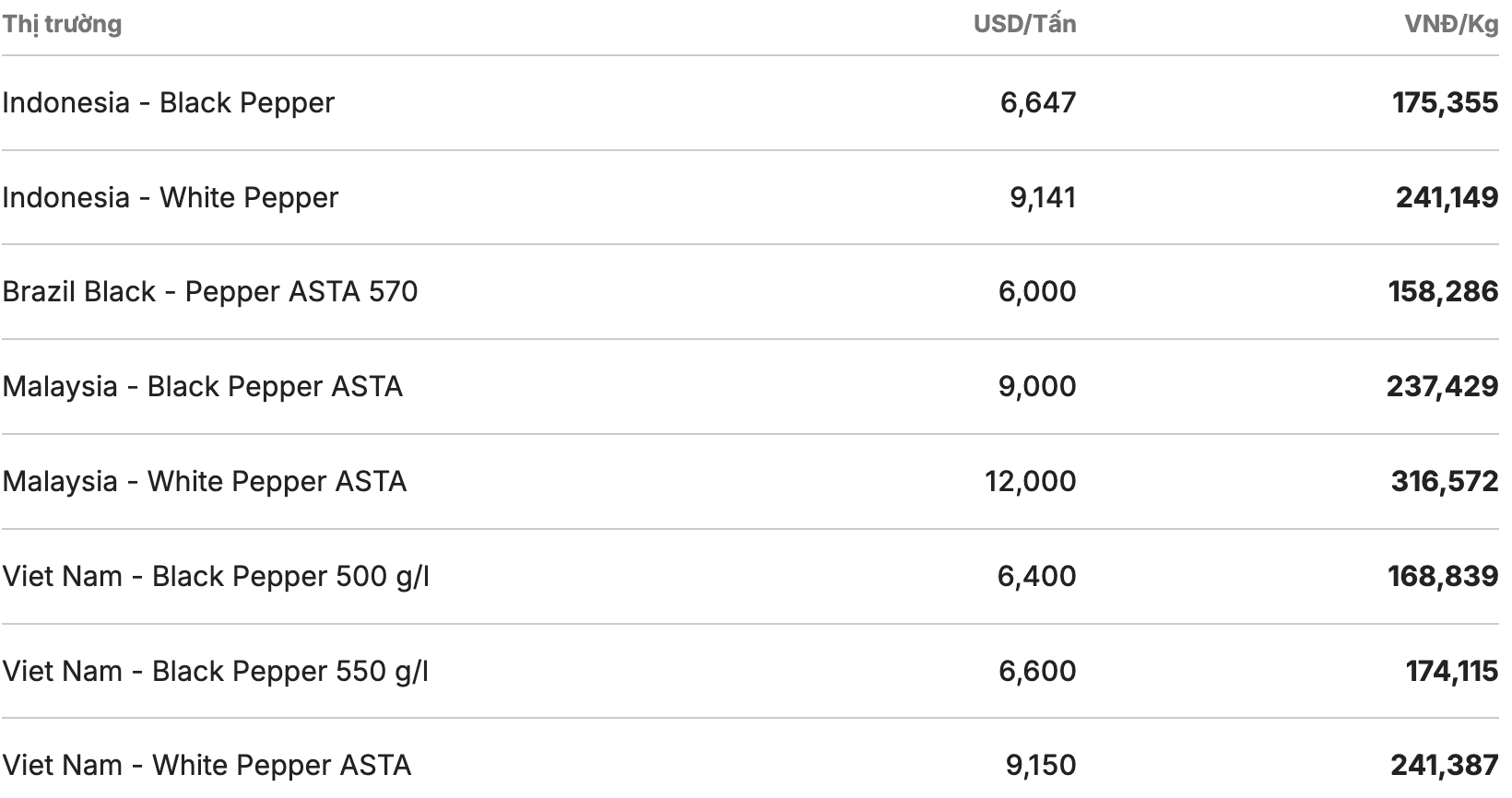
In the world market, pepper prices remain unchanged in most countries. The Indonesian exchange - one of the most vibrant markets is no exception. These two items increased and decreased interspersed in the range of 6,647 - 9,141 USD/ton (equivalent to 175,355 VND/kg - 241,149 VND/kg), down 25 USD/ton of black pepper and up 77 USD/ton of white pepper.
Meanwhile, the Brazilian market extended its unchanged days, trading at 6,000 USD/ton (about 158,286 VND/kg). In the same direction, black and white pepper continued to remain unchanged, trading at 12,000 USD/ton and 9,000 USD/ton.
Notably, in Vietnam's pepper export market, the price of black pepper of 500 g/l and 550 g/l is kept at the threshold of 6,400 - 6,600 USD/ton. ASTA white pepper continues to be offered for sale at a price of 9,150 USD/ton (equivalent to 241,387 VND/kg).
Perspectives and forecasts
Although domestic pepper prices have increased in the past 2 days, the trend of farmers selling out is not too massive because many garden owners still prioritize storing. In the context that supply is predicted to tighten in 2026 due to the impact of extreme weather, causing productivity in some regions to decrease significantly.
For businesses, the biggest challenge today is not only prices but also the problem of raw material shortages and strict technical barriers from the import market. Therefore, the ability to meet traceability standards will be a decisive factor to take advantage of price increases in the new cycle.


