
Domestic pepper prices: Sideways trend
As of 11:30 AM today (May 27), domestic pepper prices continued the series of unchanged days, averaging 139,400 VND/kg. Currently, key areas are trading in the range of 137,000 - 142,000 VND/kg.
Domestic pepper prices fell on the first day of the week and continued to enter a series of stagnant days, currently the listed prices in regions are as follows:
Gia Lai province traded at the threshold of 137,000 VND/kg.
Dong Nai and Ho Chi Minh City listed prices at 137,000 VND/kg and 139,000 VND/kg, respectively.
Meanwhile, Dak Lak and Lam Dong remained unchanged, offering for sale at the highest purchase price of 142,000 VND/kg.
World pepper prices: Conflicting developments
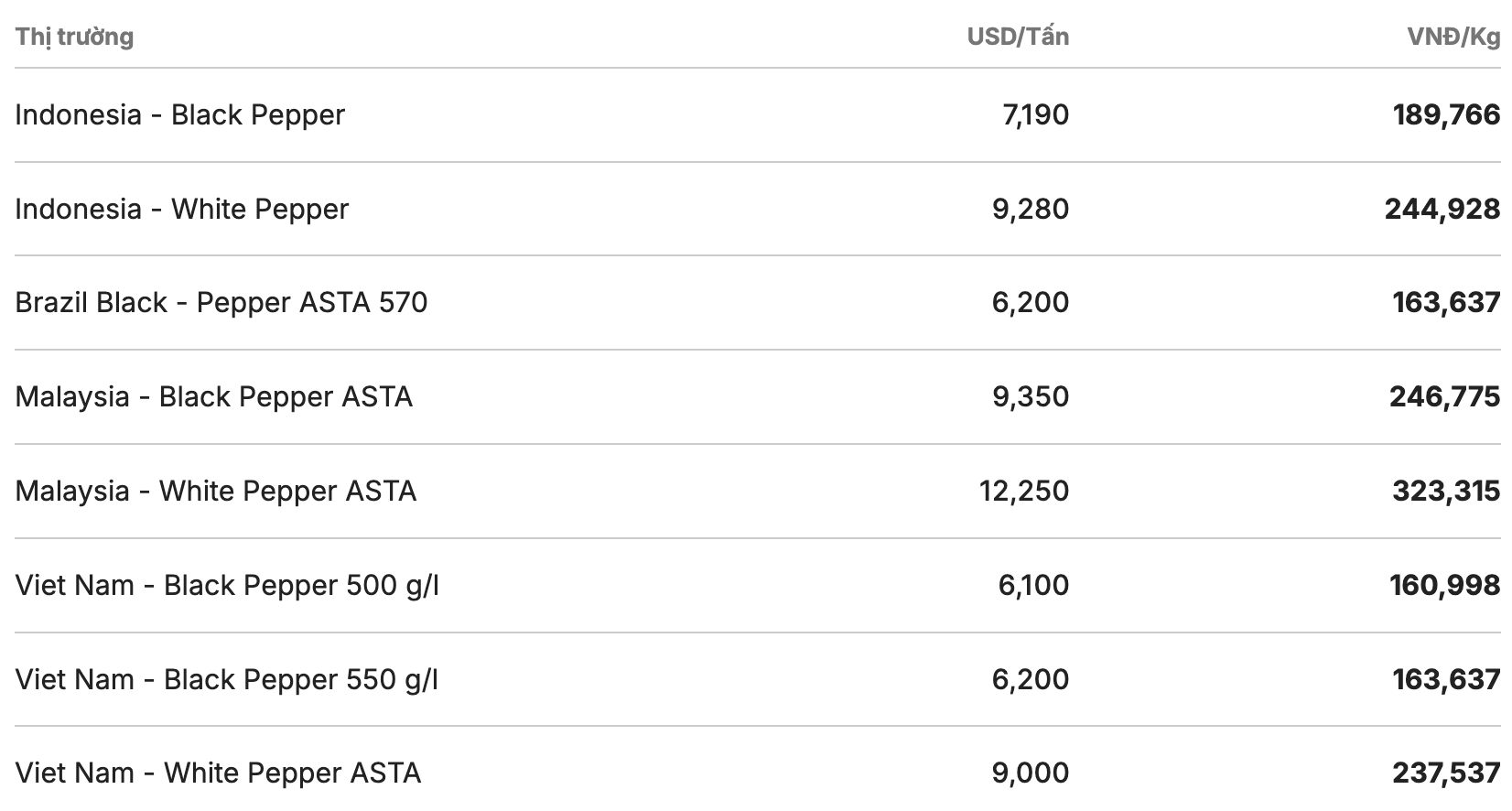
In the world market, pepper prices increased and decreased interspersed in countries. The two items of black and white pepper in Indonesia increased sharply, trading in the range of 7,190 - 9,280 USD/ton (equivalent to 189,766 VND/kg - 244,928 VND/kg), increasing by 211 USD/ton and 129 USD/ton respectively.
The Brazilian market unexpectedly decreased by 50 USD/ton after many days of listing at high prices, down to 6,200 USD/ton (about 163,637 VND/kg). Notably, black and white pepper still maintained the increase of 50 USD/ton, trading at 12,250 USD/ton and 9,350 USD/ton.
In Vietnam's pepper export market, the price of black pepper of 500 g/l and 550 g/l remains unchanged at 6,100 - 6,200 USD/ton. In the same direction, ASTA white pepper is offered for sale at 9,000 USD/ton (equivalent to 237,537 VND/kg).
Assessments and forecasts
Compared to the last days of April, the current average price has decreased by about 800 VND/kg. The price range tends to decrease in the first months of 2026.
In the context of unpredictable global trade when geopolitical conflicts, trade tensions between major economies and review activities from import markets increase, businesses need to closely monitor moves related to trade remedies and tariff policies.
Currently, Vietnam is still the world's leading pepper producer and exporter. Despite facing pressure from geopolitical conflicts, increasing logistics costs and increasingly stringent technical requirements, our country's pepper exports still maintain positive signals. It is forecast that in 2026, the pepper industry will continue to grow.


