
Domestic pepper prices: Increase and decrease intertwined
As of 11:30 am today (March 28), domestic pepper prices have increased and decreased depending on the region, averaging 139,700 VND/kg. Currently, key areas are trading in the range of 139,000 - 140,500 VND/kg.
Domestic pepper prices recorded mixed fluctuations, provinces and cities in key areas listed prices as follows:
Gia Lai and Dong Nai provinces increased by 500 VND/kg, both listed at the mark of 139,000 VND/kg.
With the same increase, City. Ho Chi Minh anchored at 139,500 VND/kg.
In the opposite direction, Dak Lak and Lam Dong, although the provinces with the highest price of 140,500 VND/kg, reversed to decrease by 500 VND/kg.
World pepper price: Price increase
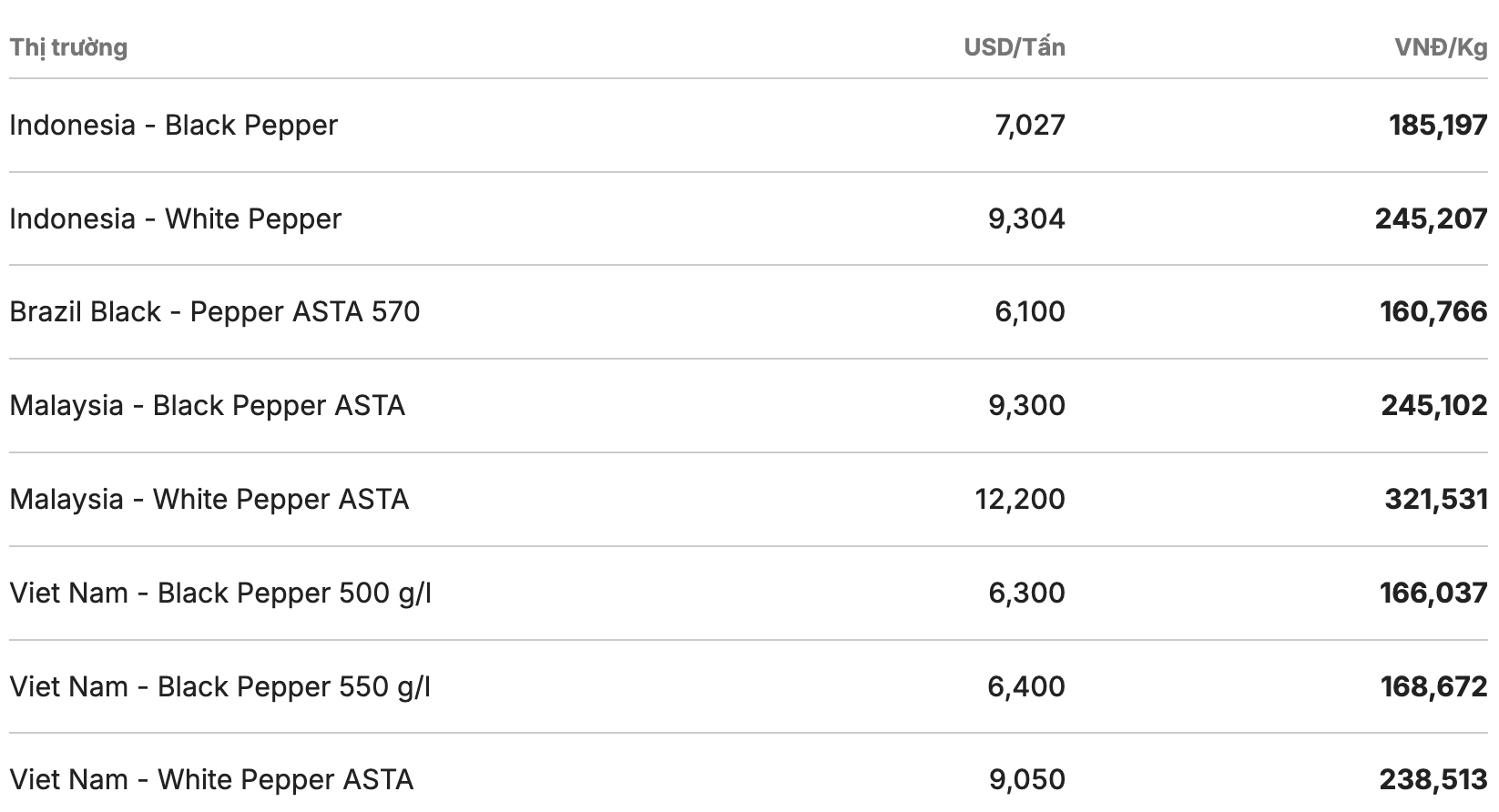
In the world market, pepper prices interrupted a series of sideways days. The Indonesian exchange - one of the most active markets reversed and increased sharply. Black and white peppers traded in the range of 7,027 - 9,304 USD/ton (equivalent to 185. 197 VND/kg - 245. 207 VND/kg), increasing by 33 USD/ton and 44 USD/ton respectively.
The Brazilian market also increased by 50 USD/ton, listed at 6,100 USD/ton (about 160,766 VND/kg). Notably, black and white pepper kept increasing from 100 - 200 USD/ton, trading at 12,200 USD/ton and 9,300 USD/ton.
In Vietnam's pepper export market, black pepper prices of 500 g/l and 550 g/l are maintained at 6,300 - 6,400 USD/ton. Meanwhile, ASTA white pepper price remains unchanged, offered for sale at 9,050 USD/ton (equivalent to 238,513 VND/kg).
Assessments and forecasts
The global pepper market is trending upwards again after the previous balanced state, as both supply and demand factors create new momentum to push prices further.
Global pepper supply is gradually narrowing due to farmers reducing investment, switching to other crops in times of low prices, along with the impact of extreme weather and epidemics reducing productivity. In Vietnam, pepper production this year may decrease by about 12-15% compared to last year due to unfavorable weather and old pepper gardens.
According to the Vietnam Pepper and Spice Plant Association (VPSA), the Middle East is also an important market area for Vietnamese pepper, accounting for about 15% of pepper exports. Therefore, in the event of prolonged Middle East conflict, it will significantly affect Vietnamese pepper exports not only to this market area but also to other very important markets such as the US and Europe.


