
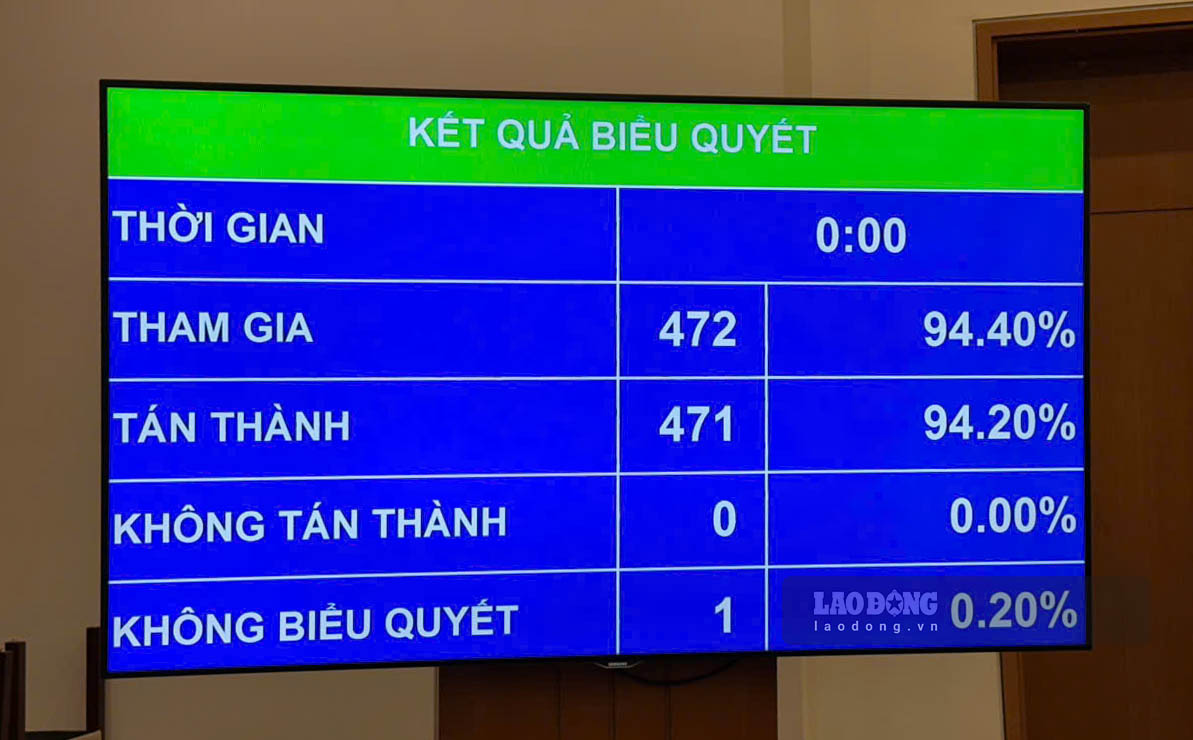
On the morning of August 24, the National Assembly passed the Law on Grassroots Mediation (amended) with 94.2% of delegates in favor.
Mediation can be done online
Before the delegates voted to approve, the National Assembly listened to Member of the Party Central Committee, Minister of Justice Hoang Thanh Tung present the Report on receiving, explaining and revising the draft Law on Grassroots Mediation (amended).
According to Minister Hoang Thanh Tung, the draft Law has focused on overcoming the obstacles of the 2013 Law on Mediation at the Grassroots level, completing the legal basis to improve the quality and effectiveness of mediation work and state management of mediation at the grassroots level, contributing to preventing disputes, building a culture of law compliance, and strengthening consensus in the community...
In which, regarding regulations on electing mediators, the draft Law inherits the regulations that are still appropriate from the Law on Mediation at the grassroots level in 2013, and at the same time supplements a number of contents to better ensure democracy, publicity, transparency and suitability with reality, such as: regulations to handle cases where the number of people meeting the conditions to be recognized as mediators is more than the number needed to be consolidated; the election of mediators can combine many forms.
Regarding the standards for mediators, the draft Law removes the word "regular" from the phrase "regular residence at the grassroots level" to expand the scope of people selected for the list of mediators and ensure consistency with the Law on Residence; at the same time, supplementing the standard of "full civil act capacity";
Supplementing in Clause 5, Article 8 regulations on cases that do not meet the standards for being a mediator, including people who are in the period of execution of disciplinary decisions, in the period of application of administrative handling measures, people who are serving criminal sentences or have not been cleared of criminal records to ensure strictness.
Notably, Article 25 of the draft Law allows mediation in the form of online or combined mediation. Accordingly, Clause 1, Article 25 stipulates that mediation is conducted in the form of direct, online or combined direct and online mediation.
In case the participating party is a disabled person or an ethnic minority and the mediator does not understand each other's language, appropriate support measures are needed, arranging interpreters to ensure that the parties participating in the mediation...
The Government will have detailed regulations related to the form of mediation at the grassroots level.
Regulations on recording audio and video of the mediation process
One of the contents added to the law is that there is a separate clause on information security in grassroots mediation (Article 5).
Accordingly, Article 5 stipulates that mediators, parties, people invited to participate in mediation, interpreters and other relevant agencies, organizations, and individuals are responsible for keeping state secrets, confidential information about private life, personal secrets, family secrets, business secrets of the parties and other information as prescribed by law, unless otherwise agreed or prescribed by law.
During the mediation process, no audio or video recording is allowed; mediators, the parties are only allowed to record for the purpose of mediation and must keep the recorded content confidential, unless the parties have an agreement or the law has other regulations.
The Law on Grassroots Mediation (amended) will take effect from March 1, 2027.


