
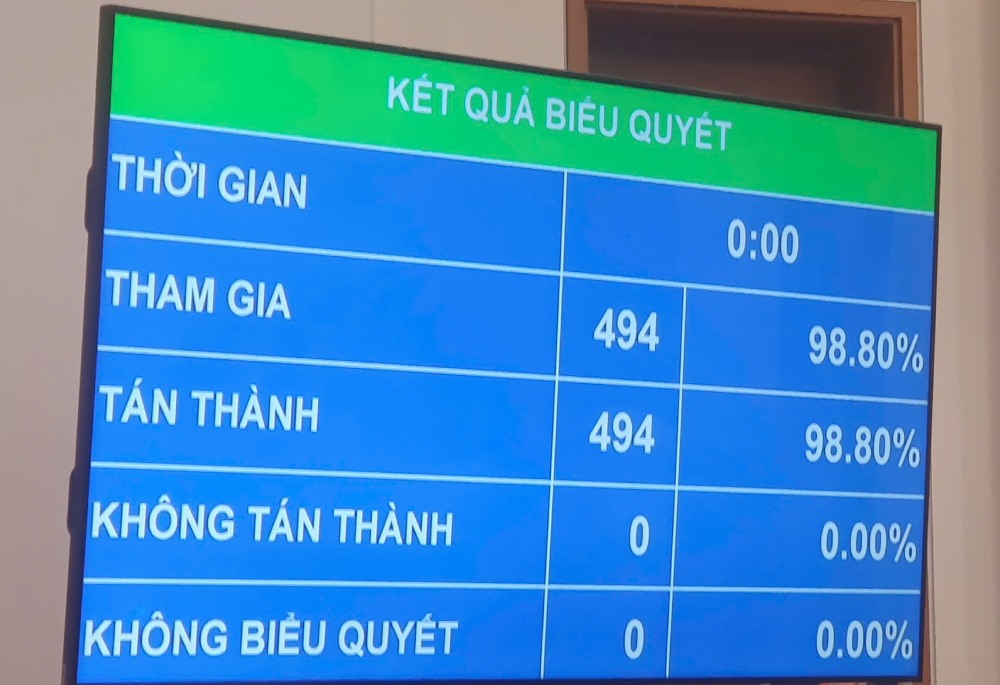
On the morning of April 24, with 494/494 delegates participating in the vote in favor, the National Assembly passed the Resolution on the socio-economic development plan 2026-2030.
According to the Resolution, strive for average GDP growth to reach 10%/year or more associated with maintaining macroeconomic stability, controlling inflation, and ensuring major balances. Improve and comprehensively improve people's lives, striving for average GDP per capita to be 8,500 USD by 2030.
Successfully implement the goal by 2030, to become a developing country with modern industry, high average income, belonging to the group of 30 economies with the world's leading GDP scale. 2 million enterprises operating in the economy by 2030. 20 large enterprises participating in the global value chain by 2030.
To achieve the above growth targets, the National Assembly requests a transition to a new growth model taking science, technology, innovation and digital transformation as the main driving forces.
Promulgate specific and superior mechanisms and policies to promote the operational efficiency of the International Financial Center and free trade zones in attracting indirect investment capital and international investment funds. Expand the foreign ownership ratio in industries that do not affect national security.
Requesting the modernization of the banking system and credit institutions, promoting the handling of weak credit institutions, cross-ownership, improving credit quality and efficiency, and maintaining stability and safety of the system.
Increase charter capital for state-owned commercial banks from the following sources: After-tax profit and fund allocation, share issuance, state budget.
Healthy development and diversification of capital sources, strengthening access to capital for domestic enterprises, prioritizing small and medium-sized enterprises, business households, and collective economy.
The National Assembly also requested to focus on investing in planned highways, gateway seaports combined with international transshipment, major airports, North-South high-speed railway lines, international connecting railway lines, urban railways; by 2030 put into use over 5,000 km of highways.
A new point in this socio-economic development plan is that the National Assembly assigned growth targets to each locality.
Accordingly, the locality assigned the highest GRDP growth target for 2026 and the average for the 2026-2030 period is Hai Phong, with 13-13.5% GRDP growth in 2026 and the average for the whole period is 13-14%.
This ratio assigned to Bac Ninh is 12.5-13% and 10% respectively; Quang Ninh is 13% and 11-12%; Ninh Binh is 11-12% and 10.5-11%; Hung Yen is 11-12% and 10-11%; Thanh Hoa is 11% for both targets; Nghe An is 10.5-11.5% and 11-12%; Khanh Hoa is 10.8% and 11-12%; Lam Dong is assigned 10-10.5% for both targets.
Hanoi is assigned GRDP targets for 2026 of 10-10.5% and 10.5-11% for the entire period; Ho Chi Minh City is assigned 10% for both targets. Hue and Can Tho are assigned GRDP growth targets for 2026 of over 10%, while Da Nang is over 11%. Gia Lai and Son La are the 2 localities assigned the lowest growth targets with 8%.
In addition, there are Dak Lak, Dong Thap, Vinh Long, Ca Mau, assigned growth targets for 2026 below double digits.


