
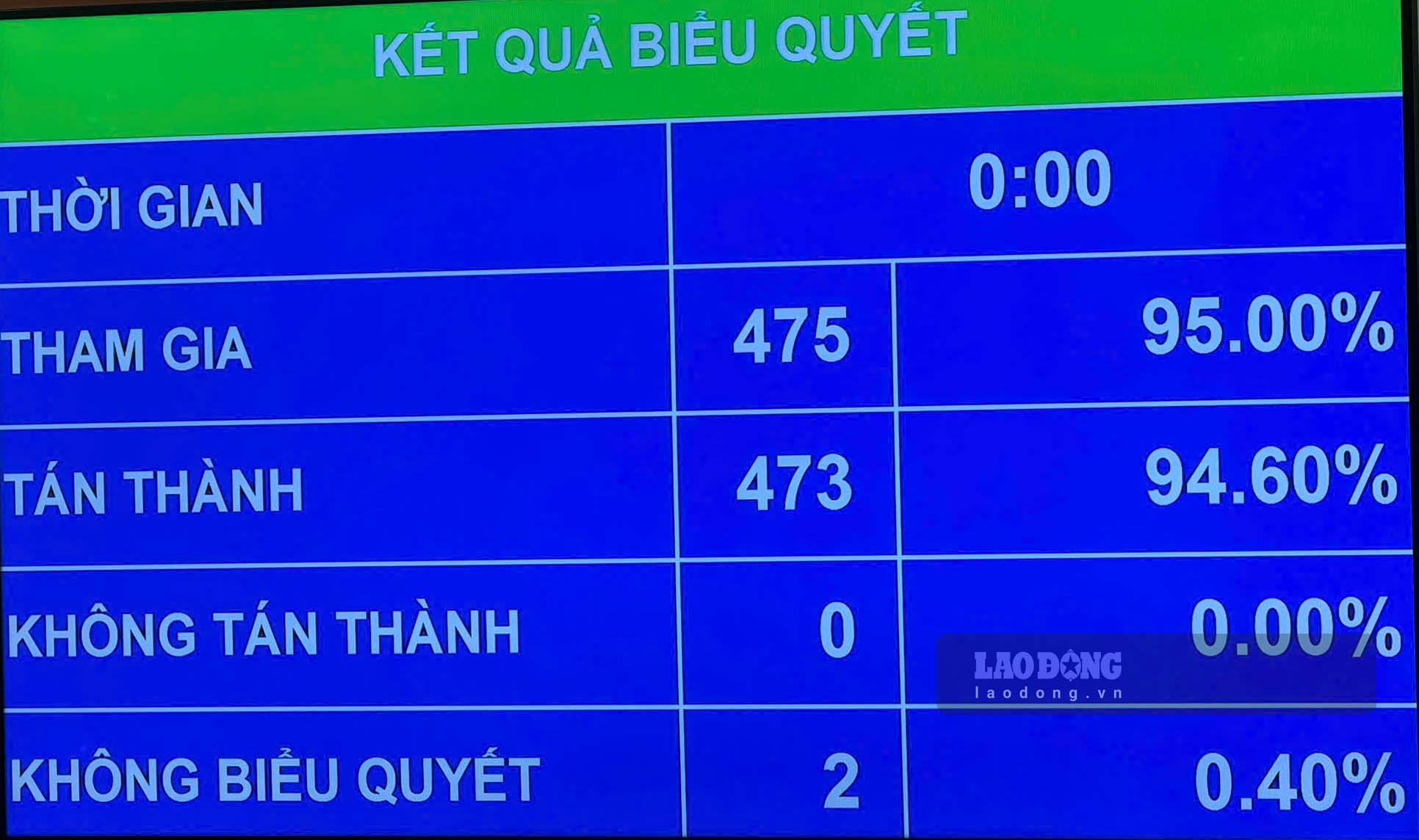
On August 23, continuing the program of the First Extraordinary Session, the National Assembly voted to pass the Oil and Gas Law (amended) with 473/475 delegates participating in the vote in favor.
Previously, Member of the Party Central Committee, Minister of Industry and Trade Le Manh Hung presented a report on the reception, explanation and revision of the Draft Law on Oil and Gas (amended) according to the conclusion of the National Assembly Standing Committee.
With the National Assembly's approval, the revised Oil and Gas Law will help promote decentralization and delegation of power; remove many bottlenecks; and at the same time open a legal framework for new energy value chains, especially carbon capture and storage (CCS) and offshore energy.
The revised Oil and Gas Law was passed with 12 chapters and 62 articles. Increased by 1 chapter and reduced by 7 articles compared to the old Oil and Gas Law.
According to the assessment of the Ministry of Industry and Trade, the Law on Oil and Gas (amended) in 2026 helps improve the practicality and feasibility of the Law on Oil and Gas, ensure the synchronicity and unity of the legal system in basic investigations on oil and gas and oil and gas activities, in accordance with international commitments and international oil and gas industry practices.
The law helps ensure basic investigations on oil and gas and oil and gas activities are safe for people and property, improve the efficiency of resource exploitation associated with environmental protection, climate change response, biodiversity conservation, bringing efficiency and benefits to the nation as well as investors on the basis of respecting Vietnam's independence, sovereignty, territorial integrity, national security and compliance with Vietnamese law.
The amended law aims to strengthen attracting foreign and private investment in the field of oil and gas exploration, exploration and exploitation in the context of increasingly difficult and complex oil and gas activities, especially in deep-water, offshore, and sensitive areas for national defense and security in the East Sea.
The law also helps develop science and technology, innovation in the oil and gas industry with the spearhead being self-reliant high-tech oil and gas services, and developing oil and gas services abroad.
One of the points of concern in the revised Oil and Gas Law is to promote decentralization and delegation of power in oil and gas activities, thereby shortening the processing process for specialized contents.
Minister of Industry and Trade Le Manh Hung said that this model operates according to the principle of innovation in governance, whichever level understands best about what, it must make a decision on that matter.
Accordingly, the state management model after being approved by the National Assembly will be divided into three specific levels.
The first is at the Government level and the Prime Minister: Deciding on macro and important issues such as oil and gas subdivision, investment incentives and issues of national defense, security, and foreign affairs (specifically stipulated in Articles 7, 14, 20, 41).
The second is the state management agency level: The Ministry of Industry and Trade is assigned to be the focal point, coordinating with ministries, branches and localities to perform the role of specialized state management.
Third is the level of Vietnam National Group of Industry and Energy (Petrovietnam): With the role of representing the host country, Petrovietnam is assigned a number of rights in signing, managing, monitoring, and supervising oil and gas activities.


