
The base salary level adjusted to 2.53 million VND/month from July 1, 2026 has contributed to improving income for public sector workers as well as serving as a basis for adjusting many related regimes and policies.
Dr. Nguyen Thuy Vu - Institute of Training and Development of Ho Chi Minh City (IFP) - said that this adjustment has helped compensate for part of the impact of inflation and improve the lives of officials, civil servants, and public employees.
However, this adjustment level has not yet created a significant difference compared to the income of the business sector. For young workers, salary is only one of the many factors considered when choosing a workplace.
They are not only interested in income but also focus on career development opportunities, the working environment and the ability to develop capacity. A slight salary increase may help them feel secure in the short term but is not enough to create long-term commitment," Ms. Vu analyzed.
According to the expert, in the context of continuously increasing housing, education, and healthcare costs along with the strong changes of the digital economy, the current base salary increase is mainly more motivating than creating a turning point in retaining high-quality personnel.
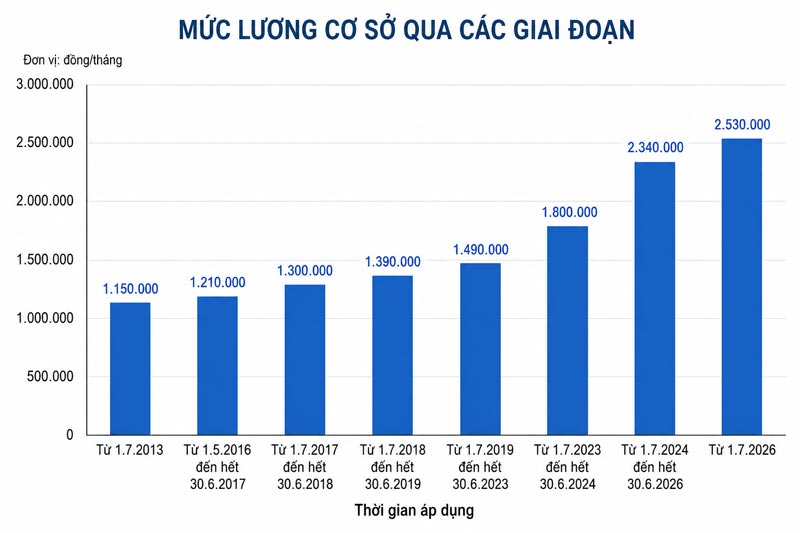
Not only affecting the workforce in the public sector, the adjustment of the base salary also indirectly affects a part of businesses.
According to the Law on Social Insurance (BHXH) 2024, the salary level used as the basis for compulsory social insurance contributions is up to 20 times the reference level. In the period before the abolition of the base salary, the reference level is determined by the base salary level itself.
From a business perspective, Ms. Dang Ngoc Thu Thao - Director of Outsourcing and Labor Leasing Services, Manpower Vietnam - said that the group most clearly affected are businesses with many workers receiving salaries equal to or exceeding the social insurance premium ceiling.
When the base salary increases, the salary ceiling used as the basis for social insurance contributions also increases, causing insurance premiums for both businesses and employees to increase for high-income personnel," Ms. Thao said.
According to her, this impact will be more clearly shown in economic centers such as Hanoi and Ho Chi Minh City, where there is a high wage level and a large proportion of workers with income exceeding the social insurance contribution ceiling.
From practical work with many businesses across the country, Manpower Vietnam predicts three trends that may appear after the base salary is adjusted.
First, increased personnel costs will directly impact the cost structure of enterprises.
Second, some businesses may shift investment resources from human resources to technology to improve productivity and control costs.
Third, cost pressure will push some businesses to accelerate the process of personnel restructuring.
According to Ms. Thao, these changes reflect the trend of an increasingly flexible labor market.
On the one hand, adjusting the base salary contributes to improving the rights of cadres, civil servants, and public employees and creates a positive impact on some social security policies.
On the other hand, for businesses with many high-income workers, increasing the social insurance contribution ceiling will create additional cost pressure, thereby promoting businesses to optimize personnel structure, apply technology and diversify forms of labor use such as outsourcing, project recruitment or remote work.
On the worker's side, the labor market is forecast to become more competitive and flexible when there are more choices about businesses, working methods as well as career development roadmaps.


