
On the afternoon of June 22, General Secretary and President To Lam chaired the first meeting of the Central Steering Committee for Institutional Improvement and Law Enforcement.
Also attending were Politburo members: Prime Minister Le Minh Hung; National Assembly Chairman Tran Thanh Man; Standing Secretary of the Secretariat Tran Cam Tu; Secretary of the Party Central Committee, Chairman of the Central Committee of the Vietnam Fatherland Front Bui Thi Minh Hoai.
Also attending were Politburo members, Secretariat members, Central Party Committee members, and members of the Steering Committee.
The meeting gave opinions on 4 groups of contents: the basic operating documents of the Steering Committee; specialized reports on mechanisms, policies, and major solutions to institutionalize the Party's guidelines and orientations; report on the situation and solutions to review, amend, promulgate, and abolish legal regulations to cut and simplify administrative procedures and unreasonable business investment conditions in 2026; project "Research and propose amendments to the Criminal Procedure Code to meet the requirements of judicial reform in the new period".
Regarding the report on mechanisms, policies, and major solutions to institutionalize the Party's guidelines and orientations on treating air pollution in major cities, the Steering Committee assessed that this is an issue that directly affects the health, quality of life of the people, labor productivity and national competitiveness.
The Steering Committee requests a strong shift from the mindset of controlling each source of emissions to managing air quality according to objectives; building a mechanism for monitoring, evaluating, and early warning of pollution risks; clearly defining the responsibilities of each sector, each locality, and each source of emissions.
Regarding cutting and simplifying administrative procedures and business conditions, the Steering Committee emphasized that administrative procedure reform is an important part of a profound institutional reform, contributing to properly shaping the relationship between the State and people and businesses in a constructive and serving administration.
Each unreasonable business procedure and condition that is cut down is a barrier removed, a development opportunity opened up.
The Steering Committee requests ministries and ministerial-level agencies to consider cutting and simplifying unreasonable administrative procedures and business investment conditions as a regular and continuous task, not only implemented in short-term campaigns; shift from pre-inspection management to post-inspection based on risk management; strictly control the promulgation of new administrative procedures and business investment conditions.
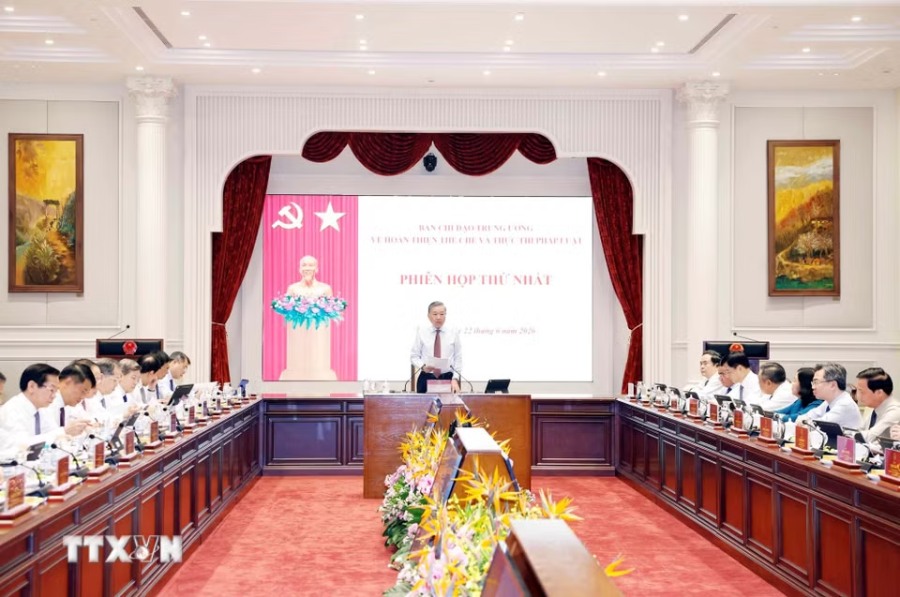
Regarding the organization of implementation, from now until the end of 2026, General Secretary and President To Lam requested to focus on quickly completing and effectively operating the working mechanism of the Steering Committee, the coordination mechanism between agencies; well prepare draft laws, resolutions, and major projects to submit to the National Assembly, overcome the situation of delays and debts of guiding documents for implementation; must create measurable changes in reducing administrative procedures, removing institutional bottlenecks, and perfecting laws in key areas.
After this meeting, the General Secretary and President requested that each member of the Steering Committee and each agency assigned tasks must immediately get to work.
The standing agency develops a plan to monitor, urge, and inspect the implementation of the meeting conclusions, periodically reporting to the Standing Committee of the Steering Committee on completed tasks, slow tasks, difficult tasks, tasks beyond authority, tasks that need to be removed, not assigning tasks with slogans, not accepting the situation that has been deployed, is being studied, has been thoroughly grasped but has not determined which products have been completed, which documents have been issued and which procedures have been reduced, which legal conflicts have been handled and the responsibility of the head to what extent.


